The Parker Solar Probe aims to touch the sun
Due to launch this month, the spacecraft will get within 6 million kilometers of our star
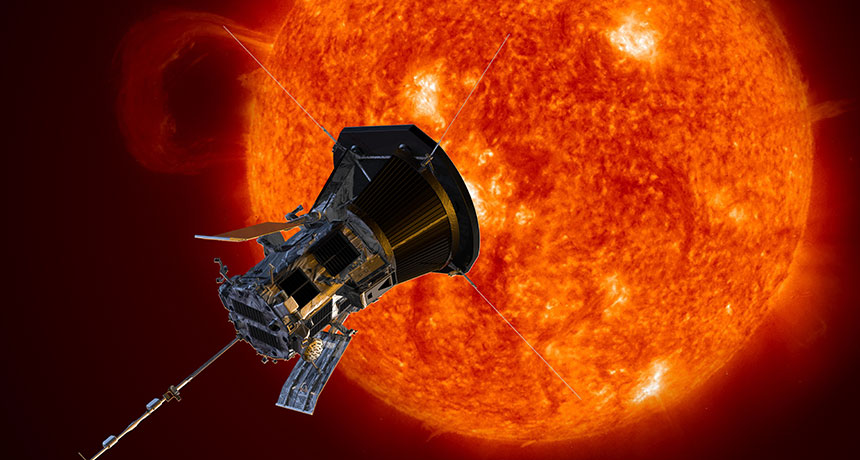
The Parker Solar Probe (illustrated) will launch in August and journey to the sun. It will fly through the star’s outer atmosphere.
JHU-APL
A spacecraft is due to head for the sun this month. This Parker Solar Probe will be the first to swoop through our star’s outer atmosphere.
It will whip around the sun two dozen times over the next seven years. At its closest, it will skim within some 6 million kilometers (4 million miles) of the star’s surface. That’s more than seven times as close as any previous spacecraft. At its nearest, Parker will hurtle through the outer atmosphere. That’s known as the sun’s corona.
Parker will zip through the corona at about 700,000 kilometers (435,000 miles) per hour. That’s fast enough to skip from Philadelphia to Washington, D.C., in about one second. Indeed, Parker will become the fastest human-made object in the solar system.
The probe is being dispatched to make closeup observations of the corona and the solar wind. That “wind” is a torrent of charged particles that the star constantly flings into space. Both observations could help resolve long-standing mysteries about the inner workings of the sun’s atmosphere. And the new data may improve forecasts for space-weather events, such as solar flares. Such flares can endanger spacecraft, astronauts — even technology on Earth.
Craig DeForest is not involved in the Parker mission. But he finds the mission “phenomenal.” DeForest works at the Southwest Research Institute in Boulder, Colo., where he studies the physics of the sun. The trove of new data gathered by the probe “is going to answer a lot of questions that we couldn’t answer in any other way,” he says. “There’s been a tremendous amount of anticipation for it.”
Setting sights on the sun
Researchers have had a probe like Parker on their wish lists for nearly 60 years. NASA was created in 1958. That same year, the Space Studies Board of the National Academies of Science and of Engineering recommended that the new agency send a spacecraft inside the orbit of Mercury. The goal was to investigate the environment about the sun.
Over the years, other research groups have floated the idea of sending missions to explore the sun. But none of these would get as close to the sun as astronomers wanted. Only recently has technology emerged to make a close-up mission possible, DeForest says.
The Parker Solar Probe is about the size of a small car. It will house instruments to take 3-D images of the sun’s atmosphere. It also will measure our star’s electric and magnetic fields. And it will catalog high-energy particles. To do these things, the craft will swoop through the sun’s corona, which sizzles at up to 10 million degrees Celsius (18 million degrees Fahrenheit). But it’s the sun’s surface that poses the greatest danger to the probe. Its lethally intense sunlight can heat the face of the spacecraft to about 1,370 °C (2,498 °F).
The Parker probe has some safeguards, though. It is armed with a heat shield. This is a layer of carbon foam sandwiched between panes of another carbon-based material. That’s similar to material used to make golf clubs and tennis rackets. As Parker swings around the sun, this heat shield will continuously face the star. It will protect the instruments tucked behind it. There they will be safe from radiation up to 475 times as intense as what Earth-orbiting spacecraft endure.
Parker will dive into the sun’s corona for the first time in November 2018. It will send its first batch of data back to Earth in early December. For scientists, that’s pretty quick gratification. When a spacecraft called New Horizons rocketed to Pluto, it took years to reach the icy dwarf planet.
The Parker probe will circle the sun 24 times. It will use the gravitational pull of Venus to gradually shrink its orbit around the sun. On its first go-round this coming November, Parker will fly within 24 million kilometers (15 million miles) of the sun’s surface. On its final loop in 2025, the probe will get within about 6 million kilometers (4 million miles).
By then, the probe may have some fuel left over. If so, it will keep cruising around the sun. Eventually, though, Parker won’t be able to fire the thrusters that it uses to keep its heat shield aimed at the sun. From then on, the probe “will start to turn,” says Nicola Fox. She is the project scientist for the Parker Solar Probe mission. “Bits of the spacecraft that are totally not designed to see the sun will be in full illumination,” she explains. “The spacecraft will break up into kind of large chunks, at first. And then they’ll get smaller and smaller.” Eventually, she says, Parker will be nothing more than a smattering of dust scattered across the sun’s corona.
Parker’s promises
The spacecraft’s legacy, however, will live on in solar science. Data from Parker could explain the strange temperature difference between the surface of the sun and the corona. The surface is a toasty 5,500 °C (9,932 °F). The corona is millions of degrees. That’s quite a jump in temperature. And it may be due to vibrating magnetic field lines. They could heat the material in the corona. Or jets of material from the sun’s surface might inject energy into its atmosphere. Parker should also provide clues to the speed of solar wind particles. It’s not yet clear where the particles get the energy needed to speed up and escape the sun’s immense gravitational pull.
The mysterious heat of the corona and the speed up of the solar wind probably have a common cause, says David McComas. He is physicist at Princeton University in New Jersey. He studies space plasma, which is made of charged particles. McComas is the principal investigator for two instruments on Parker. The instruments are known as the Integrated Science Investigation of the Sun. They will monitor high-energy particles in the solar atmosphere.
The solar wind washes over Earth at hundreds of kilometers per second. Disturbances in this cosmic breeze can mess with satellites, spacecraft and Earth’s electric-power grids. Parker will give scientists a better understanding of the sun’s turbulent atmosphere. It also will reveal secrets of the solar wind. Both could lead to better forecasts for potentially dangerous space weather events.
Parker’s zoomed-in view of the sun undoubtedly will also raise new mysteries about our home star, McComas says. The data haul from “one mission [often] just whets our appetites for even more observations down the road,” he says.
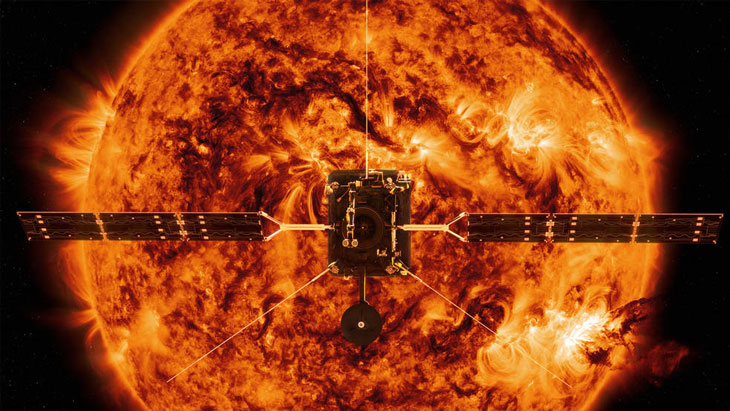
Fortunately, another spacecraft is also bound for the sun. This, the European Space Agency’s Solar Orbiter, is set to take flight in 2020. This craft will provide the first direct images of the sun’s poles. Those observations will be paired with Parker’s close view of the sun’s midriff. Together, these data could reveal how the solar wind varies at different latitudes.
These missions aren’t just about getting to know our sun. “Once you know about how our star works, you’re going to know a lot more about how other stars [do too],” Fox says. She studies the physics of the sun at the Johns Hopkins Applied Physics Laboratory in Laurel, Md.
“This is really freaking cool,” DeForest says. “We’re launching a probe and flying it through [several]-million-degree plasma on the periphery of a star. I mean, how cool is that?”