Computing
Finally! How to get a truly random number — and prove it
Researchers used two quantum devices and a math trick to ensure that newly generated “random” numbers are truly unpredictable.
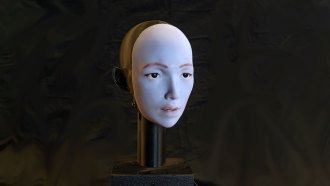
Robots that seem almost — but not quite — human can strike us as eerie. Improved lip motions might help overcome this “Uncanny Valley” effect.
Computers handle complex problems through a series of very simple answers, such yes or no, on or off — and most often, one or zero.
Such tiny robots could someday explore the cellular realm to study health and treat diseases.
John Clarke, Michel Devoret and John Martinis turned up quantum effects in an electric circuit. This 1980s find underlies today’s quantum computers.
The atoms that make us up couldn’t be shrunk or smashed closer together — at least, not without catastrophic consequences.
At the SETI Institute, Chenoa Tremblay uses radio telescopes to look for molecules and emissions given off by alien technology.
Developers can use AI to generate code, dialog, playable environments and more. But at its heart, making video games remains a creative human endeavor.
Chatbots answer one question at a time. Reasoning agents work through a problem step by step. DeepSeek makes this new type of AI far less costly.
James Whitfield began his career when quantum computing was still in its infancy. Today, he’s helping to make it more accessible to educators, researchers and others.