
All Stories by Emily Conover
- Physics
Physicists foil classic oobleck science trick
Cornstarch and water — best known as oobleck — solidifies upon impact. Researchers used a new technique to make it stay liquid.
- Physics
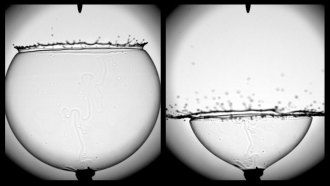
Soap bubbles’ ‘pop’ reveals the physics of the bursts
A bubble’s pop is a quiet, high-pitched noise. This can reveal the forces that occur during the bubble’s demise.
- Physics
There’s science to making great fried rice
Scientists report finding the physics that seems to explain how chefs can quickly fry rice over a hot flame without burning the food.
- Animals
Drones might one day capture a dolphin’s breath in midair
High-speed footage of dolphin spray reveals that droplets blast upward at speeds close to 100 kilometers per hour.
- Math
Color-changing fibers help unravel a knotty problem
Experiments with colorful fibers helped scientists discover a few simple rules on why the strength of various types of knots differs.
- Materials Science
Here’s how to hide some objects from heat-sensing cameras
A special coating that conceals temperature information from heat-detecting cameras might someday be used as a privacy shield.
- Physics
Giving Notre Dame back her unique voice
A 2019 fire robbed Paris’ Notre Dame cathedral of more than her roof. She also lost her voice. Now scientists are using acoustics to return her unique soundscape.
- Physics
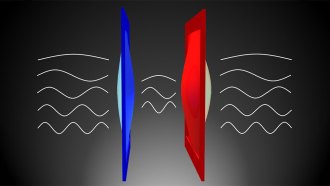
Here’s how quantum mechanics lets heat cross a vacuum
Heat can move across a vacuum if the span is small enough. As in really, really small. In a new experiment, the gap was only a few hundred nanometers.
- Physics
Glass beads help scientists puzzle out how baby planets grow
Researchers have mimicked the first stages of planet formation in the lab. All they needed were glass beads and a catapult.
- Physics
Physics Nobel rewards discoveries on cosmic evolution and exoplanets
This trio of scientists helped figure out the makeup of our universe. Two of them also identified the first known exoplanet orbiting a sunlike star.
- Chemistry
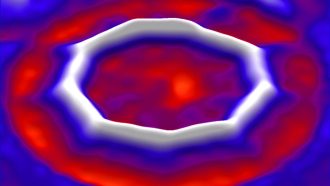
Chemists have created a ring-shaped form of carbon
A ring-shaped carbon molecule takes its place among buckyballs, carbon nanotubes and other odd forms of the element.
- Physics
This idea would turn the Earth into a giant space telescope
One astronomer has a bold solution to getting around the high cost of building big telescopes.