MS-ESS1-2
Develop and use a model to describe the role of gravity in the motions within galaxies and the solar system.
- Planets
Juno’s knocking on Jupiter’s door
The Juno spacecraft will peer into Jupiter’s clouds and fly in close to its monstrous auroras.
- Physics
Spinning black holes may ‘sing’ during a collision
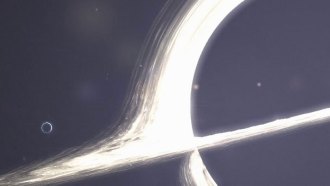
The massive black hole in the movie Interstellar would create a unique gravity-wave signal when gobbling a smaller partner.
- Space
Hurricane at this galaxy’s center is wicked fast
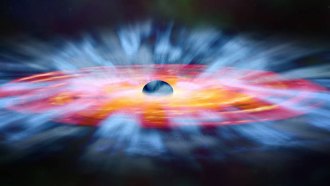
The gale-force winds around one quasar whip by at almost 200 million kilometers per hour. That’s 625,000 times faster than the strongest hurricanes on Earth.
- Physics
Gravity waves detected at last!
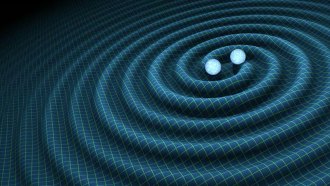
Albert Einstein predicted gravitational waves 100 years ago. Now scientists have detected them coming from the collision of two black holes.
- Physics
Explainer: What are gravitational waves?
Albert Einstein had predicted that large catastrophes, like colliding black holes, should produce tiny ripples in the fabric of space. In 2016, scientists reported finally detecting them
- Physics
How to catch a gravity wave
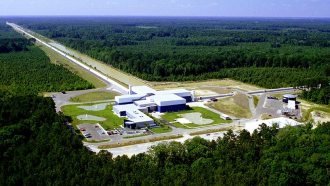
Physicists have just announced finding gravity waves. The phenomenon was predicted a century ago by Einstein’s theory of general relativity. Here’s what it took to detect the waves.
- Physics
Einstein taught us: It’s all ‘relative’
One hundred years ago, a German physicist shared some math he had been working on. In short order, his theory of relativity would revise forever how people viewed the universe.
- Physics
Stephen Hawking says his group has solved a black hole puzzle
Physicist Stephen Hawking says light sliding along the outside of a black hole holds the key to understanding what’s inside.
- Planets
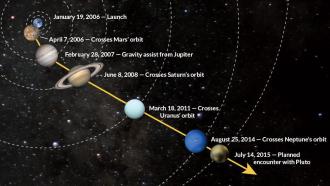
Visiting Pluto
Pluto has long been little more than a dark spot in the sky. Now NASA’s New Horizons spacecraft is about to fly by this dwarf planet. Along the way, it will collect unprecedented data on it.
- Physics
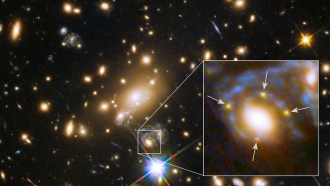
Galaxy cluster creates ‘magnifying glass’ in space
A massive galaxy’s gravity is so strong that it bends light, creating a “lens” in space. This natural magnifying glass is giving astronomers a rare view of a supernova on the other side of the universe.
- Space
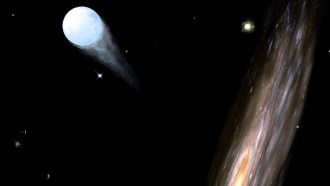
Astronomers spy fastest speeding star
A few stars have been spotted departing our galaxy. The fastest of these might have been propelled by another exploding star, a new study finds.
- Physics
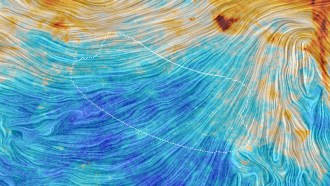
Dust erases evidence of primordial gravity waves
In March 2014, scientists claimed to have found the first echoes of the Big Bang — ripples in the very fabric of space. A new analysis shows the experts were mistaken. Dust appears to explain the confusion.