Brazilian monkeys offer lessons on how to return species to the wild
Some golden lion tamarins spent time training to live free in U.S. parks
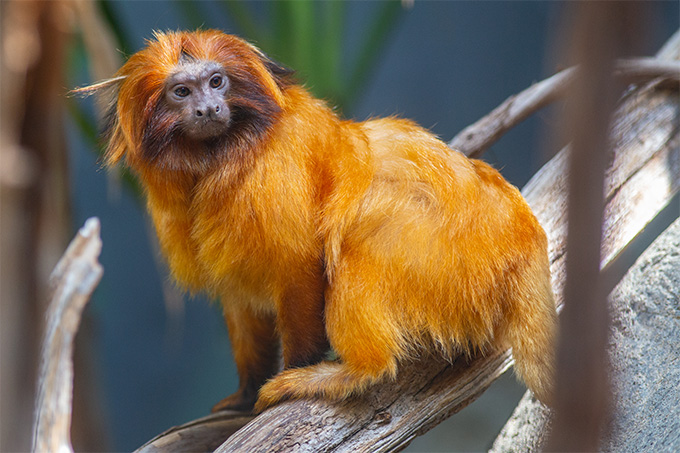
Golden lion tamarins once lived in Washington, D.C.’s Rock Creek Park. They were allowed to roam free to prepare for release in Brazil.
Skip Brown/Smithsonian’s National Zoo
Share this:
- Share via email (Opens in new window) Email
- Share on Facebook (Opens in new window) Facebook
- Share on X (Opens in new window) X
- Share on Pinterest (Opens in new window) Pinterest
- Share on Reddit (Opens in new window) Reddit
- Share to Google Classroom (Opens in new window) Google Classroom
- Print (Opens in new window) Print
A visitor to Rock Creek Park in Washington, D.C., in the early 1990s might have chanced upon a strange sight: a troop of monkeys with brilliant orange fur and long, twiggy fingers. These were endangered golden lion tamarins (Leontopithecus rosalia). The Smithsonian’s National Zoo had released the animals into a part of zoo grounds that connected to the park.
“The tamarins had the opportunity to go anywhere they wanted in the city of Washington, D.C., or beyond,” says Carlos Ruiz-Miranda. “They could have gone all the way to Baltimore.” Ruiz-Miranda is a conservation biologist. He works at the State University of Northern Rio de Janeiro in Brazil. He joined the National Zoo’s tamarin project in 1992.
The tamarins weren’t moving in permanently. They were in training to be released back to their native Brazil. This long-running effort aimed to save the species from extinction. The monkeys wore radio collars for easy tracking. They were constantly monitored by zoo staff.
Golden lion tamarins hail from Brazil’s Atlantic Forest. The forest has faced clear-cutting and development for centuries. The destruction began when Portuguese colonizers first set sights on it in 1500.
The late Brazilian biologist Adelmar Coimbra-Filho had realized that tamarins were in trouble. In the 1960s, he traveled around the Atlantic Forest and struggled to find any tamarins. He began trying to breed them in captivity in 1962. He hoped to reintroduce them into the wild.
But his and other early captive breeding efforts didn’t fare well. Scientists simply didn’t know enough about them to breed them successfully.
“For any reintroduction program, there’s some basic things you need to know about the animal,” says Ruiz-Miranda. “And tamarins were a big surprise to everybody at the beginning.”
Among most group-living primates, males mate with multiple females. But when male tamarins were housed with multiple unrelated females, problems arose. The females spent more time fighting with each other than they did mating with the male.
It turns out golden lion tamarins are typically monogamous. “You have to keep them in pairs,” Ruiz-Miranda says. Once researchers figured that out, the tamarins began breeding.
In 1984, captive-born tamarins were introduced in and around Brazil’s Poço das Antas Biological Reserve. It didn’t go very well. Fourteen tamarins were released in that first attempt. Only five monkeys remained after eight months.
Tamarins aren’t born knowing how to survive in the wild. They typically learn from their parents. Tamarins tend to live in families of a mother, a father and their offspring. Both parents help raise the babies. They teach the youngsters how to use their long fingers to fish tasty insects out of nooks and crannies. But captive-born tamarins never learned these survival skills.
The stunning failure in 1984 prompted scientists to try a different strategy. They let tamarins roam free in U.S. parks for a few months first. More captive-born tamarins were brought to Brazil between 1984 and 2000. Two-thirds of them still died within two years. Some were snapped up by jungle cats. Some were bitten by snakes or stung by bees. Many starved.
The tamarins that had trained in U.S. parks fared no better than those that hadn’t. The monkeys needed a longer training period before release, the researchers determined.
All this effort ultimately paid off. A 2023 census in Brazil found 4,800 wild tamarins. More than 2,500 of them descended from the reintroduced pioneers.
The project has brought more tamarins into the world. It has also shown the importance of considering animal behavior when trying to save a species.
Do you have a science question? We can help!
Submit your question here, and we might answer it an upcoming issue of Science News Explores