This Band Aid-like device could let you ‘feel’ the virtual world
It’s studded with tiny dots that vibrate to mimic the feel of real-world textures
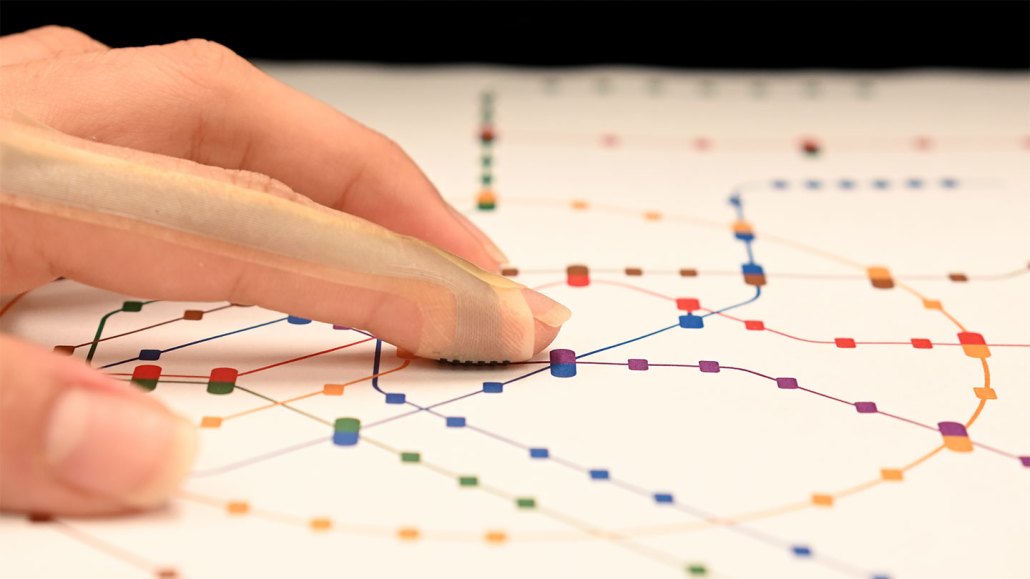
Worn on a fingertip, the new device uses a grid of tiny nodes to simulate textures, such as the feel of fabrics.
Northwestern University
This is a human-written story voiced by AI. Got feedback? Take our survey . (See our AI policy here .)
Phones, tablets and other electronic gadgets display lifelike images and play realistic sounds. What’s next? Maybe, making virtual objects feel real.
A new device that’s worn on your fingertip — like a Band-Aid — is a step in that direction. It’s designed to replicate the sensation of touch.
In early tests, volunteers wearing this device could identify patterns of virtual indentations on smooth test surfaces. They also could tell the difference between rough and smooth virtual fabrics.
This is the first tech that allows fingertips to feel virtual textures with the same speed and detail as when they’re touching real-world objects, its designers say. They described this device — named VoxeLite — in Science Advances late last year.
VoxeLite is an example of haptic, meaning touch-related, technology. Today, haptic feedback on personal devices is mostly limited to simple vibrations. But future haptic tech could add realistic touch features, says Thanh Nho Do. This materials scientist works at the University of New South Wales in Sydney, Australia. He did not take part in building VoxeLite, but he does develop haptic devices in his own lab.
In future versions, “users could explore the material properties of clothing” when shopping online, Do suggests. Before purchasing a new hoodie, for instance, someone could feel how soft it is.
This type of tech might also, one day, help blind people read messages or maps on a phone, says Sylvia Tan. A materials scientist and graduate student at Northwestern University in Evanston, Ill., she led the design of VoxeLite.
The device isn’t ready for widespread use, Tan says. “There is still a lot of work to be done.” But she thinks that work is worth doing. “Touch plays a fundamental role in how we interact with the world,” Tan says. “Yet it remains one of the least digitized senses.”
Tiny pixels of touch
Engineers and materials scientists have built many types of haptic devices. Some, like Do, have created gloves with tiny vibrating pieces. Others have used little motors that buzz against the fingertips. Still others have designed a soft skin-like covering that morphs into shapes against a user’s skin to match the surfaces of textures.
Many of those earlier devices worked too slowly to feel realistic, says Tan. Others couldn’t achieve the detail of many textures. The new device, she says, achieves both.
VoxeLite is a paper-thin piece of stretchy latex. It wraps around the user’s finger like a bandage. Embedded within it is a square grid of tiny half-spheres, called nodes. They’re linked by wires. Each node can be independently controlled. The flat side of each one sits against the pad of the wearer’s fingertip.
Tan and her team created devices with those nodes in 4×4 grids, 6×6 grids and 8×8 grids. The challenge, she says, was to put nodes close enough together that they could mimic fine details of textures, yet far enough apart that your brain would recognize them as different nodes.
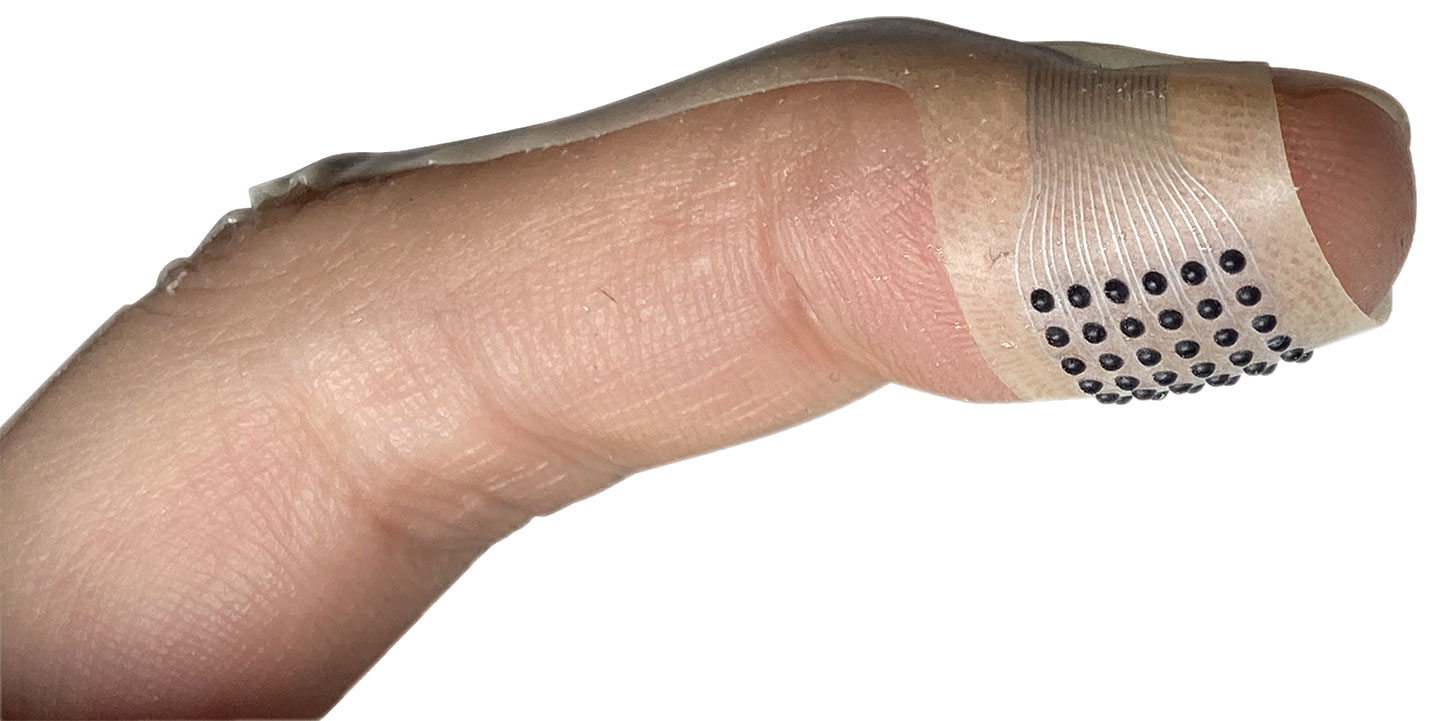
In the version of the device tested by volunteers, the nodes were spaced with their centers 1.6 millimeters (0.06 inch) apart. That grid density, Tan says, let the device convincingly mimic how materials feel to the skin.
The current prototype starts working when someone slides their finger along a smooth surface that can conduct electricity. As the finger moves, the nodes pick up electrical signals in the form of voltage. That voltage leads to a difference in electric charge between each node and the surface. And that difference in charge leads to friction.
Friction causes a node to tilt in a particular way, pushing the flat part of the dome into the person’s skin. Higher voltage leads to more friction, which mimics a rough surface. Less voltage creates less friction and feels smoother.
The nodes can change quickly — up to 800 times per second — as someone moves their finger. That’s because where many past devices used tiny motors, VoxeLite instead relies on quick-changing charges. Those changes create vibrations against the skin. All the nodes, vibrating and tilting in specific ways, add up to sensations.
Do you have a science question? We can help!
Submit your question here, and we might answer it an upcoming issue of Science News Explores
Touchy-feely
In tests, people wearing VoxeLite were first asked to identify which directions were represented by patterns on the nodes. Those directions were right, left, forward, back or going in a loop. Nodes nearest the tip of the finger might tilt the most, guiding the person in that direction. Or nodes on the left might indent into the skin, signaling left.
Next, users were asked to match the sensations they felt to the textures of real materials, such as leather and corduroy.
The volunteers correctly identified directions 87 percent of the time. They correctly matched virtual textures to real-world materials 81 percent of the time.
The new device can mimic finer textures than other haptic devices, Do says. But to work, he notes, the finger-worn device needs to move against a conductive (and electrically grounded) surface. Most objects don’t conduct electricity. “As a result, the device cannot function on most everyday objects,” he says. Those include the touchscreens on today’s smartphones and computers. They do conduct electricity. Their protective layers of glass or plastic, however, keep the new device from working on them, Tan notes.
This latest version of VoxeLite took about two years of work, and its developers are still refining it. Tan hopes it will allow her to better understand how people perceive touch. She also wants to bring down its size. Even though the device itself fits on a fingertip, it’s connected by wires to a much larger circuit on her desk.
Eventually, she hopes others will improve on her work to develop better haptic tools. She says she’s “excited to see where others might find this new type of tactile information most useful.”