
Stephen Ornes

Freelance Writer

Stephen Ornes has been writing for Science News Explores since 2008, and his 2014 story "Where Will Lightning Strike?" won an AAAS/Kavli Gold Award. He lives in Nashville, Tenn., and he has three children, who are inventing their own language. His family has a cat, six chickens, and two rabbits, but he secretly thinks hagfish are the most fascinating animals. Stephen has written two books. One is a biography of mathematician Sophie Germain, who was born during the French Revolution. The other, which was published in 2019, features art inspired by math. Visit him online at stephenornes.com.

All Stories by Stephen Ornes

  1. Health & Medicine

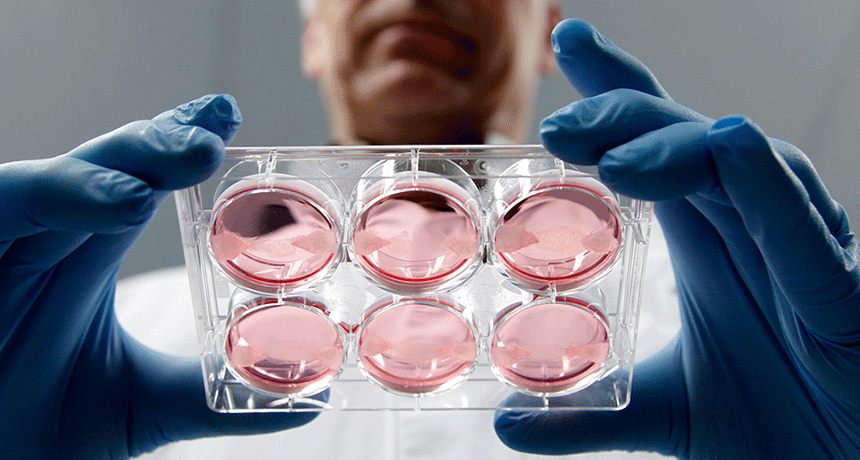
    Meat from scratch

    Scientists are working to produce meat without killing animals.

  2. Fossils

    Old relative steps down

    Ancient human ancestor climbed trees but also walked clumsily upright on the ground.

  3. Earth

    The sinking city

    Venice, Italy continues to slip into the sea.

  4. Humans

    Becoming human

    Two new studies suggest that during ice ages, steep drops in temperature may have sent ancient species moving to more temperate, or mild, areas. As a result, these species would have been isolated from other populations.

  5. Earth

    Flipping icebergs

    Capsizing icebergs may release as much energy as a bomb

  6. Environment

    Water’s worldwide travels

    Scientists track the movement of ‘virtual water,’ used in the production of goods and exchanged among nations.

  7. Fossils

    Dino drama

    Scientists study skulls to determine whether Triceratops and Torosaurus were two different species.

  8. Chemistry

    Squeeze power

    Under pressure, plastics produce energy.

  9. Earth

    Twist and shake

    A new look at the shape of the San Andreas Fault suggests future earthquakes may be stronger than previously thought.

  10. Fossils

    Early toehold on land

    A five-toed fossil now holds the record for smallest, oldest foot ever found.

  11. Physics

    Too fast to be true

    Last September, scientists working on an Italian experiment called OPERA reported a measurement that seemed too amazing to be true. Their finding involved neutrinos, supersmall and ultrafast particles that can travel through almost anything without stopping. The scientists measured the speeds of neutrinos that zipped from one underground laboratory to another and reported that the zippy little particles traveled faster than light. In November, they repeated the experiment and got the same results.

  12. Animals

    Fishy chatter

    Scientists record unidentified noises in the deep sea.