Physics
- Physics
In a breakthrough experiment, fusion gave off more energy than it used
The sun creates energy through nuclear fusion. Now scientists have too. This achievement raises hopes for developing a new type of clean energy.
- Materials Science
Let’s learn about the weird science of ice
Better understanding of ice could lead to new deicing materials or even, someday, weather control.
- Physics
Explainer: Kinetic and potential energy
Kinetic energy depends on an object’s motion; potential energy hinges on its position. The relationship between the two sits in a special balance.
- Physics
Does the size of a parachute matter?
How does a parachute work? Do bigger parachutes work better than smaller parachutes? Find out in this science project whether the size of the parachute matters.
- Tech
New robot can pick up a single drop of liquid
The new device, which looks like a pair of plastic pinchers, is the first to be able to pick up individual droplets of liquid.
- Materials Science
Scientists Say: Hydrogel
Tangled polymer chains help hydrogels hold their shape despite being full of water.
- Physics
Let’s learn about the quantum realm
On the smallest scales, the universe behaves in some pretty strange ways.
- Physics
How salty does the sea have to be for an egg to float?
Some objects float on top of the ocean, and other objects sink to the bottom. Why? Try this eggs-periment to find out!
- Physics
Scientists Say: Fusion
Nuclear fusion is the physics that powers the sun and could someday provide abundant clean energy on Earth.
- Physics
Scientists Say: Fission
Nuclear fission is the process of splitting atoms apart to release huge amounts of energy.
- Animals
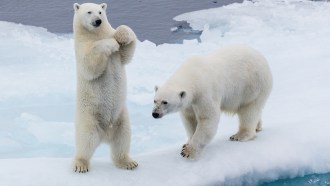
Tiny bumps on polar bear paws help them get traction on snow
Super-small structures on the Arctic animals’ paws might offer extra friction that keeps them from slipping on snow, a new study concludes.
- Physics
Explainer: What is friction?
The force of friction always acts to slow things down. It depends on just two factors: the surfaces and how hard they press together.