Questions for ‘Animals’ personalities can affect a species’ survival’
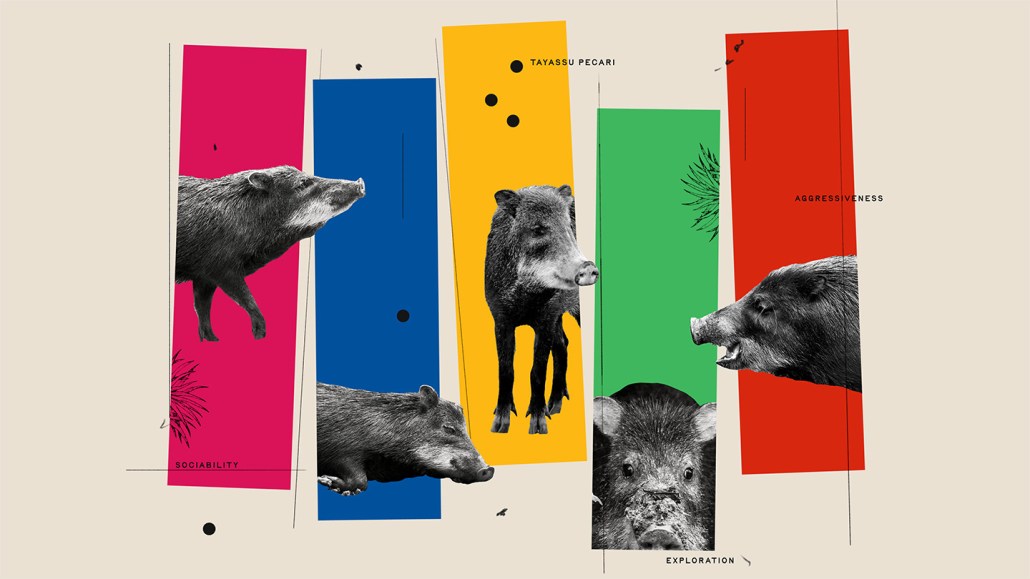
White-lipped peccaries are at risk of extinction. Efforts to return them to the wild have started to track individual traits like aggression and sociability.
Valerie Chiang/From left: wrangel/Getty Images; wrangel/Getty Images; Wirestock, Inc./Alamy; Amazon-Images/Alamy; alejomiranda/Getty Images
Share this:
- Share via email (Opens in new window) Email
- Share on Facebook (Opens in new window) Facebook
- Share on X (Opens in new window) X
- Share on Pinterest (Opens in new window) Pinterest
- Share on Reddit (Opens in new window) Reddit
- Share to Google Classroom (Opens in new window) Google Classroom
- Print (Opens in new window) Print
To accompany ‘Animals’ personalities can affect a species’ survival’
SCIENCE
Before Reading:
- Come up with a definition for “personality” in your own words. Briefly describe some aspects of your own personality.
- Describe a pet or other animal you’ve known. (If you’ve never owned a pet, describe another animal that you have interacted with repeatedly, such as a friend’s pet.) What was this animal’s name? What species was it? Would you describe its behavior as fairly typical of its species or more atypical? To what extent would you consider these behaviors as evidence of that animal having a personality? Explain your answer.
During Reading:
- What species is Naruto? Contrast one aspect of Naruto’s personality with the other members of his group.
- How has the population of Naruto’s species changed in Brazil over the last few years?
- Do the results of the study described in this story suggest that Naruto’s personality traits seemed to increase, decrease or not affect his likelihood of survival in the wild?
- What did two 2004 studies conclude about the value of diverse personalities within an animal group?
- What is the scientific name for the black-fronted piping guan?
- What are two human-related threats to black-fronted piping guan populations?
- Carlos Ruiz-Miranda has investigated the personalities of golden lion tamarins. What does he mean when he says that a humanmade bridge is a “filter of personalities” for tamarins in the wild?
- What is one challenge mentioned in the story with using wolves’ personality traits to guide reintroduction efforts?
- At the time of this story’s publication, how many of the original 25 wolves released into Colorado survived?
- What is fladry? Why might someone hang fladry from a fence?
After Reading:
- Refer back to your answer to Question 1 in Before Reading. Describe a hypothetical personality that would be very different from your own. Avoid describing a specific person. Instead, just describe generic traits that some people have, but that you do not think describe you. Also, avoid describing this other personality in negative terms. Then consider how our species may benefit overall from having people with different personalities. What are some advantages of your personality to a larger group? Come up with two ways that you tend to contribute in a meaningful way. (Don’t overthink it, just say what comes to mind.) Finally, come up with two ways that the alternate personality you’ve described — the one unlike you — might contribute in a positive way.
- Based on scenarios described in this story, under what conditions might “boldness” benefit an individual? Under what conditions might this trait become more of a risk? Reference research findings or data mentioned in this story to support your answer.
- What is a trait not mentioned in this story that might be considered advantageous in one situation and disadvantageous in another? Explain your answer by briefly describing the conditions under which this trait might be advantageous and disadvantageous. Feel free to use either animal or human examples.