Tabletop lightning helps make an alcohol used for fuels and more
High-energy plasma can help make this methanol from methane, a type of natural gas
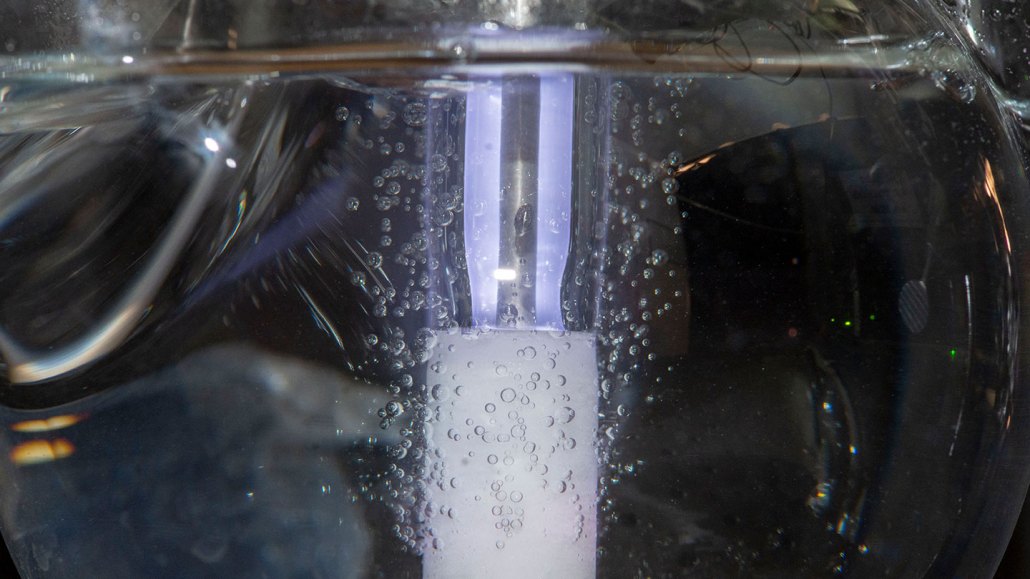
The plasma “lightning” is seen as purplish arcs in the upper half of this underwater cylinder. This same process that causes lightning in the sky can be harnessed here to make methanol for use as a fuel and more.
D. Swearer/Northwestern University
This is a human-written story voiced by AI. Got feedback? Take our survey . (See our AI policy here .)
You may not know methanol by name, but this alcohol plays a big role in making a lot of the things in our lives. It’s an ingredient in plastics and paints, for instance. And being highly flammable, it can be used as a liquid fuel. But making it has typically required multiple steps and high heat. It also produced lots of wastes. Now scientists have found an easy way to make methanol that avoids many of those drawbacks.
Their trick: Add lightning.
Lightning is a form of plasma — what many scientists call the fourth state of matter. It forms from a high-voltage electrical pulse.
Researchers have now shown plasma can quickly convert methane — the main component of natural gas — into methanol. All it takes is adding electricity, they explain in the April 15 Journal of the American Chemical Society.
“Lightning” in a bottle makes methanol in a simple, one-step process, notes Dayne Swearer. A physical chemist and chemical engineer, he led the team at Northwestern University in Evanston, Ill., that developed the technique.
Each year, companies around the world make up to 110 million metric tons (36.6 billion gallons) of methanol. “If we can offset a small fraction of that using … a simple process like this one,” Swearer says, “I think there’s a lot of cool opportunities.”
Lightning’s role
Chemists have been looking into using plasma in chemical reactions for more than a century. For Swearer, it’s a recent interest. He studies electromagnetic energy. “That’s the type of energy found in light or in electric fields, or that runs through wires,” he explains.
Working with that type of energy means understanding electrons — negatively charged subatomic particles. His team is studying ways to use electrons to transfer power.
“The electron really gives chemistry its flare,” he says. “It’s a really, really important part of chemical reactions.” He likens electrons to hooks that hold atoms together to make molecules. If you can unhook those electrons, he says, it’s possible to rearrange a molecule’s atoms.
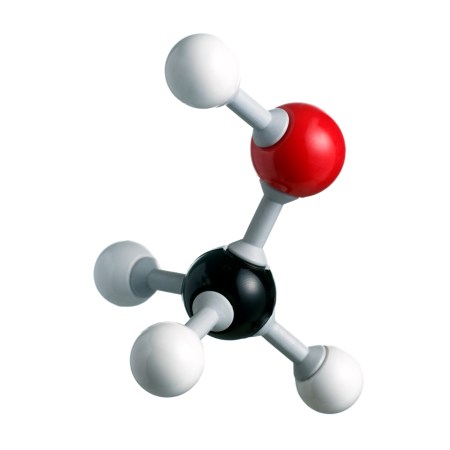
The team used bottled lightning to remodel methane molecules. The change happens quickly. First, they pump methane gas into a cylinder immersed in water. The cylinder has tiny holes, or pores, on its sides. Then the device is electrified using a much higher voltage than comes from the outlets found in a home. “Our system compresses the electricity into pulses that turn off and on really fast,” Swearer says. “These short bursts help control the chemistry.”
As the gas moves through the cylinder and out the tiny holes, an electrical pulse rips through it. That pulse lights up like tiny bolts of lightning.
This process tears electrons from the methane molecules. These glowing, high-energy electrons form a plasma that smashes into other nearby molecules. Methane molecules have one carbon atom and four hydrogens. Water molecules have one oxygen and two hydrogens. The plasma breaks one hydrogen off of each molecule.
Those broken water and methane molecules find each other and snap together like puzzle pieces, says Swearer. “We click them together.” And when they do, they become methanol. The orphaned hydrogen atoms snap together to form hydrogen molecules.
Along with the methane gas, the porous cylinder contains a type of material called a catalyst. It helps the chemicals react correctly.
Toward greener chemistry
Chemists knew electricity could be used to remodel the molecules in a gas. But figuring out how to harness that knowledge in a useful way proved hard, Swearer says. One challenge was “really understanding what’s going on inside the plasma,” he says. He credits a graduate student, James Ho, with figuring out how the plasma was behaving.
Another challenge: Not all the methane will turn into methanol. Swearer’s team is currently investigating how to improve that conversion rate.
Using lightning in a bottle to make methanol is exciting, he says. But he cautions that his team’s process is experimental. It’s not ready to replace conventional ways of making methanol. Doing that will take years, Swearer says. One obstacle, he notes, is “just the cost of electricity” needed.
Still, the new findings suggest using plasma to make fuels could have a smaller climate impact than today’s standard methods, says P.J. Cullen. He’s a chemical engineer at the University of Sydney in Australia. Why? “No need for high temperature” to make them, he says. The high heat normally needed to make methanol comes from burning fossil fuels. The electricity used for the plasma could instead come from solar, wind or nuclear sources — sources that don’t add greenhouse gases to the atmosphere.
Cullen’s group in Australia developed the plasma-making device that Swearer’s group uses. In the same journal as Swearer’s work, Cullen’s team describes a second way to convert methane to methanol with a plasma. (It, too, uses a catalyst, but one separated from the plasma.)
“Both papers point to the same main advantage,” Cullen says. Both make methanol without high heat.
These approaches both show the power of plasma, he says. They also point to how researchers could use this technology for cleaner, greener chemistry.
Do you have a science question? We can help!
Submit your question here, and we might answer it an upcoming issue of Science News Explores