Questions for ‘The lives of black holes, from birth to death’ 
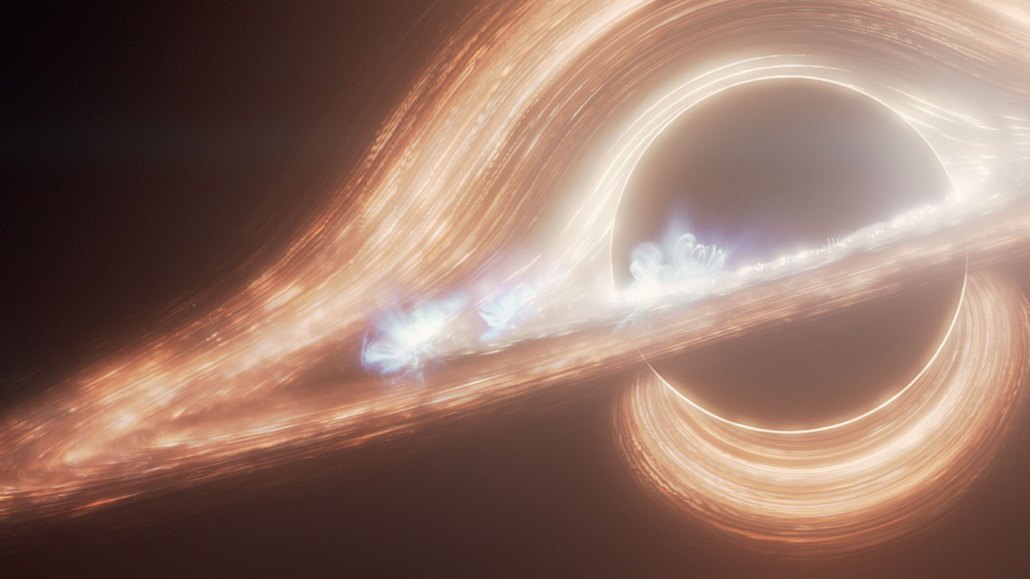
an illustration of what a flare coming from a black hole might look like

Using powerful telescopes, astrophysicists can see bright flares coming from faraway black holes. This artist’s illustration depicts the black hole at the center of the Milky Way. Its intense gravity bends light around the black hole.

NASA, ESA, CSA, Ralf Crawford (STScI)

To accompany The lives of black holes, from birth to death

SCIENCE

Before Reading:

  1. Imagine a black hole in space. What do you imagine a black hole looks like? How big do you imagine a black hole to be? What do you think a black hole is made of? Give an example of how a black hole interacts with objects around it. (Do not look up these answers. Just describe your current understanding of these objects.)
  2. Describe how you think scientists confirm that black holes exist. What types of evidence might they use to confirm the theory of black holes?

During Reading:

  1. Who proposed the theory of general relativity? What year was this theory proposed?
  2. What is the connection between the theory of relativity and a black hole?
  3. Explain what was novel about the 2019 image captured by the Event Horizon Telescope.
  4. Give one unanswered question about black holes that is referenced in this story.
  5. What is the relationship between a supernova and a black hole?
  6. Do astronomers predict our sun will eventually become a neutron star? Explain why or why not.
  7. Compare the mass of TON 618 with the mass of the sun.
  8. What is an event horizon? How does an event horizon affect what scientists can study about a black hole?
  9. Besides a star, what else might provide the precursor material for a new black hole?
  10. Describe a mechanism by which a black hole might produce measurable light.
  11. To what extent do astronomers believe the Milky Way is currently producing new stars?
  12. Which is longer: the lifespan of a black hole or the lifespan of a star that produces the black hole? Briefly explain your answer.
  13. Explain the relationship between a black hole and the theoretical “black shell.”

After Reading:

  1. Black holes can grow by colliding and fusing together. But this mechanism cannot explain the existence of the largest supermassive black holes. Give one specific reason why scientists do not believe this collision theory can explain how the largest black holes formed. Do you think it’s very important, mostly important or unimportant to understand how the largest black holes in the universe formed? Briefly explain your answer.
  2. This story says that “information” cannot leave a black hole beyond the event horizon. “Light” is referred to as an example of such information. What does it mean to say that light is “information”? Consider what information scientists might learn by measuring light. Besides learning what something looks like or how an object appears, what other information can an astronomer infer from measuring light coming from a distant object in space?
  3. What does Priya Natarajan mean when she says black holes “don’t have any memory”?