Physics explains how snakes climb and stand without limbs
Tree-climbing snakes use a special S-shaped pose instead of stiffening their whole body
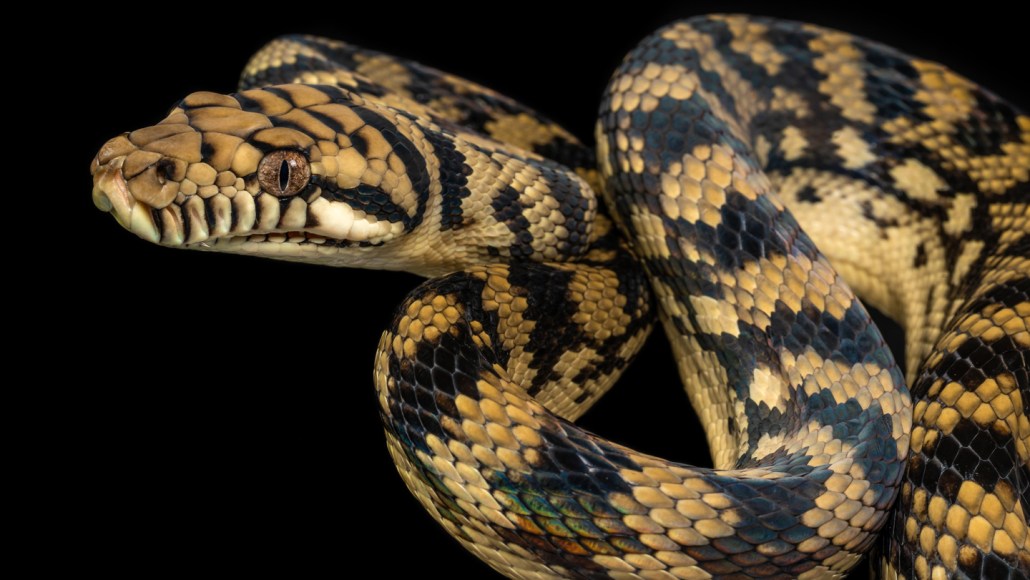
This Australian brown tree snake can lift up to 70 percent of its body into the air. A unique twisted shape helps it ascend to high perches.
Sibons photography/Alamy
This is a human-written story voiced by AI. Got feedback? Take our survey . (See our AI policy here .)
A long, wiry scrub python slithers up a tree. As it moves between branches, the snake lifts itself upright to climb higher. But how? With no arms and legs to hold itself up, why doesn’t it topple over? The secret lies in its special S-like body shape, new analyses show.
Tree-climbing snakes don’t stiffen their entire bodies to stand upright. They focus their bending energy and muscle activity on a small area near their base. This helps snakes “stand” while using as little energy as possible.
Researchers shared these findings February 25. Their work appears in the Journal of the Royal Society Interface.
“Snakes are kind of like muscular ropes,” says David Hu. “And they can basically perform magic tricks, flexing their bodies and preventing [themselves] from falling.” Hu is a bioengineer and roboticist who did not take part in the study. He works at Georgia Tech in Atlanta.
Past research has shown that as tree-climbing snakes move upward, they activate muscles along their spine. Bruce Jayne, a zoologist at the University of Cincinnati in Ohio, helped make this discovery. In the new work, Jayne and others took a close look at how snakes manage limbless climbs without buckling under their own weight.
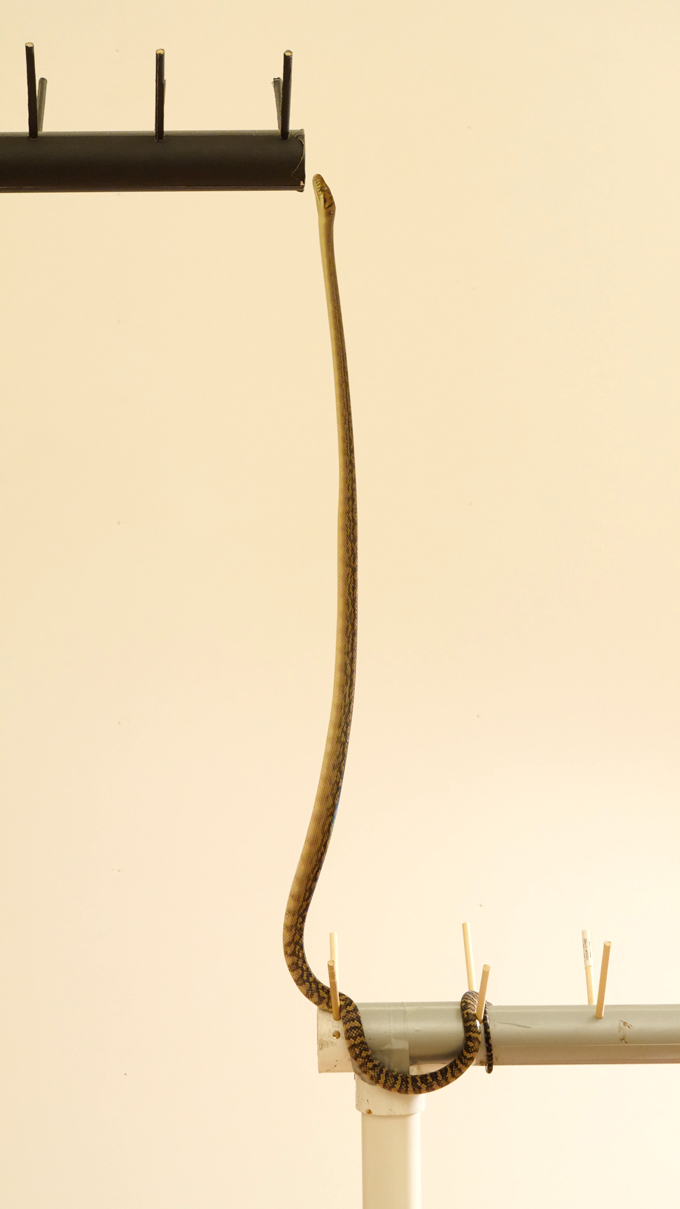
The team took videos of four snakes climbing up gaps between perches in the lab. Three were brown tree snakes (Boiga irregularis). One was a scrub python (Simalia amesthistina).
The footage showed that the creatures twisted into an S-like shape — especially if the gap they were crossing was large. The snakes were most curved close to where they perched. Above the bend, their bodies were straight, like tall poles. This sturdy position is hard for gravity to topple.
Making model snakes
To understand the forces involved in snakes’ gravity-defying feats, the researchers used computers to model the creatures. They used math to represent the snake as an “active elastic filament.” That’s a soft structure that can sense its own shape and activate muscles.
The team explored two strategies for how a snake might rise up. In one, each part of the snake’s body worked by itself, responding to the curves closest to it. In the other, muscle activity was coordinated across the entire body. While still focused more at the bottom, this helped minimize the energy needed to stand.
Models using both approaches reproduced the S-shape seen in snakes in the lab. Both concentrated the bending near the perch. The scenario that required the least energy: muscles that worked together across the entire body. In this scenario, bending force dropped as more of the snake rose into the air. This tactic reduced both the force and energy the snake used. So researchers suspect that this is the strategy that snakes use.
Standing up is one thing. But holding that pose may be harder. Snakes spend more energy staying vertical, the math models showed. And in the videos, the snakes that stood taller swayed a bit from side to side. This suggests they were actively using their muscles to stay balanced.
These findings could help in the design of snakelike robots, says Ludwig Hoffmann. A co-author of the study, this applied mathematician works at Harvard University in Cambridge, Mass. Snakelike bots could be used in space and underwater explorations, or in surveying disaster sites. Robots that use real snakes’ standing strategies, he says, could be controlled more easily and use less energy to make desired shapes.