algae: A group of single-celled and multicellular organisms, once considered plants (they aren’t). As aquatic organisms, they grow in water. Like green plants, they depend on sunlight to make their food.
bacteria: (singular: bacterium) Single-celled organisms. These dwell nearly everywhere on Earth, from the bottom of the sea to inside other living organisms (such as plants and animals). Bacteria are one of the three domains of life on Earth.
bacterial: Having to do with bacteria, single-celled organisms. These dwell nearly everywhere on Earth, from the bottom of the sea to inside animals.
cell: (in biology) The smallest structural and functional unit of an organism. Typically too small to see with the unaided eye, it consists of a watery fluid surrounded by a membrane or wall. Depending on their size, animals are made of anywhere from thousands to trillions of cells. Most organisms, such as yeasts, molds, bacteria and some algae, are composed of only one cell.
chemistry: The field of science that deals with the composition, structure and properties of substances and how they interact. Scientists use this knowledge to study unfamiliar substances, to reproduce large quantities of useful substances or to design and create new and useful substances. (about compounds) Chemistry also is used as a term to refer to the recipe of a compound, the way it’s produced or some of its properties. People who work in this field are known as chemists.
dormant: Inactive to the point where normal body functions are suspended or slowed down.
egg: A reproductive cell that contains half of the genetic information necessary to form a complete organism. In humans and in many other animals, ovaries produce eggs. When an egg fuses with a sperm, they combine to produce a new cell, called a zygote. This is the first step in the development of a new organism."
fungi: (sing: fungus) Organisms with one or more cells that reproduce via spores and feed on living or decaying organic matter. Examples include mold, yeasts and mushrooms.
microscope: An instrument used to view objects — such as bacteria or the single cells of plants or animals — that are too small to be visible to the unaided eye.
molecule: A group of atoms that represents the smallest possible amount of a chemical compound. Molecules can be made of single types of atoms or of different types. For example, the oxygen in air is made of two bound oxygen atoms (O2). Water is made of two hydrogen atoms and one oxygen atom (H2O).
moss: A small, flowerless green plant that lacks true roots. It tends to grow as carpets or rounded cushions in damp habitats. It can reproduce asexually, through fragmentation, or by means of spores released from stalked capsules.
protein: A compound made from one or more long chains of amino acids. Proteins are an essential part of all living organisms. They form the basis of living cells, muscle and tissues; they also do the work inside of cells. Antibodies, hemoglobin and enzymes are all examples of proteins. Medicines frequently work by latching onto proteins.
radiation: (in physics) One of the three major ways that energy is transferred. (The other two are conduction and convection.) In radiation, electromagnetic waves carry energy from one place to another. Unlike conduction and convection, which need material to help transfer the energy, radiation can transfer energy across empty space.
risk: The chance or mathematical likelihood that some bad thing might happen. For instance, exposure to radiation poses a risk of cancer. Or the hazard — or peril — itself. (For instance: Among cancer risks that the people faced were radiation and drinking water tainted with arsenic.)
sperm: A reproductive cell that contains half of the genetic information necessary to form a complete organism. In humans and in many other animals, testes produce sperm. When a sperm fuses with an egg, the two combine to produce a new cell, called a zygote. This is the first step in the development of a new organism."
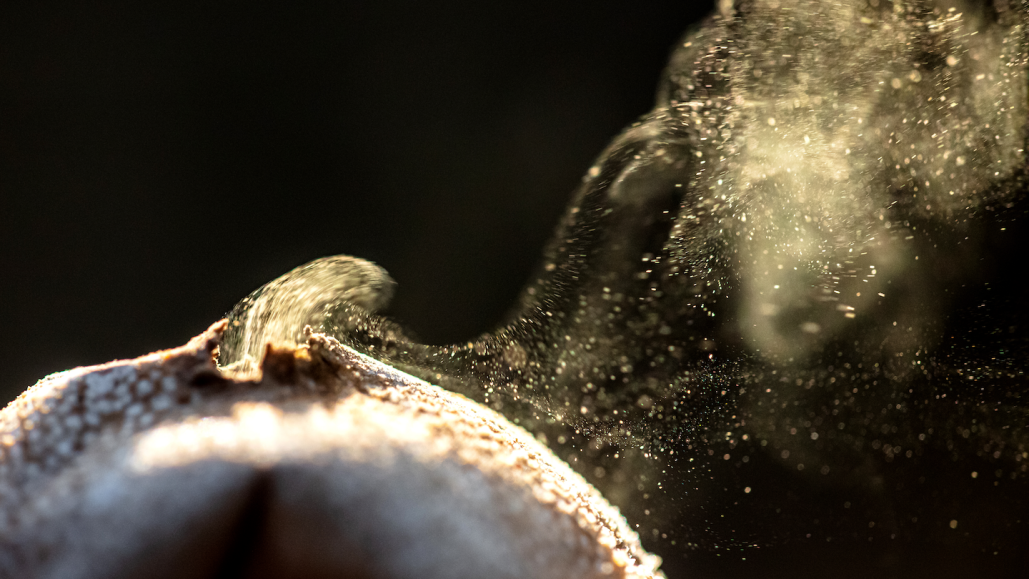
spore: A tiny, typically single-celled body that is formed by certain bacteria in response to bad conditions. Or it can be the single-celled reproductive stage of a fungus (functioning much like a seed) that is released and spread by wind or water. Most are protected against drying out or heat and can remain viable for long periods, until conditions are right for their growth.
trait: A characteristic feature of something. (in genetics) A quality or characteristic that can be inherited.
vacuum: Space with little or no matter in it. Laboratories or manufacturing plants may use vacuum equipment to pump out air, creating an area known as a vacuum chamber.
warp: A change in the shape, usually due to some twisting or curving in a normally flat surface or plane. A piece of wet lumber may warp as it dries unevenly, causing it to bow or show a slight twist.