HS-ESS1-2
Construct an explanation of the Big Bang theory based on astronomical evidence of light spectra, motion of distant galaxies, and composition of matter in the universe.
- Space
Students sent instrument to Pluto
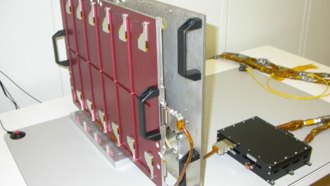
The student-built dust counter on NASA’s New Horizons spacecraft is measuring how much grit and debris orbits out beyond Neptune.
- Space
Scientists Say: Gravitational lens
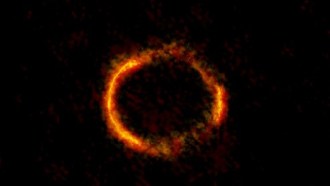
A gravitational lens is an effect that occurs when a massive object lies between a viewer and something further away. The massive object’s gravity bends light arriving from the more distant object.
- Physics
Light robs galaxy of star-making gas
Stars form from clouds of hydrogen and other gases. Astronomers have found the light from newborn stars can drive off that gas. That action can starve a galaxy of the ingredients needed to make more stars.
- Animals
When life exploded
Life exploded in diversity during the Cambrian Period. Experts are exploring what could account for this sudden change 540 million years ago.
- Planets
Explainer: What are asteroids?
Leftovers from the creation of the solar system, asteroids are space rocks that orbit the sun. Let’s hope the big ones never become meteorites.
- Planets
First mega-Earth found
Astronomers are puzzled by Kepler-10c. This exoplanet is rocky like Earth — but as massive as Neptune. And that challenges their accepted ideas about how planets form.
- Space
Sun sibling spotted
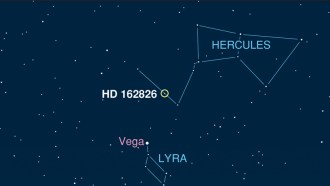
Separated at birth: Astronomers find a star 110 light-years away. It was born at the same time as our sun and from the same cloud of gas and dust.
- Planets
Distant planet may boast the longest year
On a planet far, far away, a single pass around its sun may seem to last forever.
- Planets
A ‘Goldilocks’ world?
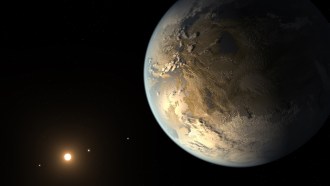
Scientists have spotted a faraway planet that is nearly the size of Earth and could host liquid water. It's too far to visit, but astronomers say the galaxy could be littered with such potentially habitable worlds. Don't hang up yet, E.T.
- Planets
Heavenly research
Groundbreaking research in astronomy landed four high school seniors spots as finalists in the 2014 Intel Science Talent Search.
- Planets
Surprising rings circle comet-asteroid hybrid
It’s too small to be a planet. Yet this planet wannabe still resembles Saturn-like giants. It’s the smallest solar system inhabitant to, like them, host rings of orbiting ice.
- Space
Waves from the birth of time
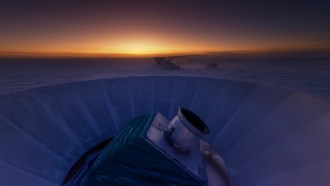
Inflation is the idea that in the split-second after the Big Bang, the universe exploded into huge-ness. Although the hypothesis is 30 years old, evidence to confirm it had been lacking. Until now.