Space
Newfound clouds of missing ‘ordinary’ matter sit outside galaxies
Dark matter isn’t the universe’s only “missing” matter. Distant bursts of radio waves have now turned up vast, faint gas clouds surrounding galaxies.
No light will ever reach Earth from beyond this distant horizon of space.
Some branches of physics hint that our universe is just one of many in a vast “multiverse.”
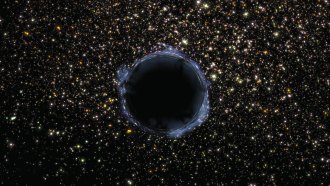
Hefty stars might have collapsed into “intermediate mass” black holes — the building blocks of supermassive ones, a teen’s research suggests.
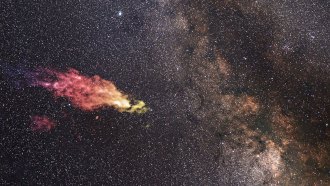
Astronomers want to know the source — and importance — of these faint, fast-moving clouds that zoom beyond and toward our Milky Way’s disk.
No one knows exactly what this stuff is, but it’s shaping our universe on the largest scales.
Astronomers now agree there’s a lone black hole wandering around the Milky Way — the first solitary black hole ever detected.
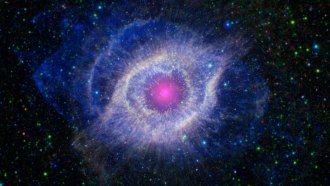
This Helix Nebula is like a colorful explosion frozen in time. Its center seems to be steadily radiating X-rays.
Studies of gravitational waves, stars and other features of the universe could reveal whether such “primordial” black holes exist.
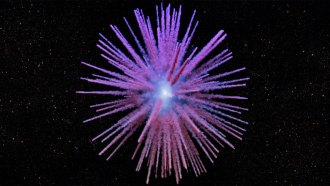
The star's odd tendrils were somehow formed by a supernova that skywatchers saw way back in 1181.