HS-ESS1-2
Construct an explanation of the Big Bang theory based on astronomical evidence of light spectra, motion of distant galaxies, and composition of matter in the universe.
- Chemistry
Dwarf galaxy spawned heavy elements
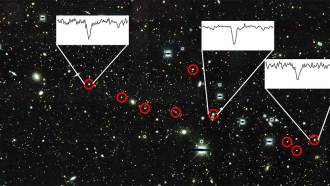
A study of nine stars in the dwarf galaxy Reticulum II found heavy elements. They had been produced after a violent stellar event sparked a chemical chain reaction.
- Space
Hurricane at this galaxy’s center is wicked fast
The gale-force winds around one quasar whip by at almost 200 million kilometers per hour. That’s 625,000 times faster than the strongest hurricanes on Earth.
- Earth
Cool Jobs: Mapping the unknown
Scientists find different ways of exploring places humans will never visit — and drawing maps to help us better understand such mysterious places.
- Physics
Scientists Say: Yottawatt
On Earth, scientists measure energy use in watts. When you have lot of those watts — one million billion billion — you have a yottawatt.
- Chemistry
Smash hit: Making ‘diamond’ that’s harder than diamonds
Scientists had suspected extreme meteorite impacts might turn graphite into an unusual type of diamond. Now they’ve seen it happen — in under a nanosecond.
- Physics
Black hole smashup sent out ‘yottawatts’ of power
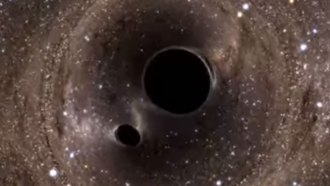
When two black holes collided, they released a lot of energy in gravity waves. How much? How about 36 septillion yottawatts of power!
- Physics
Gravity waves detected at last!
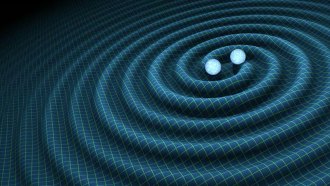
Albert Einstein predicted gravitational waves 100 years ago. Now scientists have detected them coming from the collision of two black holes.
- Physics
Explainer: What are gravitational waves?
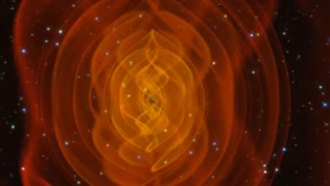
Albert Einstein had predicted that large catastrophes, like colliding black holes, should produce tiny ripples in the fabric of space. In 2016, scientists reported finally detecting them
- Physics
Einstein taught us: It’s all ‘relative’
One hundred years ago, a German physicist shared some math he had been working on. In short order, his theory of relativity would revise forever how people viewed the universe.
- Space
Pollution may give ‘first’ stars a youthful look
The oldest stars should be made of only light elements. But these suns may have sucked up heavier elements, giving them a more youthful appearance, a new study finds.
- Physics
Stephen Hawking says his group has solved a black hole puzzle
Physicist Stephen Hawking says light sliding along the outside of a black hole holds the key to understanding what’s inside.
- Planets
Pluto hosts ice mountains, data suggest
Geologic activity appears to have been reshaping Pluto, erasing craters and more.