Physics
- Physics
Einstein taught us: It’s all ‘relative’
One hundred years ago, a German physicist shared some math he had been working on. In short order, his theory of relativity would revise forever how people viewed the universe.
- Physics
Particles that zip through matter snare Nobel
Two scientists won the 2015 Nobel Prize in physics for their discovery that neutrinos, particles that can pass through almost all matter, have mass.
- Materials Science
Scientists Say: Kevlar
Many people hear Kevlar and think of body armor. But this polymer is in so much more.
- Animals
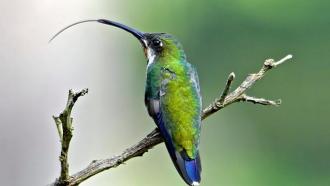
Hummingbird tongues may be tiny pumps
Scientists had thought that hummingbird tongues work through capillary action. A new study, though, concludes they work like little pumps.
- Physics
Scientists Say: Quantum
Quantum seems like a very complex word. But really, it’s a term used for something very, very small.
- Physics
Scientists Say: Viscosity
We know some liquids are thick and some are thin. This week’s word describes the property of these liquids to resist tension or pressure.
- Physics
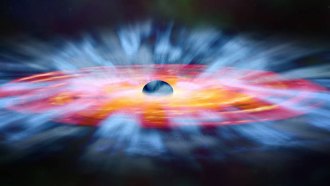
Stephen Hawking says his group has solved a black hole puzzle
Physicist Stephen Hawking says light sliding along the outside of a black hole holds the key to understanding what’s inside.
- Physics
Scientists Say: Torque
Some forces pull and some push. This force produces turning or twisting.
- Physics
Fade to black? The universe is in decline
One of the largest sky surveys ever made has found that the universe is in decline. And after losing even more energy over the next 100 billion years, it will be dark, empty and boring.
- Materials Science
Long-sought subatomic particle ‘seen’ at last
Physicists have finally caught a brief glimpse of massless subatomic particles that were first predicted to exist 85 years ago. It’s the elusive Weyl fermion.
- Microbes
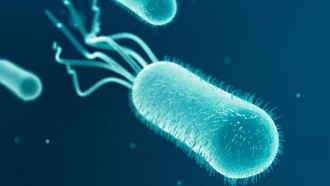
Bacteria help water effortlessly go with the flow
By adding bacteria to water, scientists were able to make a fluid flow with almost no resistance.
- Computing
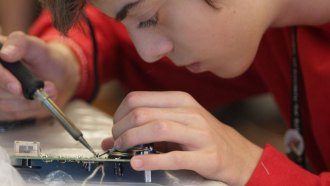
Radios: Build your own!
Building AM radios let young researchers from across the globe tune into electronics and engineering.