Physics
- Physics
Raindrops break the speed limit
Raindrops shouldn't be able fall faster than what is known as their terminal velocity. But no one told the rain. Researchers have found droplets breaking that speed limit.
- Physics
Escape from a lab-built black hole
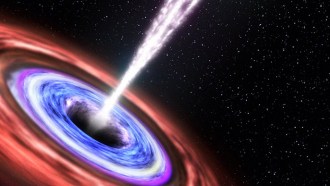
In the 1970s, physicist Stephen Hawking suggested that some particles could escape a black hole. An experiment now shows how, using a lab-made black hole ‘made’ from sound.
- Physics
How science saved the Eiffel Tower
The Eiffel Tower was an engineering masterpiece. But Parisians initially thought it too ugly to let stand for more than 20 years. So Eiffel made the tower a bastion of science. And that would soon ensure that the structure was too valuable to tear down.
- Chemistry
Sunlight might have put oxygen in Earth’s early air
High-energy bursts of ultraviolet light can break apart carbon dioxide, yielding oxygen gas. The experiment may mimic what happened on Earth billions of years ago.
- Physics
Nobel goes for creating the ‘nanoscope’
A regular microscope can’t bring into focus the nanoscale molecules from which cells are built. Using lasers and fluorescent molecules, three scientists found a way to view these tiny features. Their reward: the 2014 Nobel Prize in chemistry.
- Materials Science
Nobel goes for making white LEDs possible
The 2014 Nobel Prize in Physics has been awarded to scientists who discovered how to make blue light-emitting diodes. People really wanted white LEDs. The missing ingredient in making them was a building block: the blue LED.
- Tech
Repelling germs with ‘sharkskin’
A biotechnology company has found a way to repel superbugs without toxic chemicals. It mimics the texture of a shark’s skin.
- Climate
Where will lightning strike?
When lightning strikes, the results can be deadly. But nature’s dazzling light show also can provide scientists with insights into when and where the next thunderbolt might strike.
- Tech
Soaking up oil spills — with cotton
Natural, low-grade cotton could help clean up oil spills better than synthetic materials, a new study finds. And unlike synthetics, cotton breaks down naturally.
- Tech
Invisible plastic ‘ink’ foils counterfeiters
Hidden images make a new label virtually counterfeit-proof, thanks to a combination of chemistry and nanotechnology.
- Physics
Bracing sand sculptures with gravity
Natural sculptures of sandstone withstand strong winds and rains. The reason, a new study concludes: Gravity holds the sand grains together.
- Physics
Measure the width of your hair with a laser pointer
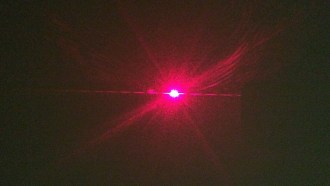
You can measure the width of a human hair with the help of a laser pointer, some math and a phenomenon called diffraction.