AI model: Short for artificial-intelligence model, it’s a particularly smart computer algorithm. Simple types of these models choose from a set of pre-selected to answer a user’s requests (perhaps to respond to a chat). More complex models may train on mountains of data to essentially figure out their own answers to potentially novel questions.
app: Short for application, or a computer program designed for a specific task.
bias: The tendency to hold a particular perspective or preference that favors some thing, some group or some choice. Scientists often “blind” subjects to the details of a test (don’t tell them what it is) so that their biases will not affect the results.
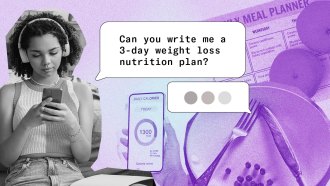
chatbot: A type of computer program known as a bot (web robot) that has been created to interact with people in a way that seems to model normal human conversation. The idea is that if they seem human-like enough, people should be more willing to "chat" with these computer programs or let them take on tasks previously handled only by people. Some chatbots can craft customized text, such as a letter or report. Others might ask or share information (by phone or online) on a company’s behalf. One drawback: They are susceptible to hallucinating — as in making up their answers — or telling people what the chatbot’s artificial-intelligence model thinks they want (even if this is not objectively healthy or true).
colleague: Someone who works with another; a co-worker or team member.
function: The specific role some structure or device plays.
model: A simulation of a real-world event (usually using a computer) that has been developed to predict one or more likely outcomes. Or an individual that is meant to display how something would work in or look on others.
policies: Plans, stated guidelines or agreed-upon rules of action to apply in certain specific circumstances. For instance, a school could have a policy on when to permit snow days or how many excused absences it would allow a student in a given year.
risk: The chance or mathematical likelihood that some bad thing might happen. For instance, exposure to radiation poses a risk of cancer. Or the hazard — or peril — itself. (For instance: Among cancer risks that the people faced were radiation and drinking water tainted with arsenic.)
social: (adj.) Relating to gatherings of people; a term for animals (or people) that prefer to exist in groups.
standardized test: A test that is administered and scored in the same way for all students and usually is given to large populations of students (not just to individual classes). Schools administer such tests in certain subjects regularly so that they can track how well their students are performing in those school subjects. The test may be given as a paper-and-pencil exam or on a computer.
subtle: Adjective for something that may be important, but can be hard to see or describe. For instance, the first cellular changes that signal the start of a cancer may be only subtly different — as in small and hard to distinguish from nearby healthy tissues.
unique: Something that is unlike anything else; the only one of its kind.