Uncategorized
- Ecosystems
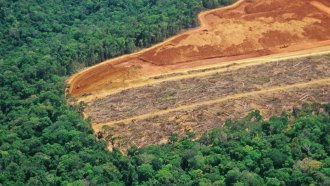
Can people protect as much space as nature needs?
To save biodiversity, nations are drafting a plan to protect 30 percent of Earth by 2030. Up for debate is how best to do that.
- Physics
What did you say? Fabric masks can really muffle voices
Some types of face masks muffle speech more than others — something that teachers should take into account.
- Agriculture
Honeybees fend off deadly hornets by decorating hives with poop
Bees usually collect pollen and nectar. Scientists were surprised to find that Asian honeybees also gather animal dung to defend their hives.
- Animals
Explainer: Insects, arachnids and other arthropods
Arthropods are all around us, but identifying them can be hard. To start, look at the four main groups: chelicera, crustaceans, myriapods and insects.
- Agriculture
Dew collector brings water to thirsty plants
This invention grabs water from the air at night. All it needs is the sun’s warmth the next day to release that moisture to growing plants.
- Chemistry
Scientists Say: Molecule
A molecule is a group of atoms linked with chemical bonds. It’s the smallest particle of a substance that has all of its chemical properties.
- Animals
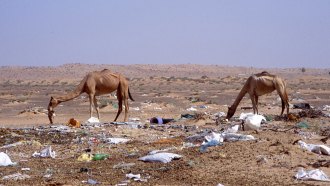
Camels have been dying after mistaking plastic for food
Plastic waste has been building up in the guts of some camels. It may now be killing off one percent of them in the United Arab Emirates each year.
- Archaeology
What the mummy’s curse reveals about your brain
A man died soon after opening a mummy’s tomb. But don’t assume the mummy killed him. Statistics help explain why coincidences may not be meaningful.
- Physics
Let’s learn about gravity
Gravity is an attraction between objects with mass. The more massive the object, the more gravity it’s got.
- Animals
Africa’s poisonous rats are surprisingly social
Scientists confirm that the African crested rat can safely cover itself in poison and also find that the rodents may live in pairs — or even family groups.
- Space
Our feverish universe is getting hotter every day
For the first time, astronomers have taken the temperature of the cosmos at different times in its history. Galaxy clusters are cranking up the heat.
-
Scientists Say: Respiration
Breathe in and out, that’s respiration. Have a cell break down sugars for energy, and that’s respiration too.