Massive underground lava tube found on Venus
This cave was discovered through a new look at 1990s data from an orbiting NASA probe
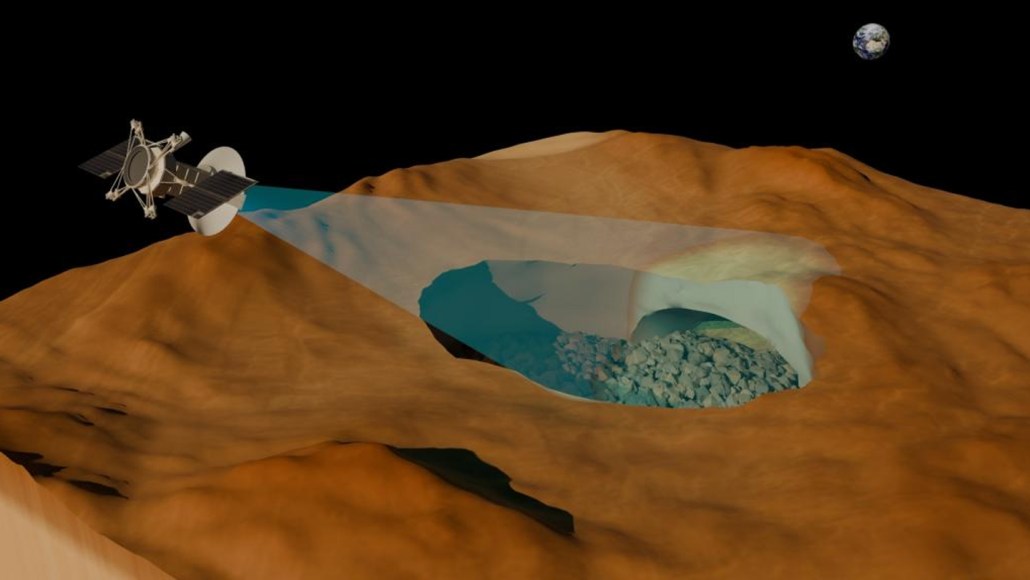
The collapsed roof of this lava tube was detected through a reanalysis of radar images taken by NASA’s Magellan probe in the 1990s.
RSLab/University of Trento
This is a human-written story voiced by AI. Got feedback? Take our survey . (See our AI policy here .)
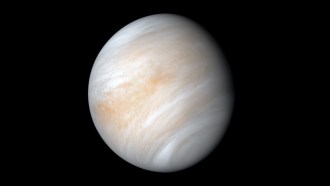
Venus, though hidden from view by dense clouds, is slowly giving up some of its secrets. One of them is a lava tube beneath its surface.
This type of cave forms from the flow of molten lava. Once that lava drains away, an underground tunnel remains. This is the first lava tube detected on Venus. Scientists discovered it by taking a fresh look at radar images of the planet. They’d been captured by a NASA spacecraft in the early 1990s.
The data revealed a collapsed “skylight” — a hole where the roof of the lava tube had caved in. Researchers shared the finding February 9 in Nature Communications.
Venus has been called Earth’s “sister planet.” It’s relatively nearby and almost the same size. But clouds shield its surface from view.
In the 1990s, NASA’s Magellan probe mapped that surface. Analyses of those maps have been revealing a landscape shaped by active volcanoes. But despite signs of this morphing surface, there’s little sign that Venus ever had plate tectonics.
The newest discovery will influence two future probes. NASA plans to launch its VERITAS mission before June 2031. The European Space Agency expects to launch its EnVision mission later that year.
Both spacecraft will carry advanced radar instruments. They’ll be able to get images of the surface of Venus “at significantly higher resolution” than is now available, says Lorenzo Bruzzone. A remote-sensing scientist, he works at the University of Trento in Italy. He also is one of the new study’s authors.
Old maps, new insights
Magellan’s maps are still the best scientists have of Venus. So Bruzzone and his team reanalyzed the decades-old data with special imaging techniques. They were scouting for those telltale skylights to hint that a lava tube was below.
Their search turned up a skylight near a massive flat, broad volcano called Nyx Mons. (Named for the ancient Greek night goddess, its name in Latin means “Mountain of Nyx.”)
Further analysis would show that this collapsed skylight was about 150 meters (490 feet) deep. It opened into an empty lava tube at least 375 meters (1,230 feet) deep.
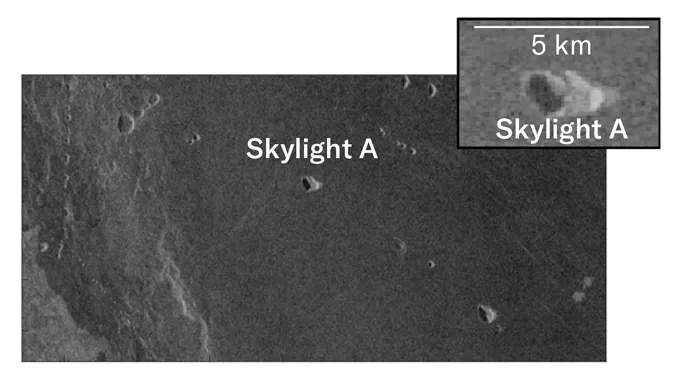
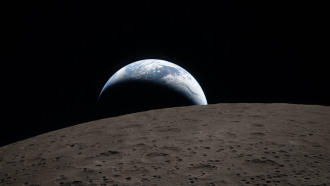
The researchers estimate the lava tube may be much, much broader — up to one kilometer (0.6 mile) wide. That’s larger than any lava tube found on Earth or Mars. It’s the size of some seen on Earth’s moon, where the gravity is much lower. Lower gravity makes it easier for large lava tubes to form. So here’s a new mystery: Why would those on Venus be so big when its gravity is similar to Earth’s?
And finding one lava tube on Venus suggests there could be more, Bruzzone says.
Lava tubes on the moon might one day be shelters for astronauts. They could protect humans from solar radiation and meteorites. Lava tubes also show up on Mars. But people will likely never visit the Nyx Mons lava tube. The pressure of the atmosphere there, at the surface of Venus, is 93 times greater than on Earth. And temps at the surface are so hot that regular silicon-based electronics wouldn’t work.
“It is remarkable that we are still extracting new insights from Magellan data,” says Anna Gülcher. She’s a planetary scientist at Germany’s University of Freiburg. She wasn’t part of the new work but, like Bruzzone, she studies how volcanoes are shaping Venus.
New insights from Magellan data, she says, point to “the lasting value of that mission, the progress we have made in data analysis and the renewed interest in the planet.”
Do you have a science question? We can help!
Submit your question here, and we might answer it an upcoming issue of Science News Explores