Beware the vipers: These snakes appear to strike the fastest
But they’re not the only ones that can attack amazingly fast
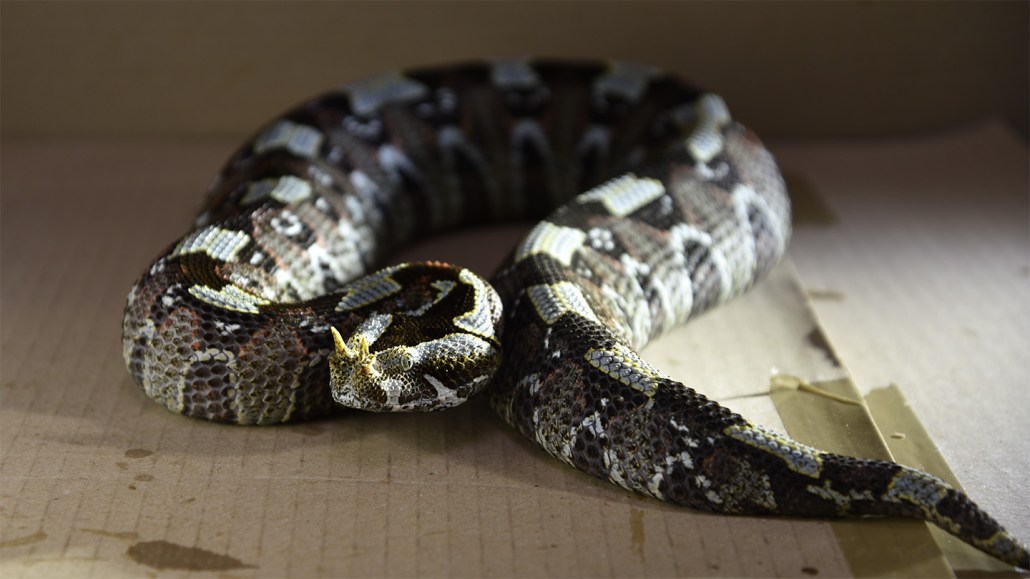
This rhino viper is shown ready-to-strike. Cameras filmed the snake striking at fake prey. They clocked its average peak strike velocity at 3.2 meters per second (10.5 feet per second).
Silke Cleuren
Share this:
- Share via email (Opens in new window) Email
- Share on Facebook (Opens in new window) Facebook
- Share on X (Opens in new window) X
- Share on Pinterest (Opens in new window) Pinterest
- Share on Reddit (Opens in new window) Reddit
- Share to Google Classroom (Opens in new window) Google Classroom
- Print (Opens in new window) Print
Some vipers are the sprinters of snakes.
Researchers compared 36 venomous snakes from three families. Vipers wielded the fastest attacks. Some members of one of the other families could give slower vipers stiff competition.
Scientists shared the new findings October 23 in the Journal of Experimental Biology.
The quickest snakes tend to be ambush predators. The true speed demon: terciopelo (Bothrops asper). This pit viper, also known as the fer-de-lance, feeds on birds and mammals. It can be found slithering from eastern Mexico to northern South America. To catch birds and rodents, its attack had an average strike velocity of 3.5 meters per second (11.5 feet per second).
Mammals, key prey for these big snakes, typically take only 60 to 400 milliseconds to react and jump away. This makes strike speed crucial for a snake to catch its meal. Considering what these vipers eat, these snakes “are the ones that have to be able to strike as quickly as possible,” points out Alistair Evans. A zoologist, he works at Monash University in Melbourne, Australia.
Large snakes also tend to be faster. Why? Like sprinters, they have more muscle.
Previous studies that analyzed snake speed typically relied on a single camera or one with low resolution. Others focused on just a few snake species. The new study included 31 vipers. Also included were four non-vipers from the family that includes cobras and one venomous snake from the colubrid family, which includes mostly nonvenomous species (such as the common garter snake).
Evans and his team used two high-speed cameras to track snakes housed at Venomworld. This facility in Paris, France, collects venom for medical and research uses. The researchers coaxed each snake to lunge at fake prey. It was made of a warm gel that mimics muscle tissue.
The fastest vipers included the terciopelo, the horned pit viper and the blunt-nosed viper. These species had maximum speeds that exceeded 3.3 meters per second (10.8 feet per second).
The rough-scaled death adder was the fastest non-viper tested. It can jab toward prey at 2.2 meters per second (7.2 feet per second). This is roughly the same strike speed as some vipers, including the eastern rock rattlesnake. The mangrove snake, the only venomous colubrid tested, was slightly slower. It struck at roughly 1.8 meters per second (5.9 feet per second).
The cameras also captured differences in how snakes bite. Vipers deliver venom with smooth, fast strikes. Some of the other venomous snakes bit and squeezed their prey multiple times. Another used its fangs to slash large wounds in its victim.
Because Venomworld houses mostly vipers, the new study focused on those snakes. But many snake species weren’t tested. Hiding among them, Evans says, could be snakes that give might some quick vipers a run for the money.