Analyze This: Primates may have evolved in the cold
Surprisingly, the earliest relative of humans, apes and monkeys might not have lived in the tropics
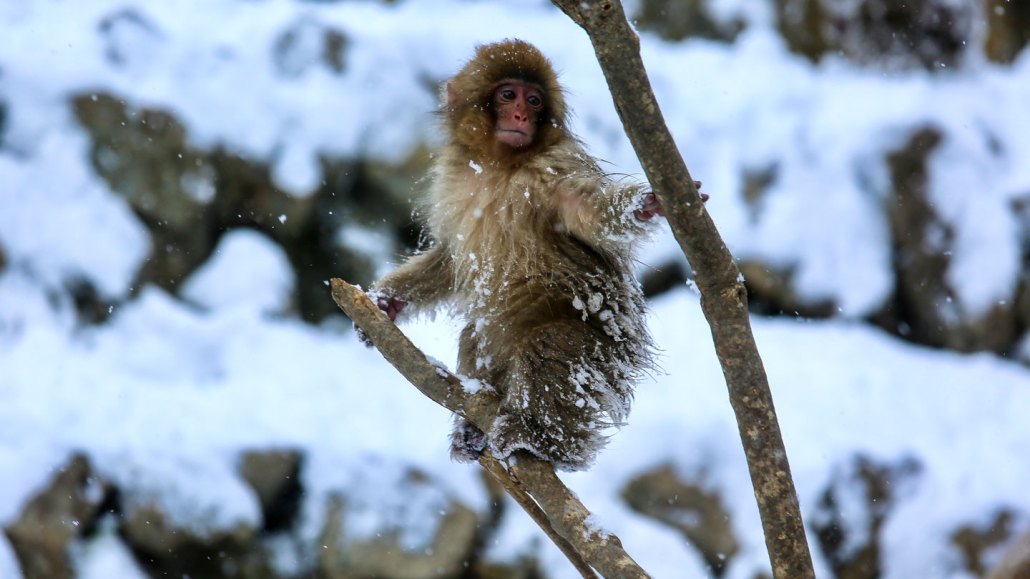
Today, primates, including monkeys and apes, are more common in the hot, humid tropics. That’s led people to think that primates evolved in such places. But some primates live in cold places, including these macaques that dwell in snowy areas of Japan.
Nial Fulton/500px/Getty Images
This is a human-written story voiced by AI. Got feedback? Take our survey . (See our AI policy here .)
Crack open a book on primates — the group that includes humans, apes, monkeys and lemurs — and you’ll likely read that these creatures evolved in hot, humid places. This old idea appears again and again, everywhere from scientific papers to YouTube videos. But a new study suggests that primates actually evolved somewhere cold.
People had a couple of reasons to suspect primates got their start in the tropics. For one thing, many species of primates today live only in tropical forests. For another, most primates have thumbs that can grasp things. That would be handy for climbing trees, hinting these animals’ ancestors may have lived in forests.
But fossils tell a different story. “Most of the fossils of primates have been found not in the tropical regions,” says Jorge Avaria-Llautureo. He’s an evolutionary biologist at the University of Reading in England. Most fossils of ancient primates are found in parts of North America, Europe and Asia that weren’t warm and rainy when the animals evolved.
Avaria-Llautureo and his colleagues dug into the huge evolutionary family tree of primates. This tree shows how different species were related and where they split off from each other. That allowed the team to figure out where the ancestors of various primate species would have lived based on locations of their descendants’ fossils. The researchers worked their way back to find where the common ancestor of all primates lived.
The scientists then used computer models to see what different places on Earth were like in the past. In particular, they looked at what type of climate existed in each place they found that primates had evolved. It was a diverse mix of climates. That’s not what you’d expect to see if ancient primates lived only in the tropics, Avaria-Llautureo says.
The first primate, which evolved 66 million years ago, most likely lived in a cold climate. “This is the most controversial result,” Avaria-Llautureo says. The team found that primates likely originated in North America and spread from there across the world. Only some 20 million years later did primates really take off in the tropics.
The findings appeared August 5 in Proceedings of the National Academy of Sciences.
At first, Avaria-Llautureo and his colleagues didn’t believe what they found. But they did many tests to see whether their results held up. “In the end, when we were sure about it, it was very exciting,” he says. But that doesn’t mean that this is the last word on where primates evolved. It’s possible future studies will turn up new ideas. “There is no final answer in science.”
Primate Places
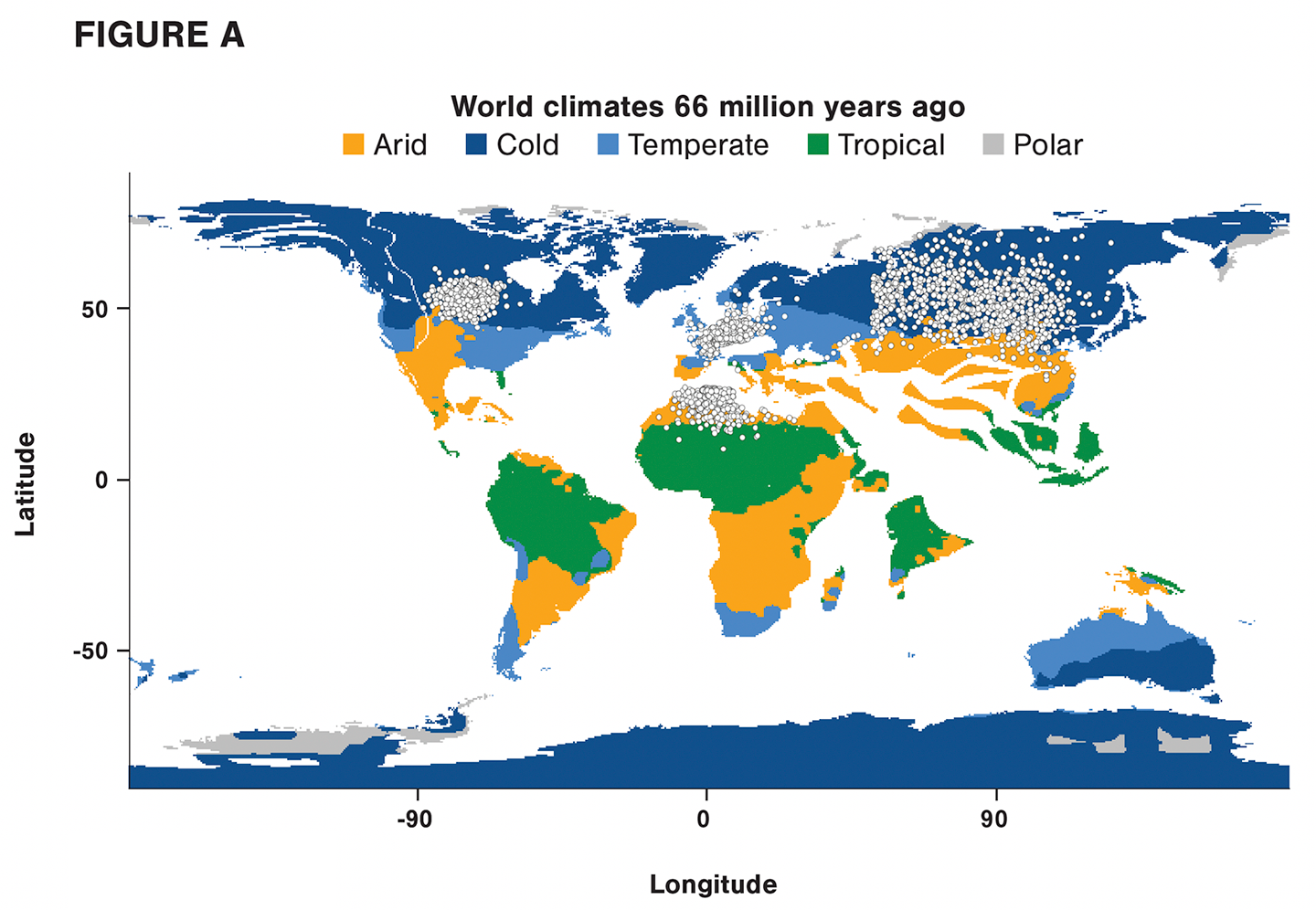
By looking at where fossils of primates have been found, researchers worked out where their ancestors would have lived. They went back all the way to the common ancestor of all primates. They found all possible locations for the common ancestor (white dots in Figure A). Models showed what the climate would have been at these locations 66 million years ago, when the first primate evolved.
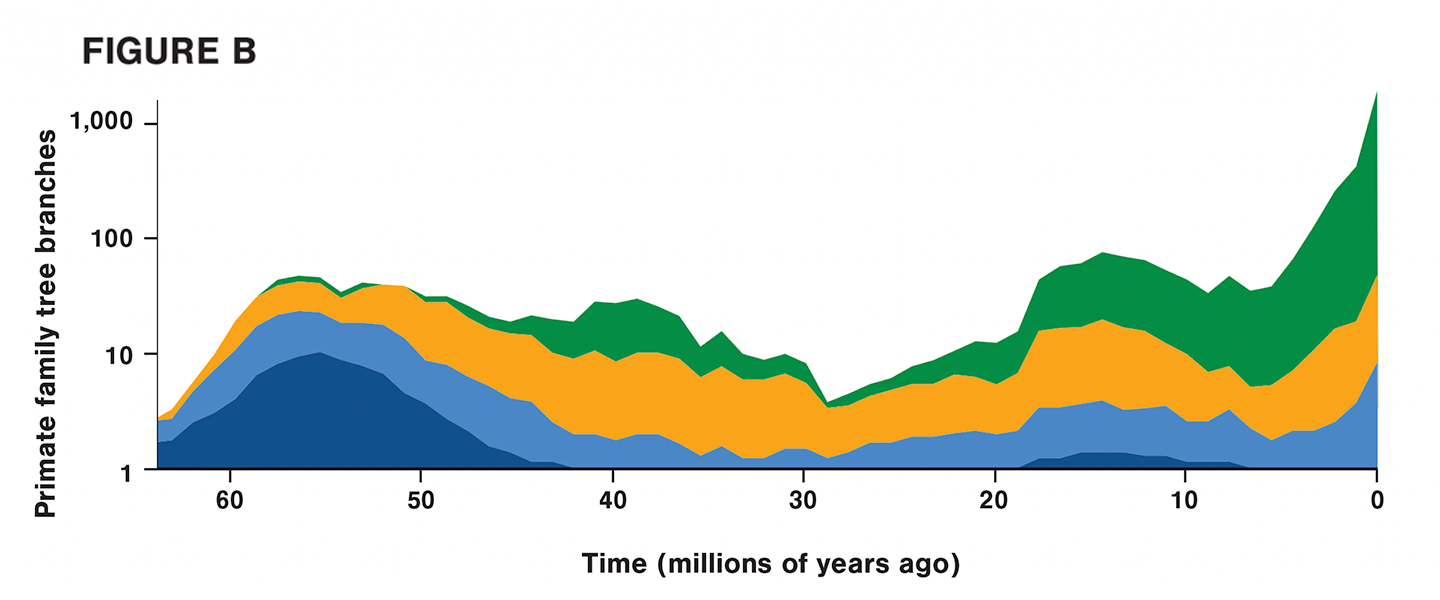
The analysis also showed how primates have spread across different types of climates since they evolved (Figure B). The value on the y-axis is the average value over a 1 million-year-period centered around the time on the x-axis. At each point along the timeline, the wider a color band is, the more branches of the primate family tree lived in that climate.
Data dive:
- Look at Figure A. What four continents have a high density of possible locations for primates’ common ancestor?
- Look at the locations where dots are clustered. What type of climate existed at each location 66 million years ago?
- Look at Figure B. How many primate family tree branches were there 66 million years ago? How are they spread between different types of environments?
- When do primates first appear in tropical environments?
- During which time periods were primates not living in cold environments?
- When do primate groups begin to live in mostly tropical areas?