Watch the first sperm whale birth caught on video by scientists
The whole whale community is seen lending a hand — even members unrelated to the mother
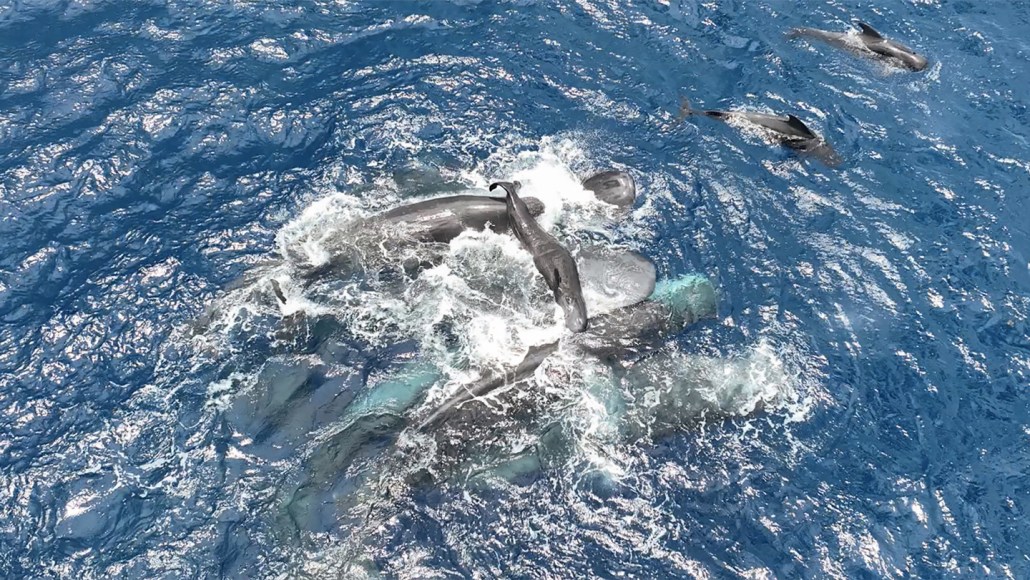
Adult sperm whales hold a newborn calf above water until it can swim on its own.
Project CETI
Share this:
- Share via email (Opens in new window) Email
- Share on Facebook (Opens in new window) Facebook
- Share on X (Opens in new window) X
- Share on Pinterest (Opens in new window) Pinterest
- Share on Reddit (Opens in new window) Reddit
- Share to Google Classroom (Opens in new window) Google Classroom
- Print (Opens in new window) Print
By Lily Burton
This is a human-written story voiced by AI. Got feedback? Take our survey . (See our AI policy here .)
It takes a village to deliver a whale calf. That’s what the most detailed video ever of a sperm whale birth shows.
In the footage, a female whale in labor is surrounded by others assisting her. Almost all of her helpers are female. But not all are related to the birthing mom. This shows that sperm whales benefit from cooperation, just as humans do.
Because getting to watch the birth of a whale is extremely rare, only a few scientific studies have described them. Some of those reports have noted other whales helping the mom through the birthing process. But scientists had never caught this on video.
In 2023, David Gruber was part of a team that got very lucky. Gruber is a marine biologist. He works with Project CETI, a nonprofit dedicated to sperm whale research. Project CETI is partly based on the island of Dominica in the Caribbean Sea. Gruber was in a boat right off the coast when his team caught the birth.
The researchers weren’t looking for a whale birth. They just happened to be in the right place, at the right time — with the right equipment. Using two drones, the team caught the whole 34-minute birthing process on tape.
A group of 10 whales surrounded the laboring mom. After the birth, her assistants took turns lifting the newborn to the surface for hours. This allowed the calf to breathe air until it could swim on its own.
The whales seemed to include the scientists in this event, Gruber says. “They literally carried the baby right past the front of our boat.” His group shared its video in Science on March 26.
Helping hands — or fins
Project CETI has been studying sperm whales around Dominica for long enough that Gruber and his colleagues could identify every individual in the video. “Not only did we capture such an amazing dataset, but we actually knew each of these whales,” he says.
Computers tracked each whale’s position in the footage. Then, a team member labeled each animal. A whale named Rounder was giving birth, the researchers determined. They also figured out what each of the other 10 whales did and how they were related to the mom.
Rounder’s helpers included whales from two different female lines. These are like whale families, also called kin groups. The kin groups’ teamwork was surprising, because these groups don’t usually spend time together searching for food. But whales from the two groups fully mixed for hours after the birth. All helped lift the newborn calf at some point.
The four whales that helped hold the calf the most were its mother, aunt, an older kin member and one whale from outside the calf’s kin group. Holding the baby up is very important, because it can’t float on its own yet. Without help, Gruber says, “it would have sunk.”
Killer whales, belugas and other cetaceans have also been seen pushing newborns to the surface. This behavior may go back to when those species shared a common ancestor, Gruber says.
The wails of labor
Along with the video, the researchers also recorded audio of the birth. They analyzed these sounds with help from some other researchers.
Sperm whales make sounds called codas. The scientists looked for changes in things like the codas’ rhythm. Those codas changed during important moments in the birth. One specific coda was heard more frequently during the birth. The team reported its findings March 26 in Scientific Reports.
Different sounds being linked with the birth is not surprising, says Denise Herzing. She’s a marine biologist who heads the Wild Dolphin Project. Based in Jupiter, Fla., this nonprofit focuses on Atlantic spotted dolphins.
“Marine mammals, in general, have specific sounds during specific behavioral contexts,” says Herzing.
After the birth, the sperm whales also ran into several pilot whales. Now, the sperm whales’ vocal style changed more. That might be because pilot whales sometimes bother sperm whales.
It takes a village
Giving birth is one of the most critical moments of a female whale’s life. Such high stakes might have driven these mammals to evolve cooperative instincts, the researchers say.
This is spot on, Herzing says. “We see different alliances of dolphins grouping into bigger groups to fight off a predator or to mate.”
Sharing the birth with the world took cooperation from the human team, too. Many scientists had to work together to film the video, analyze it and map the relationships between the whales. “It was a very profound experience for all of us,” says Gruber.