Here’s how ‘singing’ mice belt out their tiny tunes
Balloon-like air sacs in their throats create music longer and faster than any other rodent call
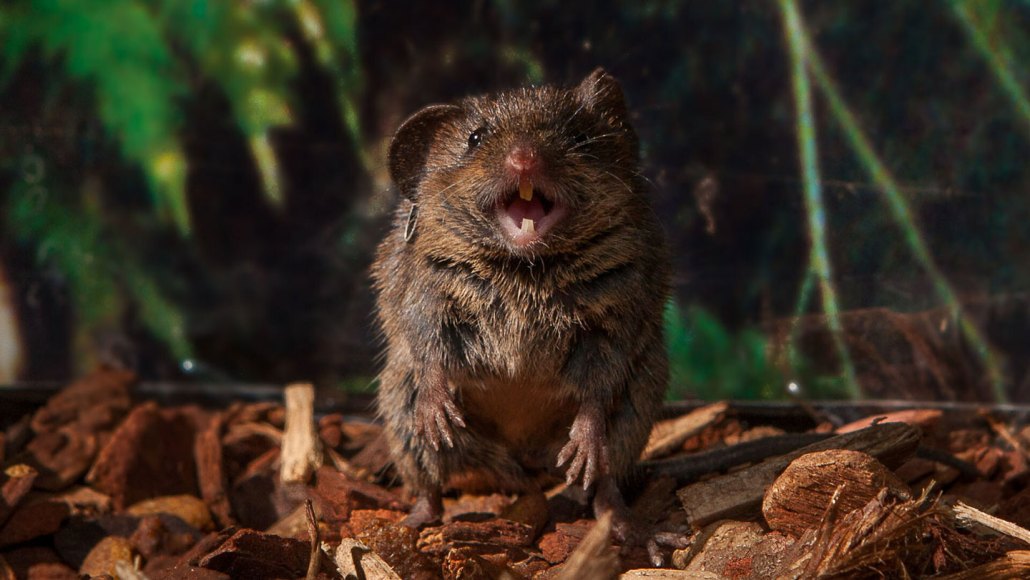
Singing mice (one shown) use inflatable sacs in their airways to create dramatic, whistling tunes.
Cold Spring Harbor Laboratory
Share this:
- Share via email (Opens in new window) Email
- Share on Facebook (Opens in new window) Facebook
- Share on X (Opens in new window) X
- Share on Pinterest (Opens in new window) Pinterest
- Share on Reddit (Opens in new window) Reddit
- Share to Google Classroom (Opens in new window) Google Classroom
- Print (Opens in new window) Print
By Jake Buehler
This is a human-written story voiced by AI. Got feedback? Take our survey . (See our AI policy here .)
Disney’s Cinderella is not the only place you can hear mice “sing.” Some real-world rodents also serenade each other. And now, scientists know how. The mice inflate tiny, balloon-like sacs in their airways. This creates whistling tunes.
Making music this way may be unique in the animal kingdom.
The critters are known as Alston’s singing mice. Found in the forests of Mexico and Central America, they truly live up to their name. Both males and females communicate with trains of high-pitched notes. Remarkably, their songs are more complex than those of any other rodent.
In just a 10-second song, an Alston’s singing mouse belts out around 100 individual breaths and notes. The melody attracts mates and warns rival males to stay away, says Samantha Smith. The song’s speed and length make it far more “extreme” than other rodents’ calls, she adds. Smith is a biologist at the University of Lausanne. That’s in Switzerland.
Smith is part of a team that wanted to know how the vocal systems of Alston’s singing mice evolved to create melodies. They started by dissecting the larynges of deceased animals. This “voice box” is a part of their bodies that helps mice (and us) breathe, swallow and make sound.
The researchers hooked each excised mouse voice box to a tube. Then, they pointed a microphone and camera toward its top. “A [voice box] is basically just a tube with a valve in it that can open and close,” explains Smith. To see how the voice box moved and produced sound, the team blew air through the tube.
Sometimes, the voice box produced sounds that ranged in the mouse’s natural pitch. But this happened only when a pouch on the inside of the voice box was inflated. When the researchers blocked this balloon with bits of wax or small metal balls, the voice box went silent. Cutting the sac had the same effect. The air sac, it seemed, is key to making the songs.
Other rodents have air sacs, but they don’t appear to use them to sing.
Smith and her teammates shared their findings May 6 in Proceedings of the Royal Society B.
A unique musical talent
Raffaela Lesch is impressed by the team’s experiment and its choice of species. She works at the University of Arkansas at Little Rock. As a bioacoustician, she studies how animals use sound to communicate.
“Working with [voice boxes] this small is not an easy task,” she says. But for Lesch, learning more about how rodents produce sound is exciting. They’re “such a diverse group with such fascinating social, behavioral and ecological adaptions,” she says.
It’s not yet clear how the sac generates its whistle. The sound could come from air vibrating at the sac’s entrance. That would be similar to the way opening a car’s sunroof can make noise as air rushes past the opening.
Do you have a science question? We can help!
Submit your question here, and we might answer it an upcoming issue of Science News Explores
Another possibility is a bit like how flutes and organ pipes work. A sharp cartilage rim at the sac’s entrance may be deflecting air, producing the tone.
Inflatable sacs in airways have evolved multiple times. Primates, birds, reptiles, frogs and other animals have them. But in those cases, air sacs alter or amplify sound produced elsewhere in the respiratory tract. (That’s the system of organs that are involved in breathing.) The songs of the singing mice, on the other hand, are made by the sacs themselves.
“Our study expands our understanding of the ways in which [air sacs] can shape vocal communication,” Smith says. Studying different features of rodent air sacs may help reveal how these songs first evolved — no Disney magic needed.