3-D: Short for three-dimensional. This term is an adjective for something that has features that can be described in three dimensions — height, width and length.
air pressure: The force exerted by the weight of air molecules.
atmosphere: The envelope of gases surrounding Earth, another planet or a moon.
atmospheric pressure: The pressure exerted by the weight of the atmosphere.
carbon: A chemical element that is the physical basis of all life on Earth. Carbon exists freely as graphite and diamond. It is an important part of coal, limestone and petroleum, and is capable of self-bonding, chemically, to form an enormous number of chemically, biologically and commercially important molecules.
carbon dioxide: (or CO2) A colorless, odorless gas produced by all animals when the oxygen they inhale reacts with the carbon-rich foods that they’ve eaten. Carbon dioxide also is released when organic matter burns (including fossil fuels like oil or gas). Carbon dioxide acts as a greenhouse gas, trapping heat in Earth’s atmosphere. Plants convert carbon dioxide into oxygen during photosynthesis, the process they use to make their own food.
chemical: A substance formed from two or more atoms that unite (bond) in a fixed proportion and structure. For example, water is a chemical made when two hydrogen atoms bond to one oxygen atom. Its chemical formula is H2O. Chemical also can be an adjective to describe properties of materials that are the result of various reactions between different compounds.
climate: The weather conditions that typically exist in one area, in general, or over a long period.
corrosive: An adjective for something that can weaken, erode or damage materials (usually metal or rock) gradually as a result of chemical reactions.
data: Facts and/or statistics collected together for analysis but not necessarily organized in a way that gives them meaning. For digital information (the type stored by computers), those data typically are numbers stored in a binary code, portrayed as strings of zeros and ones.
geological: Adjective to describe things related to Earth’s physical structure and substance, its history and the processes that act on it. People who work in this field are known as geologists.
geology: The study of Earth’s physical structure and substance, its history and the processes that act on it. People who work in this field are known as geologists. Planetary geology is the science of studying the same things about other planets.
global warming: The gradual increase in the overall temperature of Earth’s atmosphere due to the greenhouse effect. This effect is caused by increased levels of carbon dioxide, chlorofluorocarbons and other gases in the air, many of them released by human activity.
greenhouse effect: The warming of Earth’s atmosphere due to the buildup of heat-trapping gases, such as carbon dioxide and methane. Scientists refer to these pollutants as greenhouse gases. The greenhouse effect also can occur in smaller environments. For instance, when cars are left in the sun, the incoming sunlight turns to heat, becomes trapped inside and quickly can make the indoor temperature a health risk.
lava: Molten rock that comes up from the mantle, through Earth’s crust, and out of a volcano.
lightning: A flash of light triggered by the discharge of electricity that occurs between clouds or between a cloud and something on Earth’s surface. The electrical current can cause a flash heating of the air, which can create a sharp crack of thunder.
meteor: (adj. meteoritic) A lump of rock or metal from space that hits the atmosphere of Earth. In space it is known as a meteoroid. When you see it in the sky it is a meteor. And when it hits the ground it is called a meteorite.
moon: The natural satellite of any planet.
NASA: Short for the National Aeronautics and Space Administration. Created in 1958, this U.S. agency has become a leader in space research and in stimulating public interest in space exploration. It was through NASA that the United States sent people into orbit and ultimately to the moon. It also has sent research craft to study planets and other celestial objects in our solar system.
orbit: The curved path of a celestial object or spacecraft around a galaxy, star, planet or moon. One complete circuit around a celestial body.
planet: A large celestial object that orbits a star but unlike a star does not generate any visible light.
plate tectonics: The processes governing the movements of massive pieces that make up Earth’s outer layer, which is called the lithosphere. Those processes cause the rock masses to rise from inside Earth, travel along its surface, and sink back down.
pressure: Force applied uniformly over a surface, measured as force per unit of area.
radar: A system for calculating the position, distance or other important characteristic of a distant object. It works by sending out periodic radio waves that bounce off of the object and then measuring how long it takes that bounced signal to return. Radar can detect moving objects, like airplanes. It also can be used to map the shape of land — even land covered by ice.
simulator: A device that attempts to mimic the form or function of something. A flight simulator, helps airline pilots practice flying from the safety of a cockpit on the ground. Computers display what the pilot would see on the dials and out of the windows in reaction to each action he or she takes.
society: An integrated group of people or animals that generally cooperate and support one another for the greater good of them all.
solar system: The eight major planets and their moons in orbit around our sun, together with smaller bodies in the form of dwarf planets, asteroids, meteoroids and comets.
sulfuric acid: A strong acid having the chemical formula H 2 SO 4 . Used as a drain cleaner and in lead-acid car batteries, the liquid is able to burn tissues and eat through metals and even rock.
sun: The star at the center of Earth’s solar system. It is about 27,000 light-years from the center of the Milky Way galaxy. Also a term for any sunlike star.
survey: To view, examine, measure or evaluate something, often land or broad aspects of a landscape.
tectonic: Surface activity on a large rocky body (such as a planet or moon) as liquid rock flows up to the surface where it solidifies, then slowly drifts atop molten rock, carrying surface features with it.
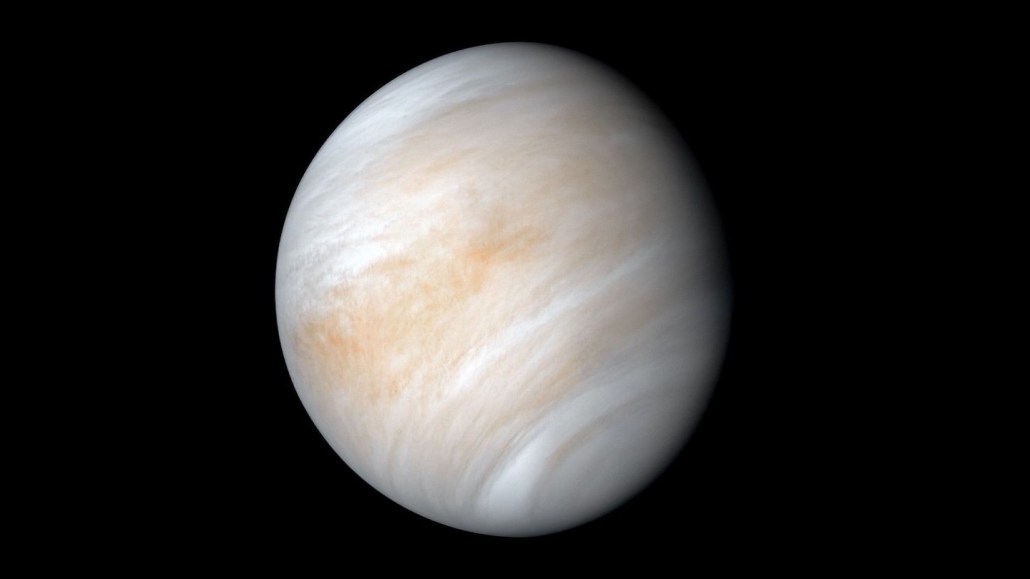
Venus: The second planet out from the sun. Just as Earth does, it has an iron core and a rocky mantle and crust. Volcanoes on the planet’s surface spewed high levels of carbon dioxide, which built up in the planet’s atmosphere. Today the air pressure at the planet’s surface is 100 times greater than on Earth, and the atmosphere now keeps the surface of Venus a brutal 460° Celsius (860° Fahrenheit).
volcanism: The processes by which volcanoes form and change over time. Scientists who study this are known as volcanologists and their field of science is known as volcanology.
volcano: A place on Earth’s crust that opens, allowing magma and gases to spew out from underground reservoirs of molten material. The magma rises through a system of pipes or channels, sometimes spending time in chambers where it bubbles with gas and undergoes chemical transformations. This plumbing system can become more complex over time. This can result in a change, over time, to the chemical composition of the lava as well. The surface around a volcano’s opening can grow into a mound or cone shape as successive eruptions send more lava onto the surface, where it cools into hard rock.