Questions for ‘Here’s why ammolite gems have a rainbow shimmer’
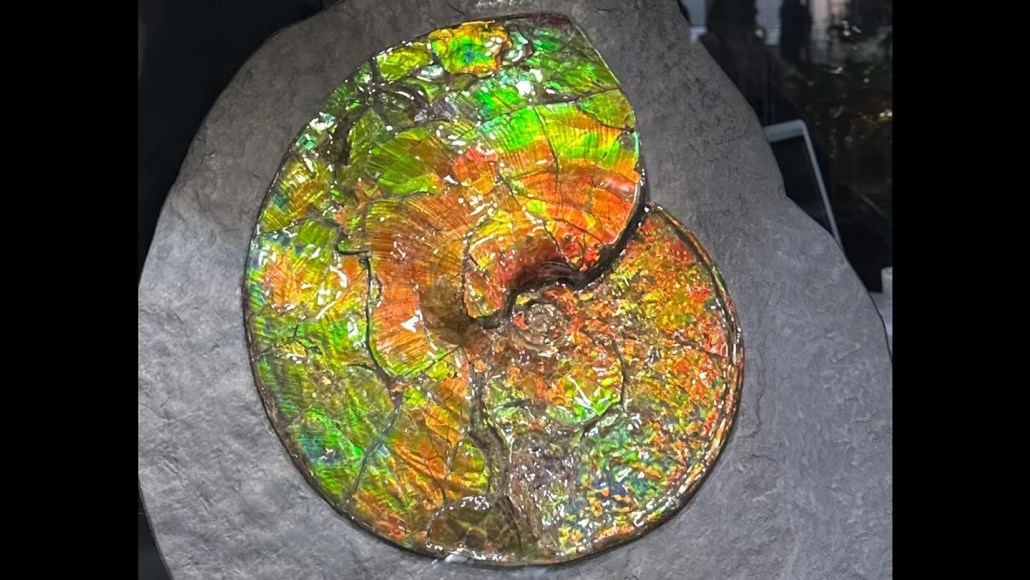
Ammolite gems are some pretty fabulous fossils. They sport a rainbow flair that comes from tiny features in their crystal plates.
H. Imai
Share this:
- Share via email (Opens in new window) Email
- Share on Facebook (Opens in new window) Facebook
- Share on X (Opens in new window) X
- Share on Pinterest (Opens in new window) Pinterest
- Share on Reddit (Opens in new window) Reddit
- Share to Google Classroom (Opens in new window) Google Classroom
- Print (Opens in new window) Print
To accompany “Here’s why ammolite gems have a rainbow shimmer”
SCIENCE
Before Reading:
- Start with a blank sheet of paper. Sketch a simple, side view of two evenly shaped sets of waves, one across the top of a sheet of paper, the other across the bottom. Make the first set of waves short and choppy waves. Make the second set long waves. Ensure that for each set, the waves extend the full length of the paper. Next, consider these two words: wavelength and frequency. Scientists use these words to describe characteristics of waves. Draw a star next to the set of waves that has longer lengths of waves, or longer wavelengths. Then, draw a square next to the set whose waves exhibit a higher frequency. Think of frequency as the number of waves occurring per unit of time. Finally, describe the relationship between wavelength and frequency. For a given set of waves, as the wavelength increases, what happens to the frequency of the waves per unit of time?
- The electromagnetic spectrum depicts the wavelengths of light and organizes them into categories. For instance, light detectable to the human eye is called “visible light.” Within the range of visible light, how does the human eye interpret different wavelengths?
During Reading:
- What “mystery” about ammolites had puzzled scientists until now?
- What is the common name for the material known as nacre?
- Describe how the “crystal plate” structure of ammolite compares with other nacre-containing fossils.
- How does the thickness of those crystal plates affect the ammolite’s appearance?
- Describe the major difference between the structure of ammolite versus other nacres that makes ammolite more vibrant. How did scientists discover this?
- What causes the unique structure of ammolite? Why is a 4-nanometer gap important?
- Review graphs (a) – (c) in the Science News Explores version of the article. What does the x-axis (or horizontal axis) represent? What does the y-axis (or vertical axis) represent?
After Reading:
- Consider graphs (a) – (c) in the Science News Explores version of the article. In one sentence, state what sets ammolite apart from the other materials, based on these graphs. Then, describe how the appearance of the lines in the graphs shows this difference.
- Use what you’ve learned reading this story to create a graph for an imaginary material that appears consistently blue-green, with no trace of red. Be sure to use units and label your x- and y-axes.