Questions for ‘Microbes that dwell in tree bark devour major climate gases’
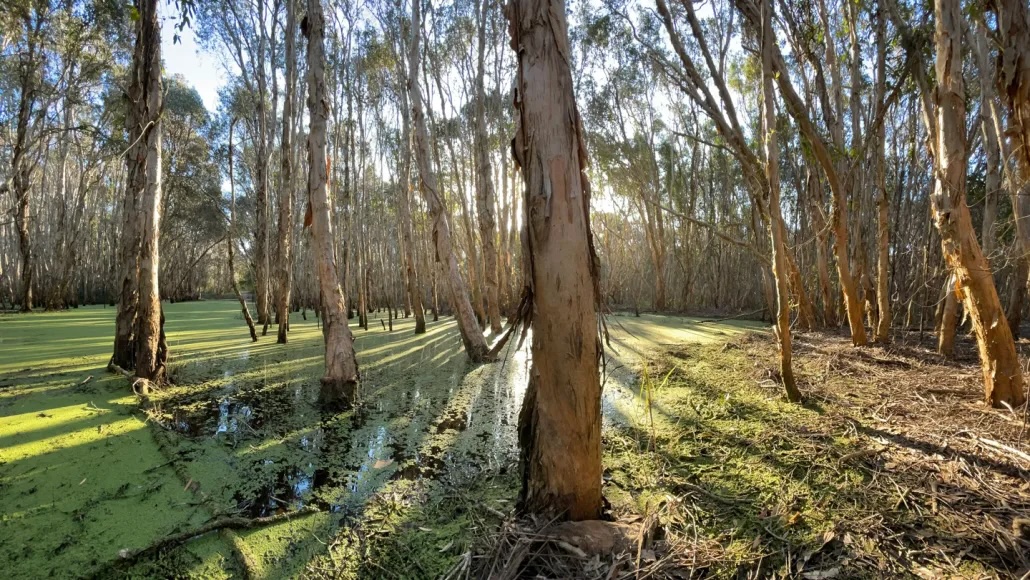
Wetlands, like the one seen here, are a major source of atmosphere-warming methane. Microbes living in tree bark consume this gas, providing an important climate benefit.
L. Jeffrey
Share this:
- Share via email (Opens in new window) Email
- Share on Facebook (Opens in new window) Facebook
- Share on X (Opens in new window) X
- Share on Pinterest (Opens in new window) Pinterest
- Share on Reddit (Opens in new window) Reddit
- Share to Google Classroom (Opens in new window) Google Classroom
- Print (Opens in new window) Print
To accompany ‘Microbes that dwell in tree bark devour major climate gases‘
SCIENCE
Before Reading:
- Do trees overall tend to worsen global warming or help keep about where it is? Explain, to the best of your understanding, the role that trees play in global warming.
- Imagine trying to fill a leaky, hole-ridden bucket with water. You put this bucket under a faucet and turn on the spigot. This system — the bucket, the surroundings and the faucet — could technically achieve a balanced state. Scientists might call this state a “dynamic equilibrium.” Dynamic equilibrium means that, despite the bucket losing water (through leaks) and gaining water (from the faucet), the overall state (the volume of water in the bucket) remains the same. Imagine you want to keep the bucket at half full. What is one way that you might achieve a state of dynamic equilibrium?
During Reading:
- Besides methane and carbon dioxide, list two gases mentioned in this article that are implicated in global warming.
- Contrast the potency of methane as a greenhouse gas to carbon dioxide, as measured over a 100-year period.
- About how many trillions of microbes inhabit 2 square meters of typical tree bark?
- What is one major natural source of methane?
- An Australian study found that only 35 percent of methane entering a tree “from below” is actually emitted into the atmosphere. Explain the importance of this finding.
- What were the most common gases that microbes living in paper bark trees and other common Australian tree species dined on (oxidized)?
- What is the estimated amount of methane being consumed by tree-bark microbes? (Hint: Give your answer as a range, using millions of tons of methane as your unit.)
- Why does this new study strengthen the argument that planting more trees can help combat climate change?
After Reading:
- Chemists represent methane gas as CH4. This means that every molecule of methane consists of one atom of carbon and 4 atoms of hydrogen. Carbon makes up 75 percent of methane’s mass. Refer back to the estimated impact of tree-bark microbes on removing global methane before it can get into the air. Use the low estimate value to calculate how much pure carbon is involved in this exchange. Explain how you arrived at your answer.
- Refer to your answer to Question 2 in Before Reading. Explain how this bucket might serve as an analogy for methane’s movement into or out of Earth’s atmosphere. Consider what you know about climate change. How accurate is it to describe Earth’s carbon movement into or out of the atmosphere as a state of dynamic equilibrium? Explain your answer.