Earth
- Earth
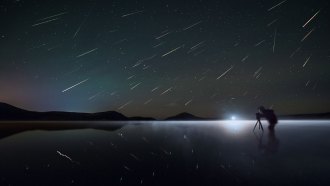
Let’s learn about meteor showers
Meteor showers happen when Earth’s orbit passes through trails of debris left behind by comets or asteroids.
- Earth
Scientists Say: Magma and lava
The word magma refers to molten rock deep inside Earth. That rock is called lava when it reaches Earth’s surface.
- Earth
Explainer: How auroras light up the sky
The northern and southern lights are considered natural wonders of the world. Here’s how these and related splendid sky glows form.
- Climate
Research on climate and more brings trio the 2021 physics Nobel Prize
Syukuro Manabe and Klaus Hasselmann pioneered work on simulations of Earth’s climate. Giorgio Parisi probed complex materials.
- Earth
Scientists Say: Anthropocene
Humans are changing the world in profound ways. Some scientists think those changes have launched a new epoch in Earth’s history: the Anthropocene.
- Earth
Moon’s orbital wobble can add to sea-level rise and flooding
In a dozen years or so, the tide-enhancing effects of a wobble in the moon’s orbit should lead to dramatically higher sea levels in some coastal cities.
- Ecosystems
Cheatgrass thrives on the well-lit urban night scene
Middle-grade campers team up with ecologists at Denver University to show that streetlights boost the growth of a reviled invasive species.
- Animals
Will the woolly mammoth return?
Scientists are using genetic engineering and cloning to try to bring back extinct species or save endangered ones. Here’s how and why.
- Animals
Cloning boosts endangered black-footed ferrets
A cloned ferret named Elizabeth Ann brings genetic diversity to a species that nearly went extinct in the 1980s.
- Chemistry
Scientists Say: Aerosol
Aerosols are tiny bits of solids or drops of liquids suspended in gas. Aerosols include mist, fog and soot, as well as pollution from fossil fuels.
- Environment
Wildfire smoke seeds the air with potentially dangerous microbes
Studies now show that most wildfires don’t kill microbes. That’s fueling worries about what risks these smoke hitchhikers might pose to people.
- Animals
Endangered or just rare? Statistics give meaning to the head counts
Whether studying tiny birds or massive whales, researchers collect a lot of data. The field of statistics helps them make sense of those data.