Physics
- Animals
Bacteria make ‘spider silk’ that’s stronger than steel
Part spider silk, the material is better than what some spiders make. Researchers think it might make the basis for surgical threads or unusually strong fabrics.
- Earth
Here’s how ice needles can sculpt natural rock art
Striking stone patterns adorn remote cold landscapes the world over. The recipe for these adornments: Freeze, thaw, repeat.
- Chemistry
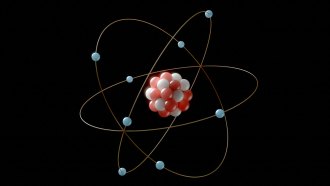
Scientists Say: Electron
Electrons are negatively charged particles. They are attracted to the positively charged particles in the center, or nucleus, of an atom.
- Animals
A spider’s feet hold a hairy, sticky secret
Their widespread stickiness traces to the shape of hairs on its feet, scientists now find.
- Earth
Explainer: How auroras light up the sky
The northern and southern lights are considered natural wonders of the world. Here’s how these and related splendid sky glows form.
- Brain
A sense of touch could upgrade virtual reality, prosthetics and more
Scientists and engineers are trying to add touch to online shopping, virtual doctor appointments and artificial limbs.
- Climate
Research on climate and more brings trio the 2021 physics Nobel Prize
Syukuro Manabe and Klaus Hasselmann pioneered work on simulations of Earth’s climate. Giorgio Parisi probed complex materials.
- Physics
Let’s learn about dark matter
Dark matter is only detectable by the gravitational pull it exerts on visible objects, like stars and galaxies.
- Chemistry
Scientists Say: Plasma
In physics, plasma refers to one of the four states of matter. In medicine, plasma describes the part of blood that ferries cells, nutrients and more throughout the body.
- Materials Science
Tiny swimming robots may help clean up a microplastics mess
Big problem, tiny solution. Researchers in the Czech Republic have designed swimming robots that can help collect and break down microplastics.
- Chemistry
Scientists Say: Aerosol
Aerosols are tiny bits of solids or drops of liquids suspended in gas. Aerosols include mist, fog and soot, as well as pollution from fossil fuels.
- Materials Science
Take a look at this weird, bendy type of ice
These specially grown threads of ice bend into curves, then spring back when released.