Physics
- Math
Lack of diversity in his field has troubled this mathematician
As a kid, Edray Goins didn’t like math. But he fell in love with the subject in college and is now training the next generation of minority mathematicians.
- Physics
Scientists Say: Photon
This word describes light as a particle. A photon is the tiniest possible bit of electromagnetic radiation.
- Health & Medicine
New ultrasound treatment kills off cancer cells
Low-frequency ultrasound destroys cancer cells while leaving most healthy cells intact.
- Health & Medicine
Silk can be molded into strong medical implants
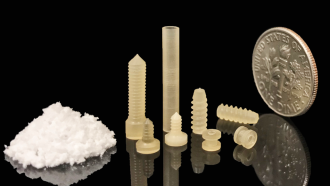
Freeze-dried and powdered silk has a long shelf life. It also is cheap to ship and can be molded into sturdy medical implants.
- Animals
Try This: Walking on water with science
Water striders walk on water. How do they do it? They spread out. This experiment will show you how it works.
- Physics
Soap bubbles’ ‘pop’ reveals the physics of the bursts
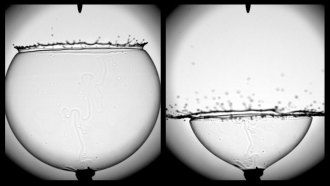
A bubble’s pop is a quiet, high-pitched noise. This can reveal the forces that occur during the bubble’s demise.
- Chemistry
Converting trash to valuable graphene in a flash
Flash heating of carbon-rich wastes creates graphene, which has many commercial uses.
- Physics
Explainer: Understanding waves and wavelengths
A wave is a disturbance that moves energy from one place to another. Only energy — not matter — is transferred as a wave moves.
- Physics
There’s science to making great fried rice
Scientists report finding the physics that seems to explain how chefs can quickly fry rice over a hot flame without burning the food.
- Animals
Analyze This: Shimmering colors may help beetles hide
Delve into data showing how brilliant colors that shift as a viewer — or predator — moves may help iridescent insects blend in.
- Physics
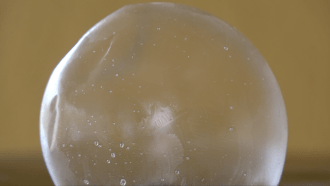
How to temporarily ‘fossilize’ a soap bubble
Here’s how to freeze a soap bubble in midair. Warning: The environment needs to be frosty, and even then it can take a certain amount of trial and error.
- Health & Medicine
Experts rethink need for X-ray shielding of patients
For close to 70 years, workers who perform X-ray scans of the body have been advised to shield sensitive tissues with lead 'aprons.' That may soon stop.