Physics
- Materials Science
A better way to stop a bullet?
A teen researcher's tests suggest that fabric body armor might stop bullets better if it were woven using a three-fiber, triangular mesh instead of the typical two-fiber-mesh configuration.
- Physics
After 30 years, this supernova is still sharing secrets
It’s been 30 years since astronomers first witnessed the stellar explosion known as SN 1987A. Today, researchers are still learning from this cataclysmic phenomenon.
- Physics
Why your shoelaces untie themselves
High-speed video shows how the combined motions of a shoe’s swinging and landing on the ground provoke shoelaces to come untied.
- Materials Science
Nanowires made from silver are super stretchy
When silver nanowires stretch slowly, atoms on their surface can spread to heal weak spots. The discovery could lead to more flexible electronics.
- Physics
These antennas turn anything into a radio station
Engineers have developed antennas that can turn ordinary objects — even posters — into radio stations.
- Climate
Cool Jobs: Head in the clouds
What do a microbiologist, an atmospheric scientist and a materials engineer have in common? They’ve all got their heads in the clouds.
- Physics
Getting ready for the solar eclipse
A total solar eclipse will race across the continental United States in August 2017. Scientists and the public are preparing to watch and learn.
- Tech
How to safely watch a solar eclipse
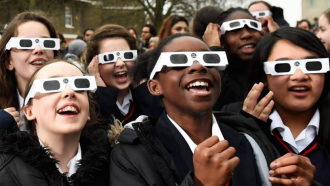
Certified safety glasses are a must for protecting your eyes when looking at the sun. Here’s how to safely enjoy a solar eclipse, like the one on August 21, 2017.
- Physics
Eclipses come in many forms
Eclipses are one of nature’s most awesome spectacles, and scientists have learned a lot by observing them and related celestial alignments — occultations and transits.
- Computing
Single atoms become teensy data storage devices
Most people consider a thumb drive to be an amazingly small device for storing data. But this new system uses a ten-thousandth the number of atoms of today’s data-storage devices.
- Physics
Auto-focus eyeglasses rely on liquid lenses
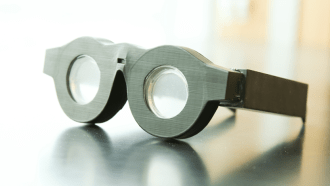
Engineers have designed what could be the last eyeglasses anyone would need. Right now, they’re bulky but smart. Liquid lenses are key to their adjustability — and those lenses focus automatically.
- Animals
Frog’s gift of grab comes from saliva and squishy tissue
What puts the grip in a frog’s high-speed strike? Quick-change saliva and a super-soft tongue, scientists find.