Physics
- Earth
Bright night lights, big science
When the northern lights flare, blame the sun. Scientists say auroras “surge” when energy from solar wind builds up on the night side of the Earth.
- Earth
Tracking warfare by ‘Earth shakes’
Geophysicists are discovering how weapons shake, rattle, and roll the Earth. What they’re learning might one day help win wars.
- Chemistry
New bendy device could power wearable electronics
A new device with lithium and silicon electrodes uses chemistry to generate electricity as it bends back and forth.
- Materials Science
Wet suits with hair?
The dense hair that keeps sea otters warm in frigid waters may inspire development of “furry” wet suits for scuba divers.
- Earth
News Brief: Why rainbows can lose some hues
When the sun is right near the horizon, such as at sunset, its light travels through the most atmosphere. When there’s also plenty of water in the air, this can rob colors from a rainbow, scientists now report.
- Physics
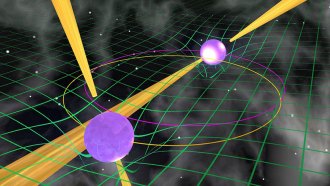
Zombie stars: A source of gravitational waves?
Scientists have found indirect evidence that the dense cores of dead stars are making ripples in space, known as gravitational waves. These waves have been predicted but never yet directly “seen.”
- Animals
Some fish wear an invisibility cloak
Some fish can hide in open water. How? Tiny crystals in their scales and skin help them reflect and blend in with polarized light.
- Environment
Engineers consider liquid salt to generate power
A new type of power plant, a molten salt reactor, might provide electricity in a cleaner and safer way than current nuclear technology.
- Ecosystems
Two SNS writers win big
Here’s a Cool Job: writing about science. Two people who regularly do that for SNS have just picked up awards for stories on the physics of lightning and how nature recycles the dead to feed the living.
- Physics
Explainer: Locating a gun with sound waves
Recording the sound of a gun from three microphones can help scientists pinpoint the weapon’s location.
- Physics
Boom! Sounding out the enemy
Armistice Day marked the end of the Great War. But what arguably won the war was acoustics — the science of sound. It allowed Allied troops to home in on and rout the enemy.
- Chemistry
Explainer: Temperature and electrical resistance
Higher temperatures mean more energy and more motion. In contrast, cold means slow moving molecules.