Planets
- Planets
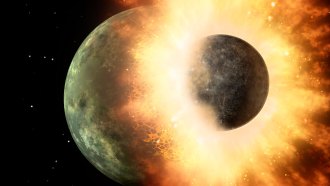
Scientists Say: Theia
Clues about this ancient protoplanet's catastrophic end may have been entombed in Earth's lower mantle for billions of years.
- Planets
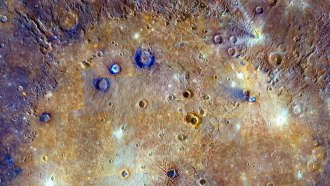
Experiment: Make your own craters!
Let’s make our own craters in cocoa and flour to learn how these features form throughout the solar system — and why they’re different sizes.
- Planets
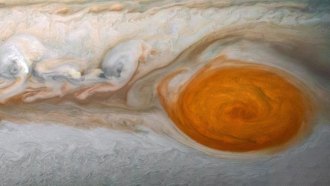
Analyze This: Jupiter’s Great Red Spot is shrinking
If the windstorm keeps dwindling, the Great Red Spot could someday disappear — like an earlier spot observed in the 1600s.
- Physics
Scientists Say: Magnetosphere
This magnetic field encapsulates our planet, sheltering us from damaging energetic threats posed by the cosmos and our own sun.
- Planets
‘Percy,’ NASA’s rover, finds its first hint of ancient life on Mars
The robot examined a Mars rock containing organic compounds and “leopard spots.” On Earth, such spots usually come from microbial life.
- Planets
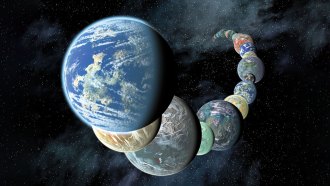
Here are 5 exoplanet mysteries the James Webb telescope could help solve
This space telescope could reveal much about the formation, makeup and evolution of distant exoplanets.
- Planets
Active volcanoes may be common on Venus
Researchers took a new look at decades-old images from NASA’s Magellan spacecraft. These now suggest volcanic activity is widespread on the planet.
- Planets
Pluto’s heart may hide the rocky wreckage of an ancient impact
A huge, rocky remnant beneath Pluto’s surface could explain the odd location of Sputnik Planitia — its famous heart-shaped basin.
- Planets
The desert planet in ‘Dune’ is pretty realistic, scientists say
Humans could live on the fictional planet Arrakis from Dune. But thankfully giant sandworms probably could not.
- Space
Here’s how to build an internet on Mars
Future Red Planet residents will need to get online to talk to each other and Earth. But that will require a lot of new tech.
- Space
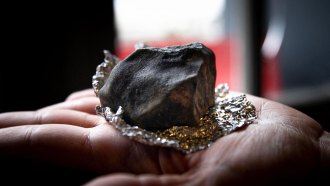
Let’s learn about meteorites
Meteorites are bits of space rock that have crash-landed on Earth — or on another celestial body.
- Planets
Huge polygons on Mars hint its equator may once have been frozen
A Chinese rover used radar to reveal long-buried terrain. The discovery hints that Mars’ equator was once much colder and wetter.