Planets
- Physics
Explainer: All about orbits
A handful of rules can describe the route some object repeatedly takes around another in space. Calculating that path, however, can be quite complex.
- Earth
Scientists Say: Atmosphere
An atmosphere is an envelope of gas around a planet, dwarf planet or moon.
- Planets
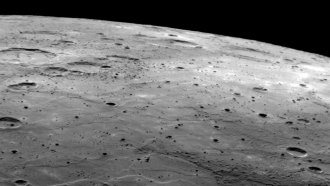
Mercury’s surface may be studded with diamonds
Billions of years of meteorite impacts may have transformed much of Mercury's graphite crust into precious gemstones.
- Planets
Let’s learn about Pluto
Once known as a pipsqueak planet, Pluto is now the solar system’s best known dwarf planet.
- Chemistry
No, organic molecules alone don’t point to life on Mars
These carbon-based molecules, found in a meteorite, may reflect merely a mixing of water and minerals on the Red Planet over billions of years.
- Planets
The long-awaited James Webb Space Telescope has a big to-do list
The James Webb Space Telescope has been in the works for so long that new fields of science have emerged for it to study.
- Planets
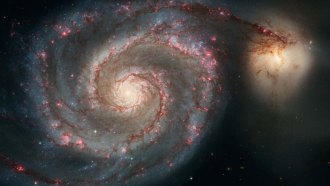
Astronomers may have found first known planet in another galaxy
The spiral-shaped Whirlpool galaxy may be home to the first planet spotted outside our own Milky Way galaxy.
- Planets
NASA’s Perseverance rover grabbed its first Martian rocks
Two finger-sized pieces of stone drilled from a basalt rock are the first bits of Mars ready to be brought to Earth.
- Planets
Pluto is no longer a planet — or is it?
In the 15 years since Pluto lost its status as a planet, some scientists continue to use whatever definition works best for them.
- Planets
Jupiter’s intense auroras heat up its atmosphere
Jupiter’s hotter-than-expected upper atmosphere may be warmed by charged particles slamming into the air above the poles.
- Planets
This image may be the first look at exomoons in the making
These observations offer some of the best evidence yet that planets around other stars have moons, or exomoons.
- Planets
Born in deep shadows? That could explain Jupiter’s strange makeup
Dust that blocked sunlight might have caused the gas giant to form in a deep freeze, a new study suggests.