Space
- Space
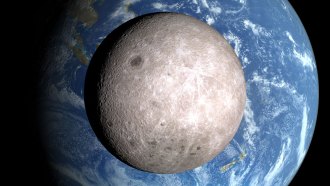
Looking for aliens from the far side of the moon [COMIC]
Earth’s noise and light pollution can make it hard to detect signs of life on other planets. The solution? Telescopes that use the moon as a shield.
- Space
This astronomer searches for alien chemistry and tech
At the SETI Institute, Chenoa Tremblay uses radio telescopes to look for molecules and emissions given off by alien technology.
- Space
35 years on, Hubble continues to revolutionize astronomy
The Hubble Space Telescope is an icon in astronomy. Here are some of its most out-of-this-world images.
- Space
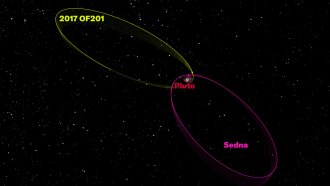
A new dwarf planet may skirt the edge of our solar system
For the distant object, one trip around the sun takes over 24,000 years. Its orbit challenges a proposed path for a hypothetical “Planet Nine.”
- Space
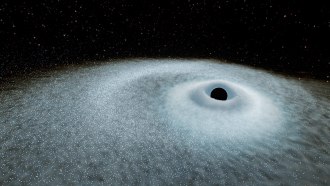
Megastars shredded by black holes offer new type of cosmic explosion
Called extreme nuclear transients, these events are 30 to 1,000 times as bright as supernovas — and their glow may persist for a year or more.
- Space
Scientists Say: Lagrange point
Between and around a two-body system — such as the Earth and sun — there are five points of prime celestial real estate.
- Planets
Here’s how future Martians might take their first breaths
Mars would need an atmosphere thick enough to hold heat and with enough oxygen for people to breathe. This is how we might terraform Mars.
- Planets
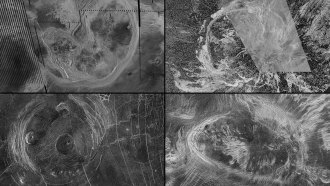
The surface of Venus is morphing
Circular landforms speckling Venus' surface may be the work of tectonics — similar to the forces that reshape Earth’s surface.
- Space
A rogue black hole is on the loose in our galaxy
Astronomers now agree there’s a lone black hole wandering around the Milky Way — the first solitary black hole ever detected.
- Planets
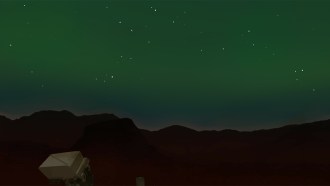
Perseverance took the first picture of a visible aurora on Mars
A faint yet visible aurora has been spotted on Mars. It’s the first such light show seen from another planet's surface.
- Physics
Can a supervillain destroy the sun?
Although our sun is a dwarf yellow star, it’s more than massive enough to weather any attempts to alter it — super or otherwise.
- Space
A passing star could fling Earth out of orbit — or into the sun
Computer models show that a star's tug could send Mercury, Venus or Mars crashing into Earth — or let Jupiter eject our world from the solar system.