Let’s learn about exoplanets
These planets are outside of our solar system
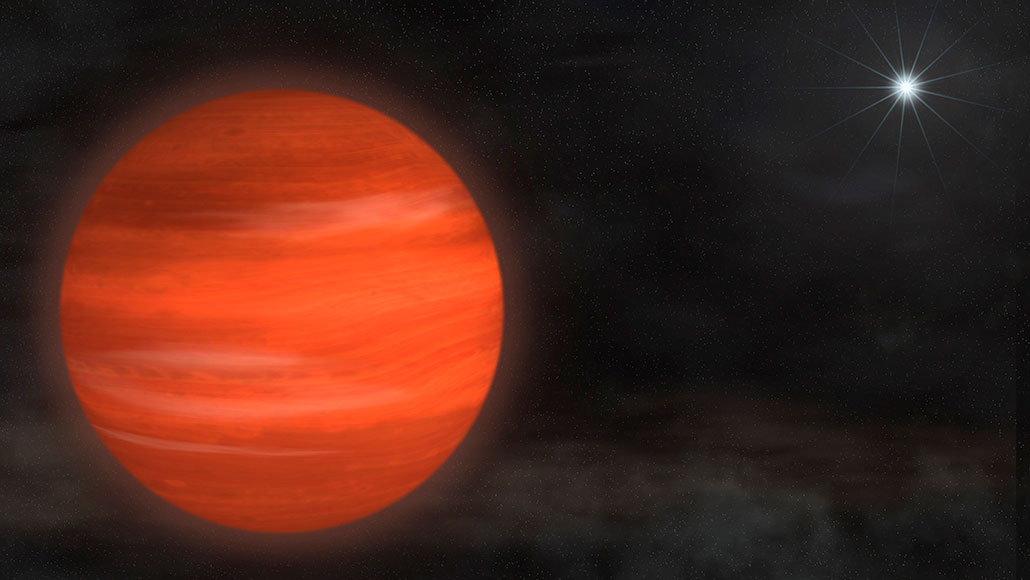
This is an artist’s image of the exoplanet Kappa Andromedae b, a planet 13 times the size of Jupiter.
S. Wiessinger/NASA's Goddard Space Flight Center
Share this:
- Share via email (Opens in new window) Email
- Share on Facebook (Opens in new window) Facebook
- Share on X (Opens in new window) X
- Share on Pinterest (Opens in new window) Pinterest
- Share on Reddit (Opens in new window) Reddit
- Share to Google Classroom (Opens in new window) Google Classroom
- Print (Opens in new window) Print
Most of us probably aren’t going far away for a vacation this year. But we can still daydream. How about a rock-climbing trip on Proxima b? Watching the lightning crash on HAT-P-11b? Maybe go to see the double sunrise on Kepler-453b? If you haven’t heard of these vacation destinations, that’s because no one has been to them — yet. They are all exoplanets.
A planet is an object in space that orbits a star. In order to count as a planet, it has to be big enough that gravity has pulled it into a roundish shape. It also has to have enough gravity to clear other objects out of its path around its star. A planet is one of these objects that orbits our particular star — the sun. When a planet orbits another star, it’s called an exoplanet.
Exoplanets have all sorts of fascinating properties. Some have two suns. Exoplanets could have atmospheres filled with hydrogen. Some have lightning storms more intense than anything the Earth has ever seen. And a few might be places where scientists could look for life. They are in the Goldilocks zone — an area at just the right distance from a star to allow liquid water to flow on the surface of the planet. They might even get rain.
Want to know more? We’ve got some stories to get you started:
Distant planet may boast the longest year: This ‘year’ is 163,000 Earth years long (6/2/2014) Readability: 7.8
Planets with hydrogen skies could harbor life: Earth microbes survived atmospheres hosting only the most abundant element in our universe (6/2/2020) Readability: 7.5
This planet’s lightning storms are like nothing on Earth: HAT-P-11b has some truly intense electric weather (6/3/2016) Readability: 7.0
Explore more
Like Tatooine in ‘Star Wars,’ this planet has two suns
Profile: Looking for life beyond the solar system
Small, distant worlds are either big Earths or little Neptunes
R.I.P. Kepler, the planet-hunting telescope
Scientists consider how to visit the closest exoplanet
Want to visit an exoplanet? Pack your bags! NASA has an Exoplanet Travel Bureau where you can learn about different exoplanets and take a virtual tour of what they might look like.