Scientists Say: Space junk
Earth’s orbit is turning into a trashy place
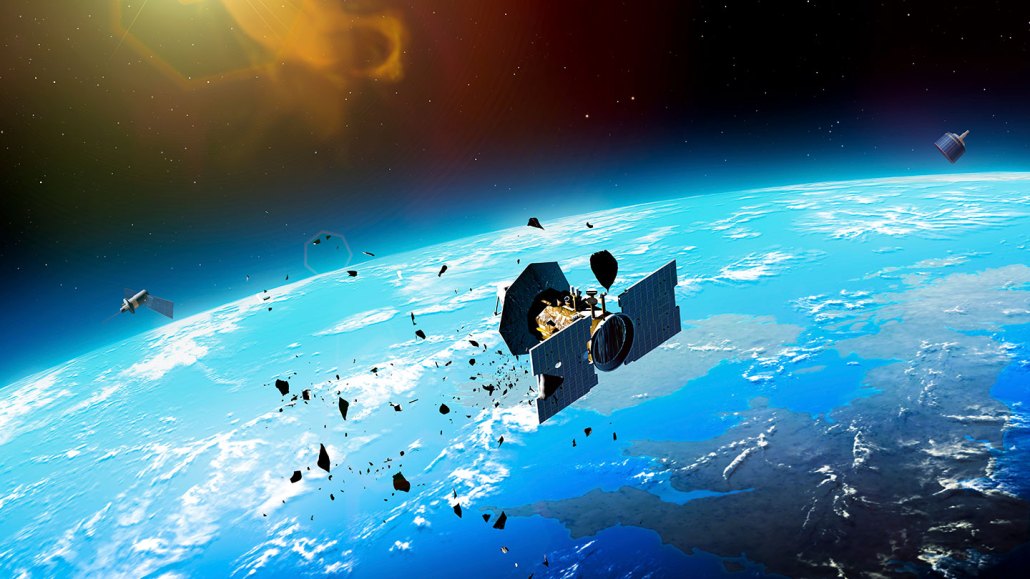
Space junk comes from various sources. Debris from derelict satellites is one example. Such debris often forms from collisions between two objects in orbit.
MarkGarlick/Science Photo Library/Getty
Share this:
- Share via email (Opens in new window) Email
- Share on Facebook (Opens in new window) Facebook
- Share on X (Opens in new window) X
- Share on Pinterest (Opens in new window) Pinterest
- Share on Reddit (Opens in new window) Reddit
- Share to Google Classroom (Opens in new window) Google Classroom
- Print (Opens in new window) Print
Space junk, (noun, “sp-ACE Junk”)
Space junk, also called space debris, refers to trash left in space by humans. This trash includes objects as large as abandoned satellites and as small as flecks of paint.
Humans have been generating space junk for as long as we have been exploring space. This junk includes discarded rocket boosters, old satellites and fragments left over when objects collide. In 2009, for example, two satellites crashed nearly 800 kilometers (about 500 miles) above Siberia. The crash created thousands of new pieces of space junk.
Items lost during space missions make up a small amount of space junk. In 1965, American astronaut Ed White lost a glove during a spacewalk. Other astronauts have lost cameras, tools and even a toothbrush.
Space junk is a growing problem. That’s because it shares the same, well, space, as other objects that orbit Earth. One of those objects is the International Space Station. There’s also weather, communication and other satellites people on Earth rely on.
Objects in orbit around Earth typically zoom at scorching speeds. Space junk can zip around at up to 8 kilometers (5 miles) per second — or 29,000 kilometers (18,000 miles) per hour. At such speeds, any collision — even with something tiny — could rip holes in a spacecraft or damage satellites.
More than 36,500 pieces of space junk larger than 10 centimeters (about 4 inches) orbit Earth today. They’re joined by more than 300 million even smaller pieces. As more trash ends up in space, more collisions will likely occur. Those collisions will break the trash into smaller — but still dangerous — pieces.
Some space junk eventually re-enters the atmosphere. But that can take a long time. Debris orbiting closer to the Earth may fall into the atmosphere after a few years. Objects farther out may take hundreds or thousands of years.
On re-entry, smaller space junk typically burns up in the atmosphere. So, it rarely hits Earth. But large pieces sometimes do. Debris from Skylab — an abandoned space station — fell from orbit on July 11, 1979. Chunks of the station fell over Western Australia and the Indian Ocean. Australian officials fined NASA $400 for littering.
In a sentence
In 2021, NASA instructed the seven astronauts on board the International Space Station to take cover as they approached a region littered with space junk.