antenna: (plural: antennae or antennas) In biology: Either of a pair of long, thin sensory appendages on the heads of insects, crustaceans and some other arthropods. (in physics) Devices for picking up (receiving) electromagnetic energy.
array: A broad and organized group of objects. Sometimes they are instruments placed in a systematic fashion to collect information in a coordinated way. Other times, an array can refer to things that are laid out or displayed in a way that can make a broad range of related things, such as colors, visible at once. The term can even apply to a range of options or choices.
astronaut: Someone trained to travel into space for research and exploration.
astronomer: A scientist who works in the field of research that deals with celestial objects, space and the physical universe.
crater: A large, bowl-shaped cavity in the ground or on the surface of a planet or the moon. They are typically caused by an explosion or the impact of a meteorite or other celestial body. Such an impact is sometimes referred to as a cratering event.
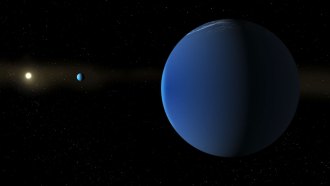
exoplanet: Short for extrasolar planet, it’s a planet that orbits a star outside our solar system.
hydrogen: The lightest element in the universe. As a gas, it is colorless, odorless and highly flammable. It’s an integral part of many fuels, fats and chemicals that make up living tissues. It’s made of a single proton (which serves as its nucleus) orbited by a single electron.
magnetic field: An area of influence created by certain materials, called magnets, or by the movement of electric charges.
metal: Something that conducts electricity well, tends to be shiny (reflective) and is malleable (meaning it can be reshaped with heat and not too much force or pressure).
moon: The natural satellite of any planet.
NASA: Short for the National Aeronautics and Space Administration. Created in 1958, this U.S. agency has become a leader in space research and in stimulating public interest in space exploration. It was through NASA that the United States sent people into orbit and ultimately to the moon. It also has sent research craft to study planets and other celestial objects in our solar system.
prototype: A first or early model of some device, system or product that still needs to be perfected.
radiation: (in physics) One of the three major ways that energy is transferred. (The other two are conduction and convection.) In radiation, electromagnetic waves carry energy from one place to another. Unlike conduction and convection, which need material to help transfer the energy, radiation can transfer energy across empty space.
radio waves: Waves in a part of the electromagnetic spectrum. They are a type that people now use for long-distance communication. Longer than the waves of visible light, radio waves are used to transmit radio and television signals. They also are used in radar.
satellite: A moon orbiting a planet or a vehicle or other manufactured object that orbits some celestial body in space.
star: The basic building block from which galaxies are made. Stars develop when gravity compacts clouds of gas. When they become hot enough, stars will emit light and sometimes other forms of electromagnetic radiation. The sun is our closest star.
telescope: Usually a light-collecting instrument that makes distant objects appear nearer through the use of lenses or a combination of curved mirrors and lenses. Some, however, collect radio emissions (energy from a different portion of the electromagnetic spectrum) through a network of antennas.
tether: A tie or cord that loosely anchors some object to a semi-fixed position. Or the process of tying some object to a cord that will keep it loosely affixed to that position. (Consider the child’s game tether ball, whereby a cord it attached to a ball on one end and an anchoring pole on the other end.)
universe: The entire cosmos: All things that exist throughout space and time. It has been expanding since its formation during an event known as the Big Bang, some 13.8 billion years ago (give or take a few hundred million years).
wave: A disturbance or variation that travels through space and matter in a regular, oscillating fashion.
wavelength: The distance between one peak and the next in a series of waves, or the distance between one trough and the next. It’s also one of the “yardsticks” used to measure radiation. Visible light — which, like all electromagnetic radiation, travels in waves — includes wavelengths between about 380 nanometers (violet) and about 740 nanometers (red). Radiation with wavelengths shorter than visible light includes gamma rays, X-rays and ultraviolet light. Longer-wavelength radiation includes infrared light, microwaves and radio waves.
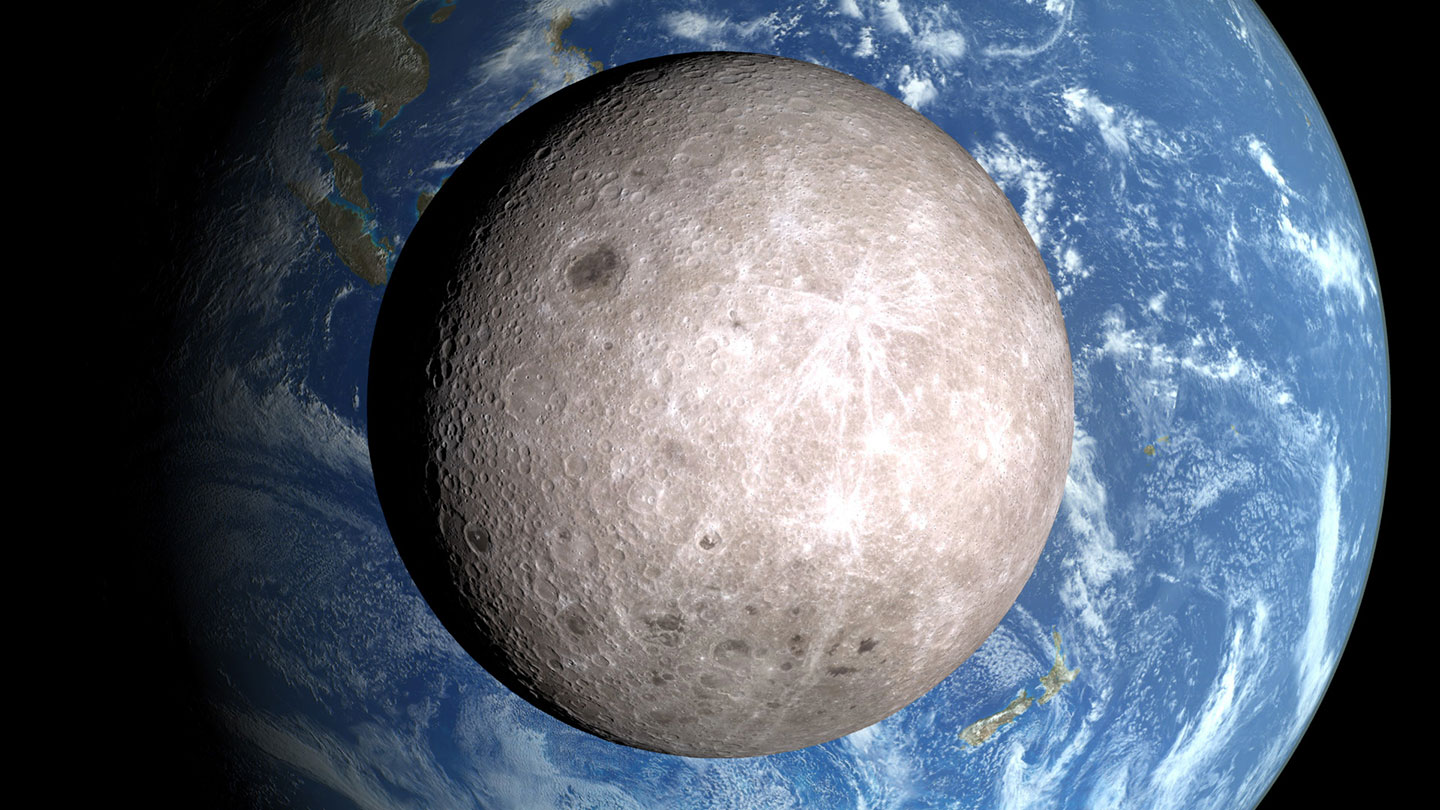


![Text on the image: FARSIDE would also study the structure of the universe before the first stars formed over 13 billion years ago. Scientists call this the “cosmic dark ages”. Mahesh: “The only way of doing that is to look for a signal from hydrogen [gas], and the only way we can get that signal to go to the far side of the moon.”
Image: A brown-haired scientist wearing a lavender sari stands outside in the dark, with tiny stars in the background. She lights up her face from the underside with a flashlight.](https://www.snexplores.org/wp-content/uploads/sites/3/2025/09/1440_moon_telescope_comic_panel_7.png)