Flamingos hunt by creating their own underwater tornadoes

Coordinated movements of their beaks and feet create shrimp-sucking whirlpools in the water

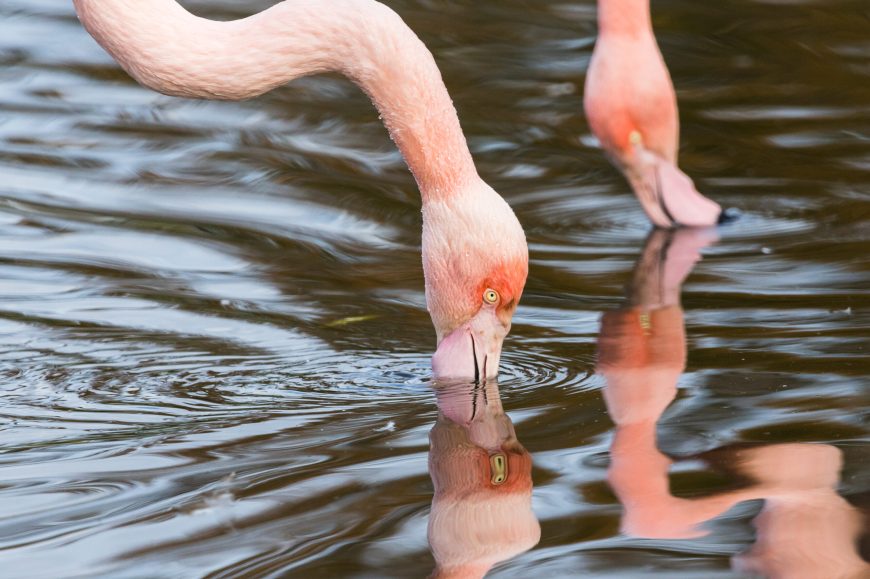
Close up of a pair of preening Chilean flamingos in the water.

Flamingos use a strange little dance of stomping feet and bobbing necks to slurp up shrimp.

wellsie82/Getty Images

Flamingos are feeding machines. They spend a large part of their day with their heads upside down in water, gobbling up brine shrimp and other small prey. A new study reveals the unique technique these animals use to fill their appetites.

The flamingos don’t just sit with their beaks open, hoping shrimp swim their way. Underwater, they are doing a clever sequence of head and feet movements. These moves may look clumsy. But they have a surprising effect that sucks up food from the bottom of the water.

Researchers shared the new findings May 12. The work appeared in Proceedings of the National Academy of Sciences.

illustrated text reads "Wild Things: A graphic tale" with animals drawn around the letters
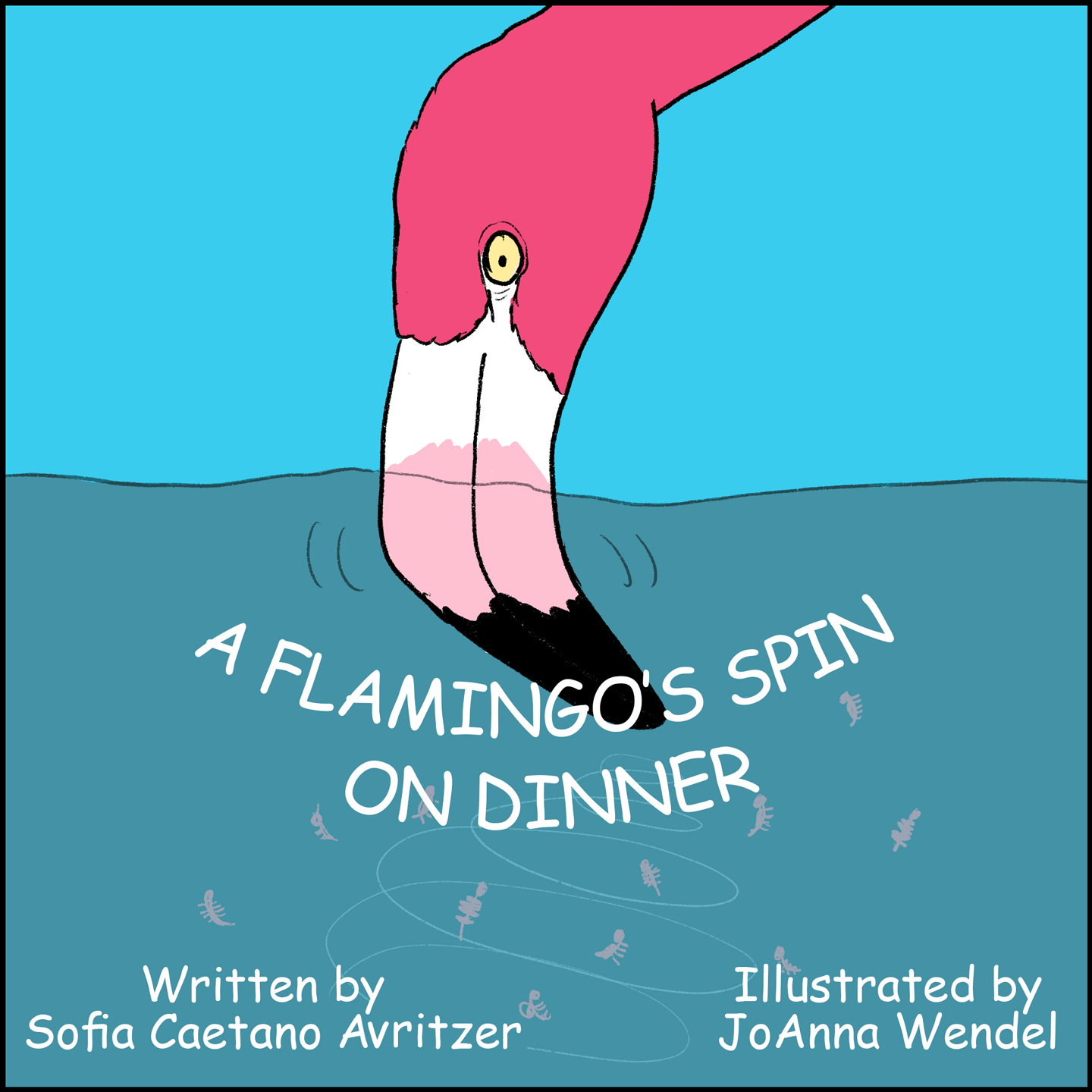
Title Panel: Text: A flamingo’s spin on dinner. Written by Sofia Caetano Avritzer. Illustrated by JoAnna Wendel. Image: A flamingo dips its beak into water and swirls it around, creating a vortex that small shrimp get caught up in.
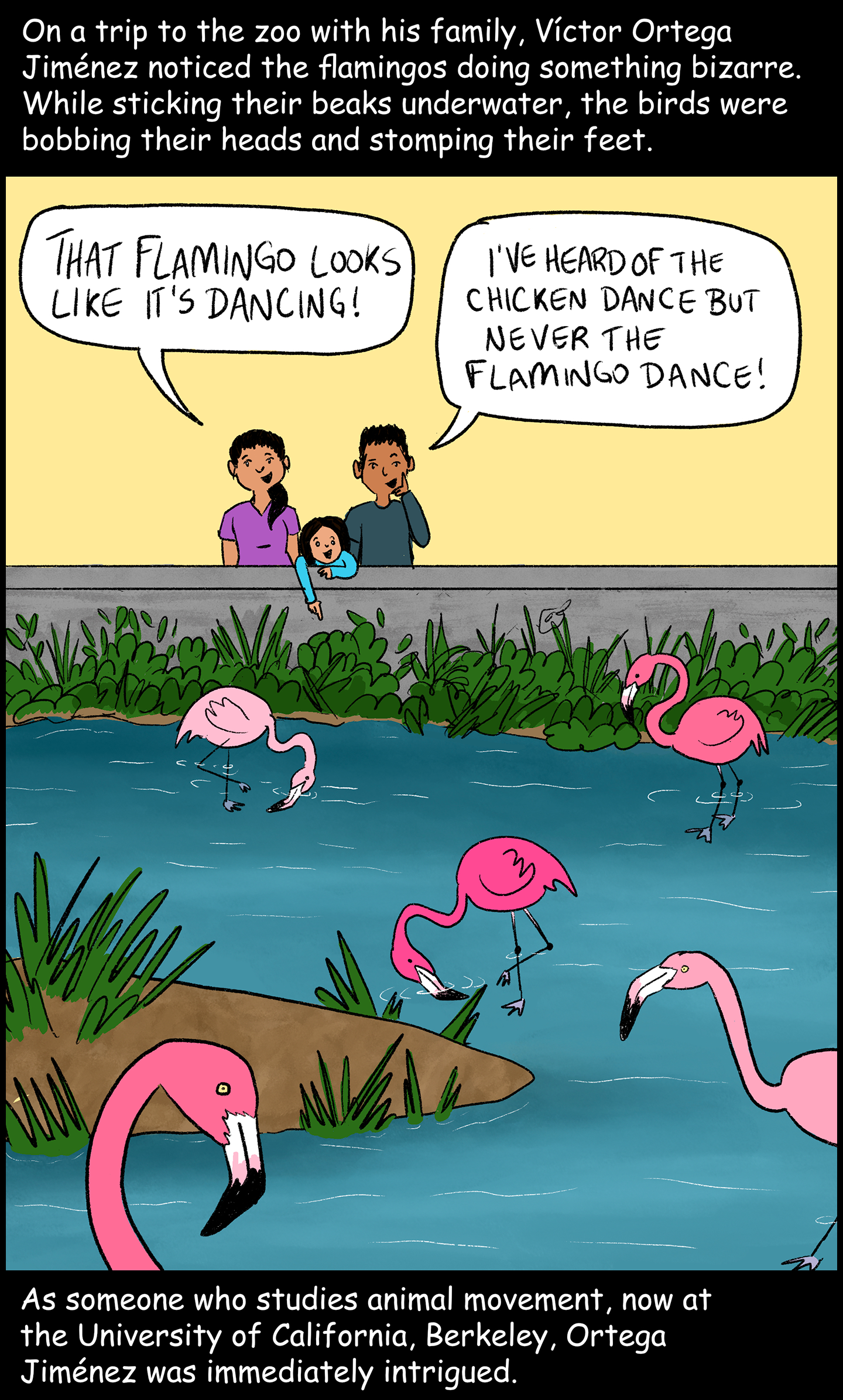
Panel 1: Text (above image): On a trip to the zoo with his family, Victor Ortega Jimenez noticed the flamingos doing something bizarre. While sticking their beaks underwater, the birds were bobbing their heads and stomping their feet. Image: A mom, dad and little kid stand at the edge of a flamingo enclosure. Inside the enclosure, four pink flamingos walk around a pond, some with their beaks dipped into the water. The little kid is pointing and smiling at one of the flamingos doing this. The mom says, “That flamingo looks like it’s dancing!” The dad says, “I’ve heard of the chicken dance but never the flamingo dance!” Text (below image): As someone who studies animal movement, now at the University of California, Berkeley, Ortega Jimenez was immediately intrigued.
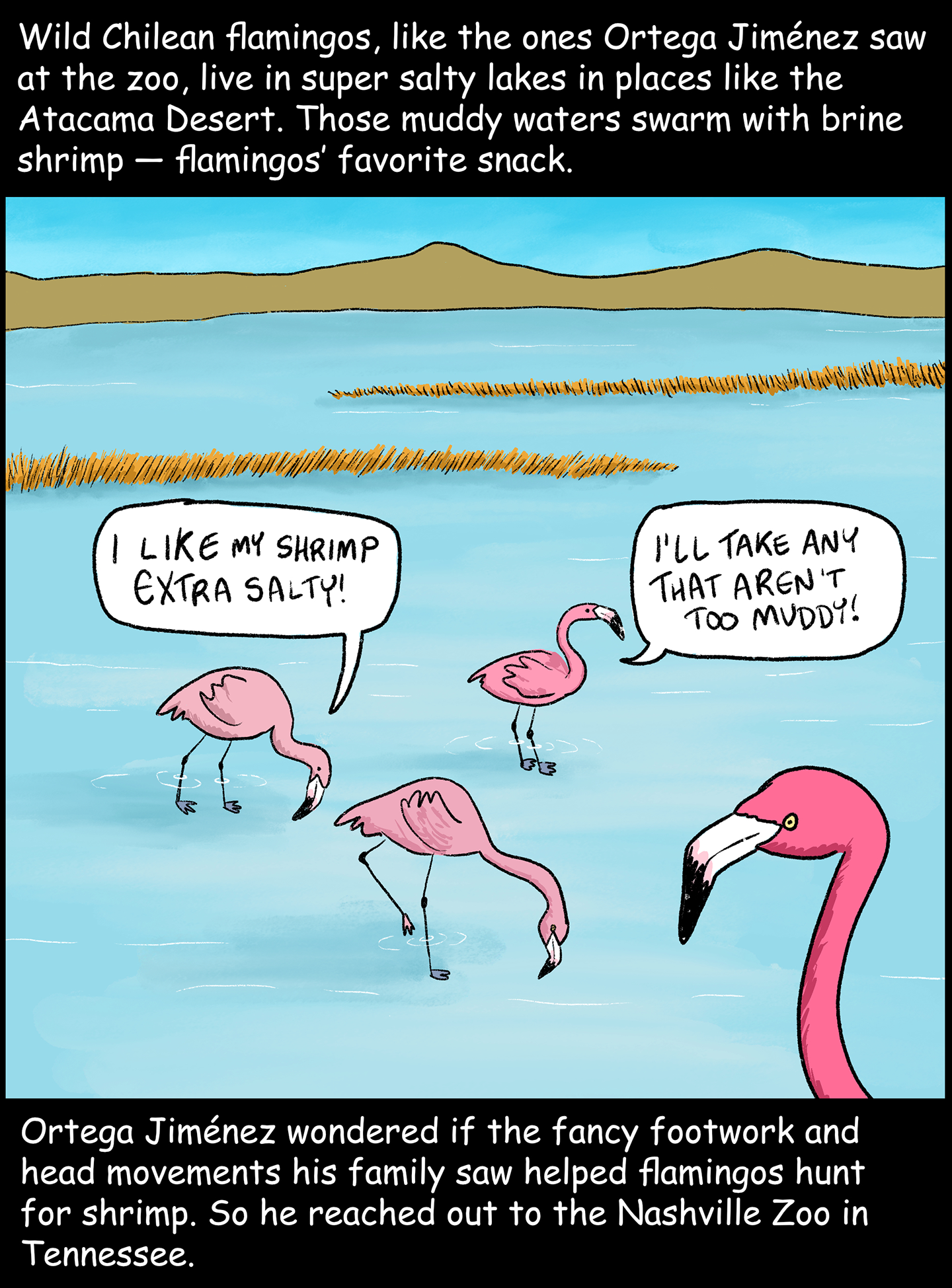
Panel 2: Text (above image): Wild Chilean flamingos, like the ones Ortega Jimenez saw at the zoo, live in super slaty lakes in places like the Atacama Desert. Those muddy waters swarm with brine shrimp — flamingos’ favorite snack. Image: Four flamingos strut around the shallow waters of a wide salt lake in a desert landscape. One of the flamingos, with its beak dipped below water, says, “I like my shrimp extra salty!” Another flamingo standing up says, “I’ll take any that aren’t too muddy!” Text (below image): Ortega Jimenez wondered if the fancy footwork and head movements his family saw helped flamingos hunt for shrimp. So he reached out to the Nashville Zoo in Tennessee.
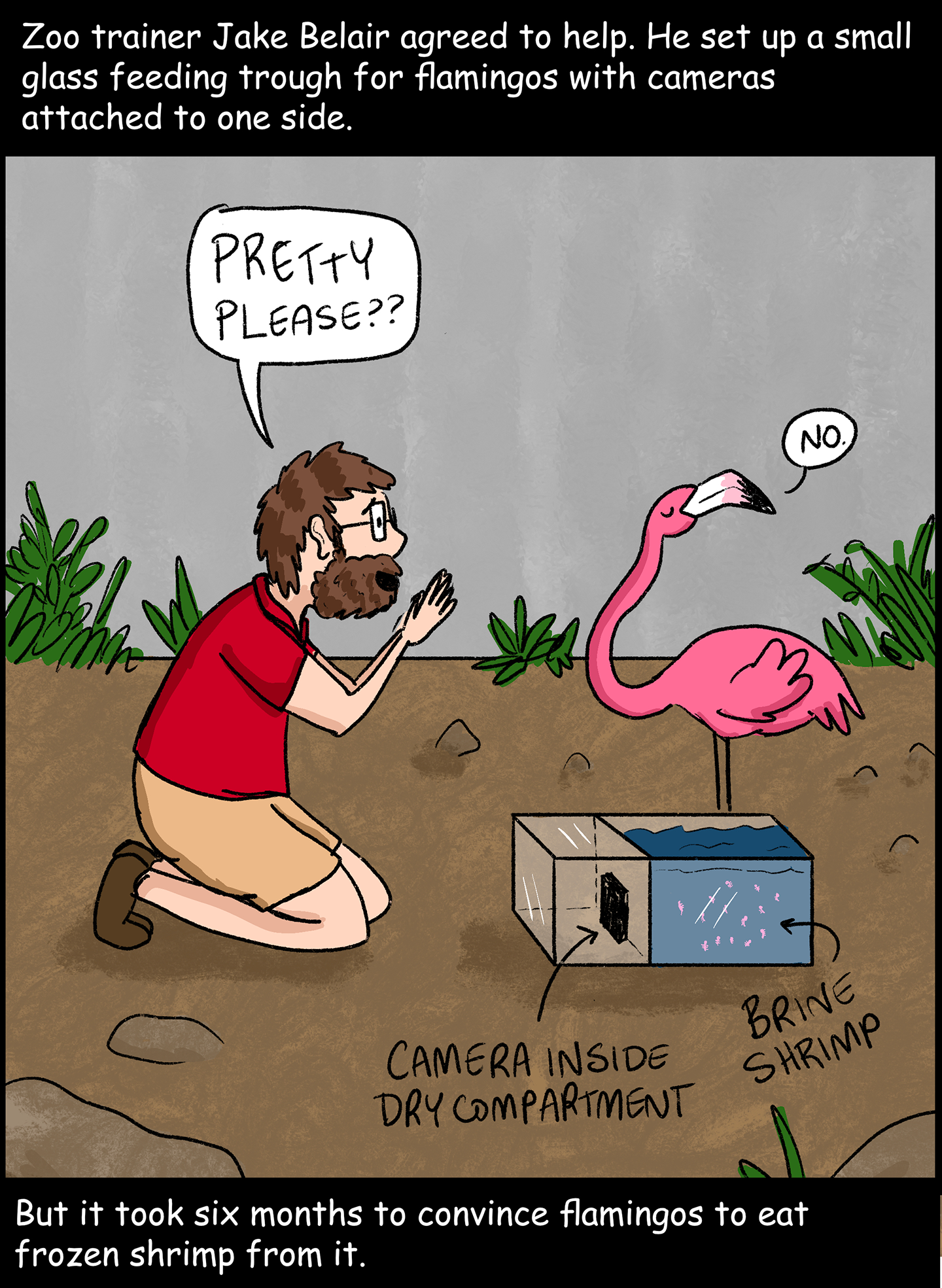
Panel 3: Text (above image): Zoo trainer Jake Belair agreed to help. He set up a small glass feeding trough for flamingos with cameras attached to one side. Image: Inside a flamingo enclosure, a flamingo stands in front of a glass container. The right side of the glass container is filled with water and shrimp. The left side of the container holds a camera pointed at the right side. A man in a red shirt and khaki shorts crouches down on his knees with his hands together in front of the flamingo. The man, who wants the flamingo to eat from the trough, is saying, “Pretty please??” But the flamingo is turning its head away and saying, “No.” Text (below image): But it took six months to convince flamingos to eat frozen shrimp from it.
Panel 4: Text (above image): Finally, the scientists could see what was happening beneath the water’s surface. Turns out, flamingos’ head-bobbing move created underwater vortices that sucked shrimp straight into their beaks. Image: Three panels show a flamingo in different parts of the vortex making process. The left panel shows a flamingo starting to swirl its beak around. The flamingo is saying, “Just gonna whip up something quick for dinner!” The middle panel shows the flamingo’s motion starting to whip up a small vortex of shrimp. The right panel shows the vortex pulling the shrimp up toward the flamingo’s mouth. Text (below image): The birds also snapped their beaks 12 times a second. This move, called “chattering,” helped the flamingo suck up water — and the shrimp.
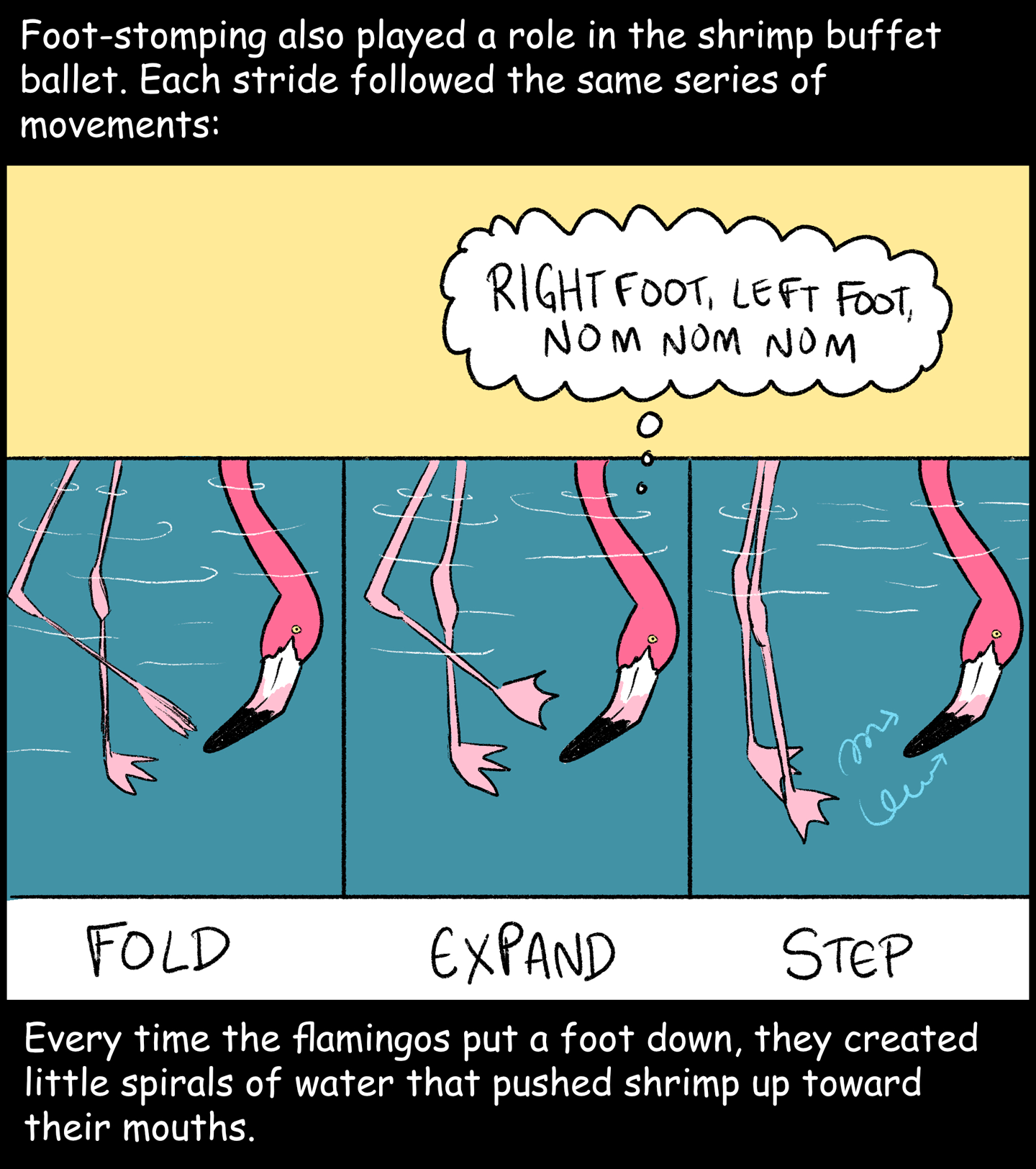
Panel 5: Text (above image): Foot-stomping also played a role in the shrimp buffet ballet. Each stride followed the same series of movements. Image: Three panels show a flamingo in different parts of the foot stomping process. The left panel, titled “Fold,” shows a flamingo folding up its little foot. The middle panel, titled “Expand,” shows the flamingo splaying out its foot. The right panel, titled “Step,” shows the flamingo stamping its feet. The flamingo is thinking, “Right food, left foot, nom nom nom.” Text (below image): Every time the flamingos put a foot down, they created little spirals of water that pushed shrimp up toward their mouths.
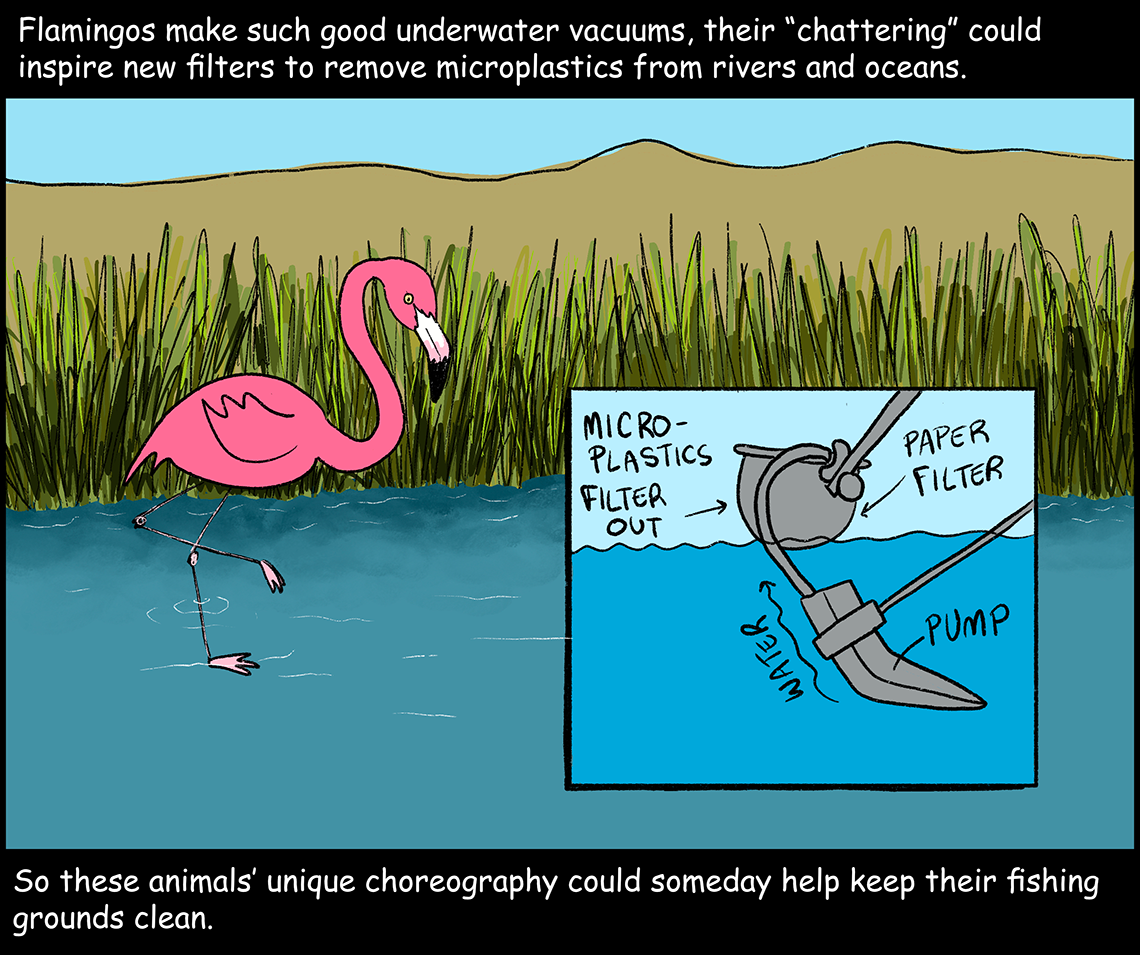
Panel 6: Text (above image): Flamingos make such good underwater vacuums, their “chattering” could inspire new filters to remove microplastics from rivers and oceans. Image: A flamingo walks through the shallow water of a pond under a blue sky. An inset shows how a flamingo-inspired water filter might work. A pump shaped like a flamingo’s beak dips underwater. Water travels up through the pump to a container above the water, where microplastics are filtered out. Text (below image): So these animals’ unique choreography could someday help keep their fishing grounds clean.
All: JoAnna Wendel

Sofia Caetano Avritzer is the 2025 AAAS Mass Media Fellow with Science News. She has a Ph.D. in neuroscience from The Rockefeller University, where she studied how fruit flies move their eyes and navigate the world.

JoAnna Wendel is a freelance science writer and cartoonist in Portland, Ore. She loves to make comics about all types of science, but she especially loves drawing planets, invertebrates and sea creatures. When she's not drawing, JoAnna is probably reading, hiking or hanging out with her cat, Pancake.