Uncategorized
- Physics
Galaxy cluster creates ‘magnifying glass’ in space
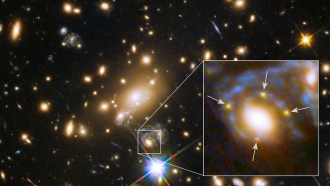
A massive galaxy’s gravity is so strong that it bends light, creating a “lens” in space. This natural magnifying glass is giving astronomers a rare view of a supernova on the other side of the universe.
- Brain
Scientists Say: Cortical homunculus
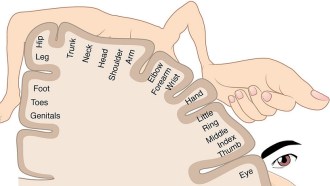
If you draw a representation of your body as seen by your brain, it’s called a homunculus. On it, parts sensitive to touch or used for fine movement are large, while others are small.
- Health & Medicine
Replacement ‘plastic’ may be as risky as BPA
Bisphenol chemicals are the basic building block of many common plastics. Some governments have banned BPA from baby bottles. But mounting evidence suggests that its replacement, BPS, may be no safer.
- Space
Astronomers spy fastest speeding star
A few stars have been spotted departing our galaxy. The fastest of these might have been propelled by another exploding star, a new study finds.
- Animals
The social lives of whales
New tools are giving scientists an unprecedented glimpse into the behaviors of whales and dolphins. And these new data are upending long-held assumptions.
- Earth
Ancient ocean linked to supercontinent’s breakup
The supercontinent Pangaea started breaking apart 200 million years ago. This may have been triggered by the shrinking of the Tethys Ocean, a new study finds.
-
America’s top teen scientists
The Intel Science Talent Search is America’s top high school science competition. This year, the top finishers took home more than $1 million in prizes.
- Physics
How to pick up messages after they’re gone
By watching for light’s ‘echoes,’ physicists think they can retrieve information being relayed by or as light. It could make it possible for astronomers to view distant objects without having to see the light they cast off.
- Health & Medicine
Scientists Say: Circadian
We often feel the pull of sleep when the sun goes down. Light and our own biology put us into a regular, 24-hour rhythm that has its own word.
- Animals
Where an ant goes when it’s gotta go
The black garden ant has been spotted defecating inside its own nest. Scientists now characterize these spots as ant toilets.
- Earth
News Brief: Volcanic spark zaps ash to glass
The lightning associated with some erupting volcanoes can be quite crafty — turning ash into lots of microscopic glass beads.
- Physics
Science in Hollywood
Audiences are getting smarter, so the makers of movies, TV shows and video games are responding by enlisting scientists to make everything on screen appear even more authentic.