Analyze This: Even as Earth’s oceans warm, one spot has gone cold
A ‘cold blob’ in the North Atlantic may signal a major ocean current’s decline
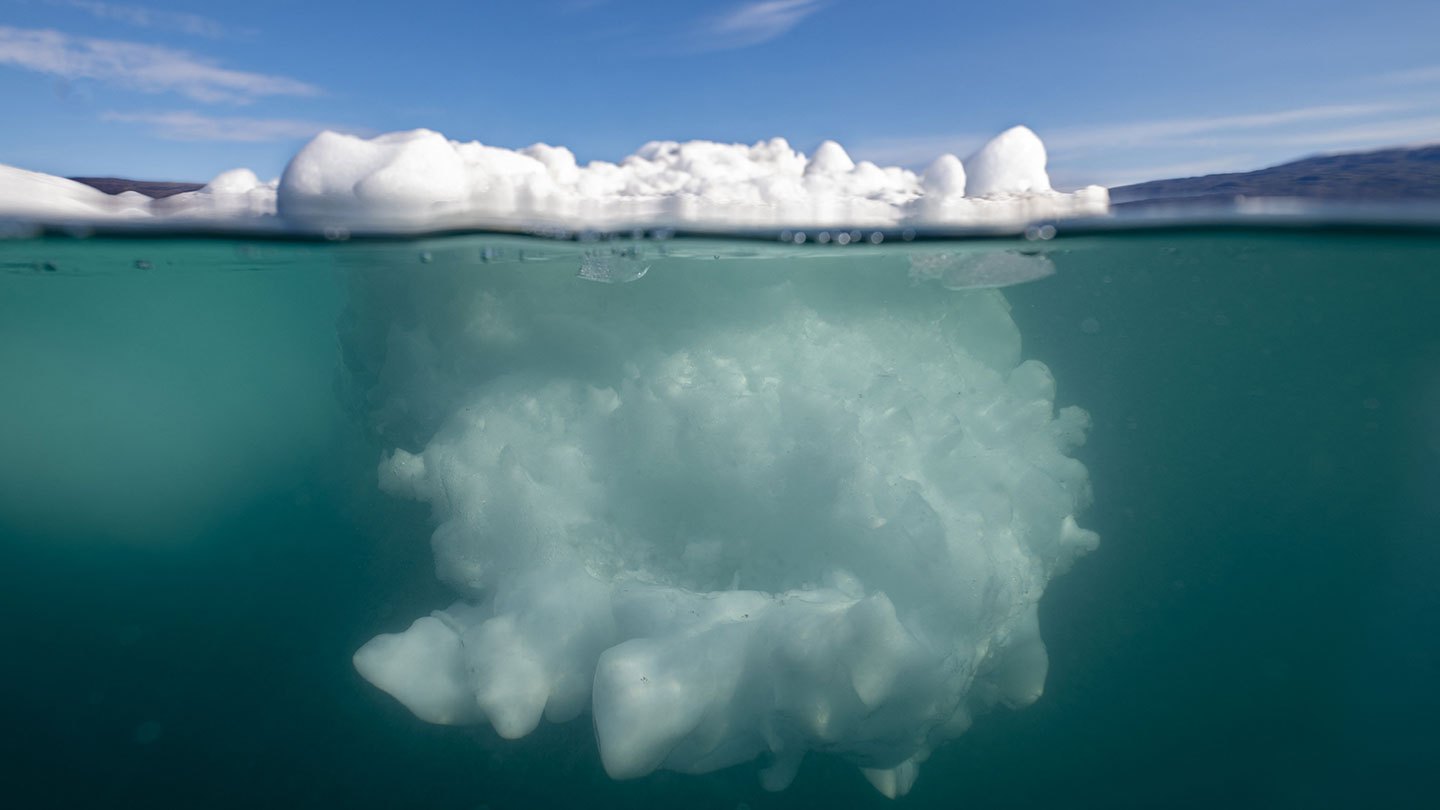
One part of the Atlantic Ocean just south of Greenland and Iceland has gotten colder, even as the rest of Earth's oceans have warmed. It may be linked to a major ocean current shutting down.
OLIVIER MORIN/AFP VIA GETTY IMAGES
Earth’s oceans are heating up. But since the 19th century, one patch in the North Atlantic has cooled by about 1 degree Celsius (1.8 degrees Fahrenheit). Scientists now think they know why. The “cold blob” is the result of a heat-carrying current moving more slowly across the Atlantic.
The cooling spot is just south of Greenland. Experts have thought that the patch was getting colder because less heat was coming into that area through ocean currents. Specifically, less heat was carried by the Atlantic Meridional Overturning Circulation, or AMOC. This massive current brings heat from the tropics northward toward Europe. It shapes temperature and precipitation in Europe, North Africa and beyond.
But a weaker AMOC wasn’t the only possible explanation for the cold spot. Another option was that the area might be losing lots of heat to the atmosphere. That heat escaping the ocean’s surface would leave colder waters behind.
To sort out what was happening, researchers looked at decades of data on temperatures and heat flow in the North Atlantic. Temperature records there go as far back as 1870. Satellite records started around 1993. If the water was losing heat from its surface — and the AMOC was holding steady — the data should show an uptick in heat moving to the atmosphere over time.
That’s not what the team found. Instead, there’s been a decrease in the amount of heat escaping to the atmosphere at this spot over the last 70 years, especially since 1993. The water has cooled even though less heat is moving to the air. And the largest drop in heat has been in the top 1,000 meters (3,300 feet) of the ocean. That’s where AMOC is located. This suggests the AMOC’s heat supply to this region has been declining over the last few decades.
The researchers shared this finding in the June 16 Geophysical Research Letters.
The study is a warning sign that the AMOC is slowing down. It is possibly nearing a tipping point, says study coauthor Stefan Rahmstorf. He is a physical oceanographer. That’s someone who studies water properties and processes such as waves, currents and how the ocean and atmosphere interact. He works at the Potsdam Institute for Climate Impact Research in Germany.
A shutdown of the AMOC could bring more extreme high and low temperatures to different parts of Europe. It could also reduce rainfall on the continent, which would be devastating for agriculture.
Rahmstorf now thinks this shutdown is more likely to happen than he used to. “For [30] years of my career studying this, I considered the #AMOC tipping risk a high impact but low probability risk for the future of humanity,” Rahmstorf wrote June 9 on X. “Recently, I’ve changed my mind.”
A chilling pattern
Figure 1
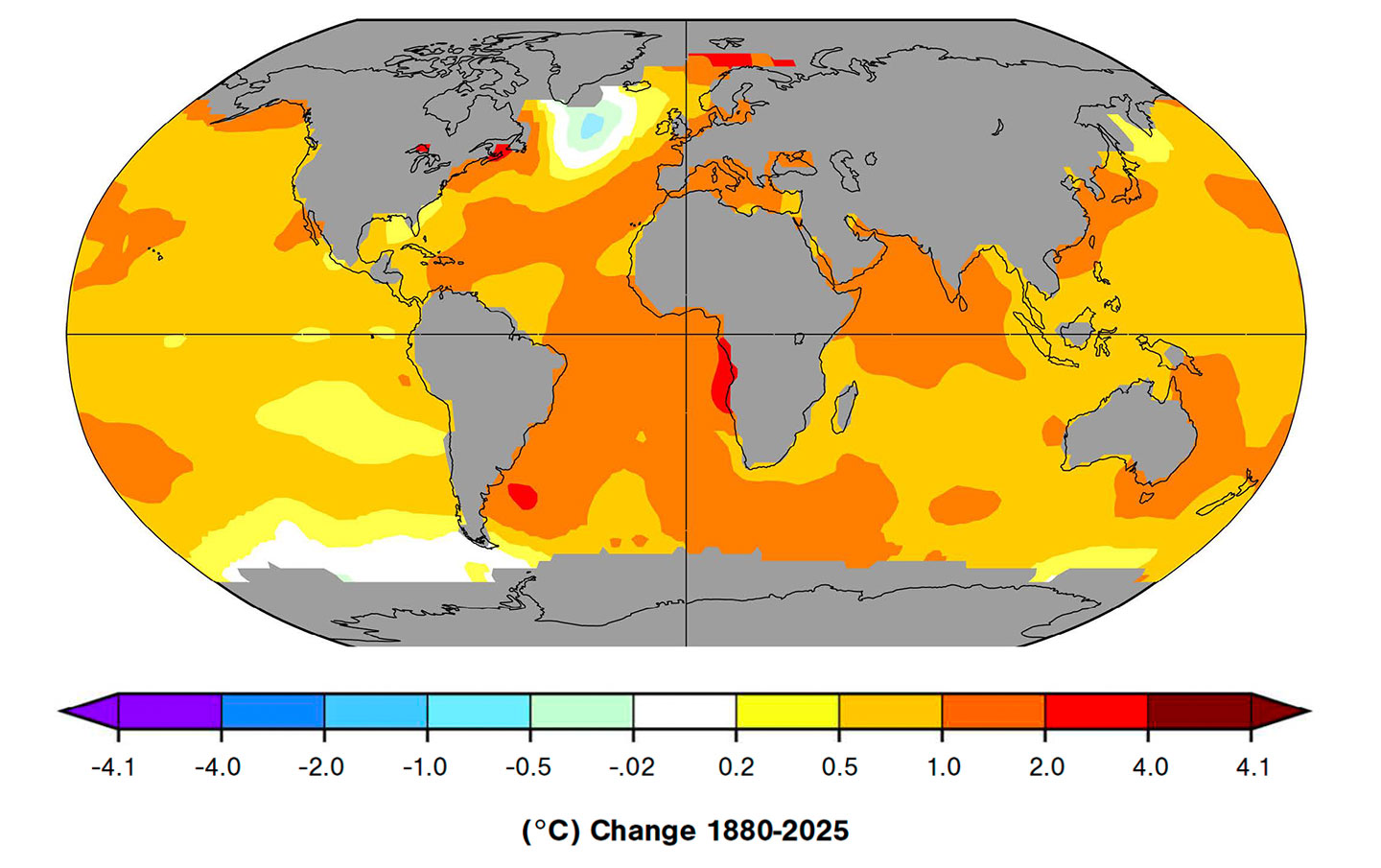
Scientists reanalyzed decades of data from the North Atlantic Ocean. They used temperature records and measurements from satellites. This revealed how the sea surface temperature across the Earth has changed from 1880 to 2025.
Figure 2
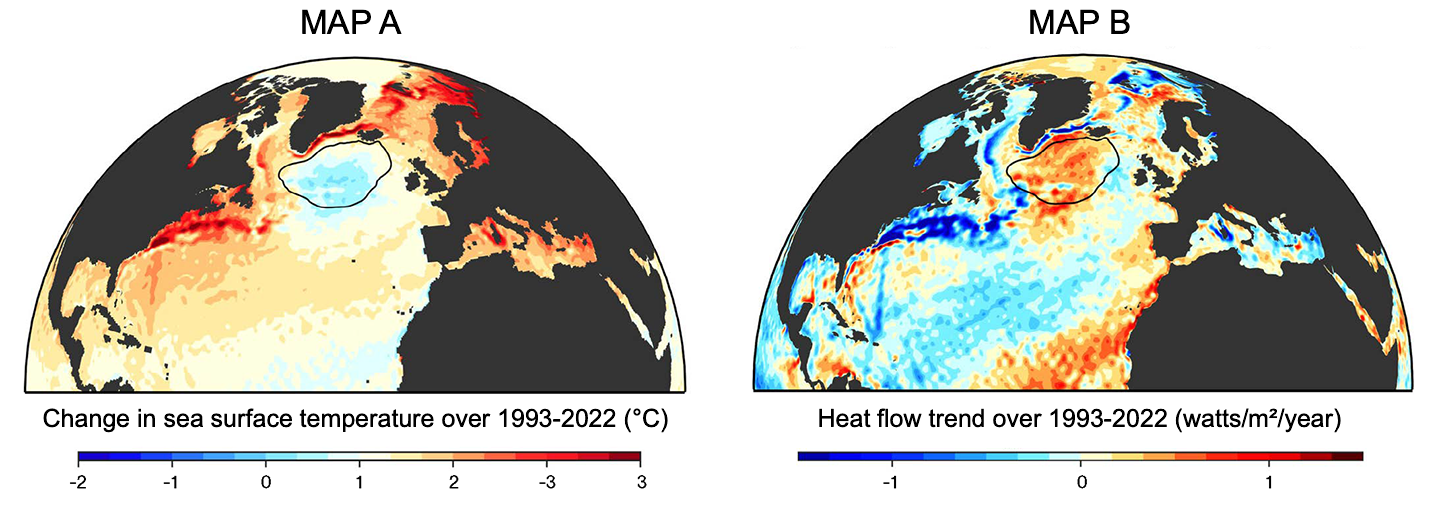
In addition to ocean temperature changes over time (A), the researchers also looked at changes in how much heat was moving out of the ocean to the air (B). Heat flow is measured in watts (energy per time) from a square meter of the ocean surface per year. The colors in B show changes in the heat flow trend: Negative (blue) values mean more heat is leaving the ocean over time. Positive (red) means less heat is leaving the ocean over time. The cold blob is roughly the circled area.
Data Dive:
- Look at Figure 1. What is the change in sea surface temperature from 1880 to 2025 in the middle of the Atlantic Ocean?
- Describe the change in sea surface temperature at the cold blob.
- Look at Figure 2. What was the change in sea surface temperature in the cold blob from 1993 to 2022?
- What is the trend in heat flow in the cold blob from 1993 to 2022?
- What sorts of values for heat flow would we expect if more heat was moving into the atmosphere over time?