calcium: A chemical element and alkali metal common in minerals of the Earth’s crust and in sea salt. It is also found in bone mineral and teeth, and can play a role in the movement of certain substances into and out of cells.
carnivore: An animal that either exclusively or primarily eats other animals.
chemical: A substance formed from two or more atoms that unite (bond) in a fixed proportion and structure. For example, water is a chemical made when two hydrogen atoms bond to one oxygen atom. Its chemical formula is H2O.
coexist: To exist at the same time as or along with.
diet: (n.) The foods and liquids ingested by an animal to provide the nutrition it needs to grow and maintain health. Sometimes this is a specific food-intake plan.
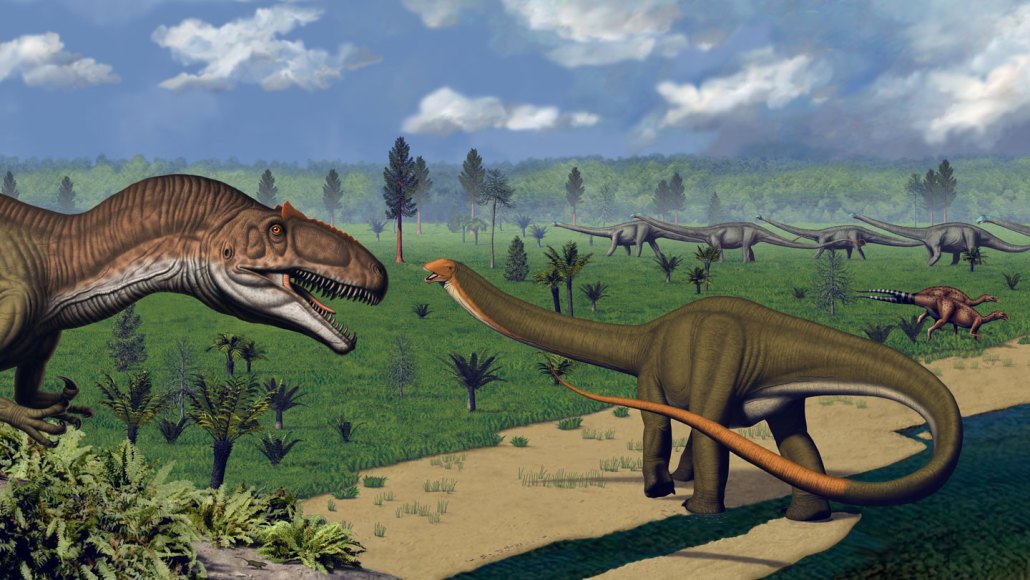
dinosaur: A term that means terrible lizard. These reptiles emerged around 243 million years ago. All descended from egg-laying reptiles known as archosaurs. Their descendants eventually split into two lines. For many decades, they have been distinguished by their hips. The lizard-hipped line are believed to have led to the saurischians, such as two-footed theropods like T. rex and the lumbering four-footed Apatosaurus. A second line of so-called bird-hipped, or ornithischian dinosaurs, appears to have led to a widely differing group of animals that included the stegosaurs and duckbilled dinosaurs. Many large dinosaurs died out around 66 million years ago. But some saurischians lived on. They are now the birds we see today (and who have now evolved that so-called “bird-hipped” pelvis).
element: (in chemistry) Each of more than one hundred substances for which the smallest unit of each is a single atom. Examples include hydrogen, oxygen, carbon, lithium and uranium.
enamel: The glossy, hard substance that covers a tooth.
herbivore: A creature that either exclusively or primarily eats plants.
isotopes: Different forms of an element that vary somewhat in mass (and potentially in lifetime). All have the same number of protons in their nucleus, but different numbers of neutrons.
Jurassic: Lasting from about 200 million to 145.5 million years ago, it’s the middle period of the Mesozoic Era. This was a time when dinosaurs were the dominant form of life on land.
neutron: A subatomic particle carrying no electric charge that is one of the basic pieces of matter. Neutrons belong to the family of particles known as hadrons.
nutrient: A vitamin, mineral, fat, carbohydrate or protein that a plant, animal or other organism requires as part of its food in order to survive.
paleontologist: A scientist who specializes in studying fossils, the remains of ancient organisms.
range: (in math or for measurements) The extent to which values can vary (such as the highest to lowest temperatures).
theropod: A usually meat-eating dinosaur that belonged to a group whose members are typically bipedal (walk on two legs). They range from small and delicately built to very large.
Tyrannosaurus rex: A top-predator dinosaur that roamed Earth during the late Cretaceous period. Adults could be 12 meters (40 feet) long.