Let’s learn about trace fossils
Ancient creatures’ burrows, footprints, poops and piles of vomit offer clues into their daily lives
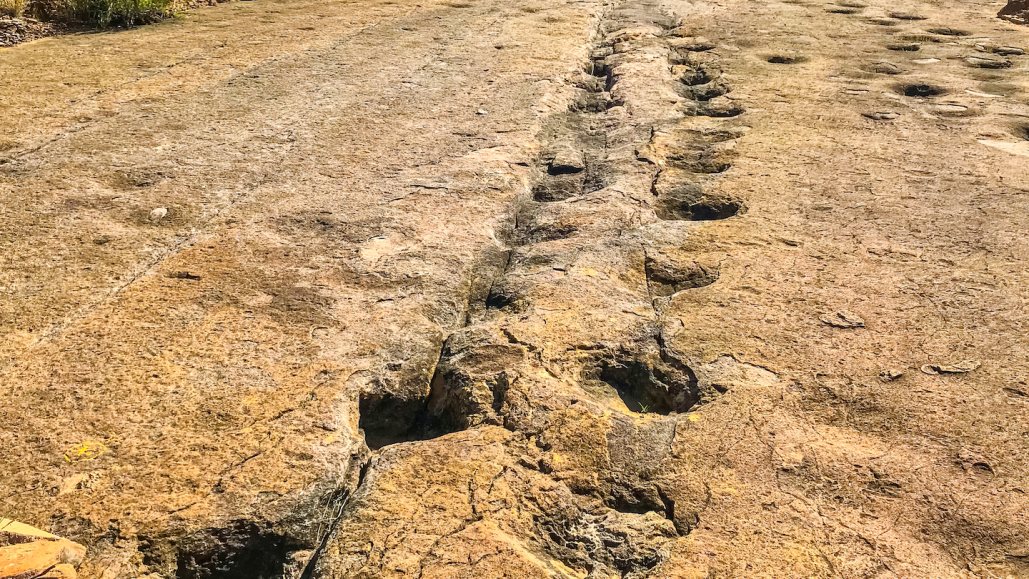
These Ankylosaurus dinosaur footprints are trace fossils. They preserve the story of an ancient animal’s walk through what is now the Wide Toro Toro National Park Valley in Potosi, Bolivia.
Alexandre Morin-Laprise/Getty Images
Share this:
- Share via email (Opens in new window) Email
- Share on Facebook (Opens in new window) Facebook
- Share on X (Opens in new window) X
- Share on Pinterest (Opens in new window) Pinterest
- Share on Reddit (Opens in new window) Reddit
- Share to Google Classroom (Opens in new window) Google Classroom
- Print (Opens in new window) Print
When you hear the word “fossil,” you might at first think of a dinosaur skeleton at your local museum. Or perhaps the imprints of leaves or shells in a rock from a nearby creek. Both are examples of body fossils. But there is a second type of fossil: trace fossils.
Body and trace fossils are created through similar processes. In both cases, some trace of an ancient life form is left in sediment. That remnant gets preserved when the sediment transforms into hard rock. But while body fossils preserve the remains of ancient life forms themselves, trace fossils keep a record of those life forms’ activities. Examples include burrows, nests, footprints, poop and vomit.
Ichnologists use trace fossils to obtain snapshots of ancient life forms’ daily lives that these scientists can’t get from remains alone. Take, for instance, fossilized poop, called a coprolite. Coprolites can offer clues about an ancient creature’s diet.
Fossil dung has revealed that, more than 150 million years ago, flying reptiles called pterosaurs ate mollusks and crustaceans. These fossils have also shown that tens of thousands of years ago, squirrels may have snacked on the remains of woolly mammoths and wolves.
Dietary info can also come from fossil vomit, known as regurgitalite, and fossilized stomach contents, called cololites.
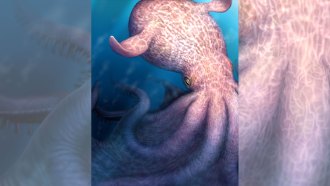
The marks that ancient animals carved into their environments can also make useful trace fossils. Rocks from coastal Taiwan, for example, contain burrows likely dug by giant worms some 20 million years ago. Those lairs suggest that the worms lurked beneath the seafloor like Star Wars monsters and shot out to attack their prey.
Scientists have also studied dinosaurs’ footprints to tease out details like how fast they ran.
Want to know more? We’ve got some stories to get you started:
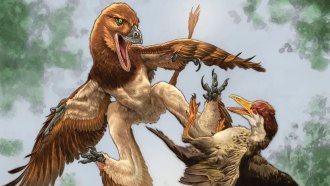
New clues about dino speed come from birds strutting through mud Scientists use dinosaurs’ tracks in wet ground to estimate how fast they ran millions of years ago. (8/22/2025) Readability: 6.4
Frozen poop reveals Ice Age squirrels’ ecosystem DNA stored in ancient scat shows the Yukon rodents ate their way through the food chain. (8/25/2026) Readability: 6.8
Giant worms may have hidden beneath the ancient seafloor to ambush prey Trace fossils may be evidence of predatory behavior similar to modern bobbit worms. (2/16/2021) Readability: 8.1
Explore more
Fossil vomit shows what one 290-million-year-old predator dined on
New fossils bring the wide world of pterosaurs to life
Fossil stomach reveals a dinosaur’s last meal
New beetle species found in fossil poop of this dino relative
A love of small mammals drives this scientist
The secret to T. rex‘s incredible biting force is at last revealed
Activities
Want to see how easy it is for ancient life forms to leave traces behind? Make your own trace fossil with instructions from the Natural History Museum of Los Angeles County.