Art helped this astrophysicist make sense of math
Ronald Gamble studies supermassive black holes and the shape of spacetime around them
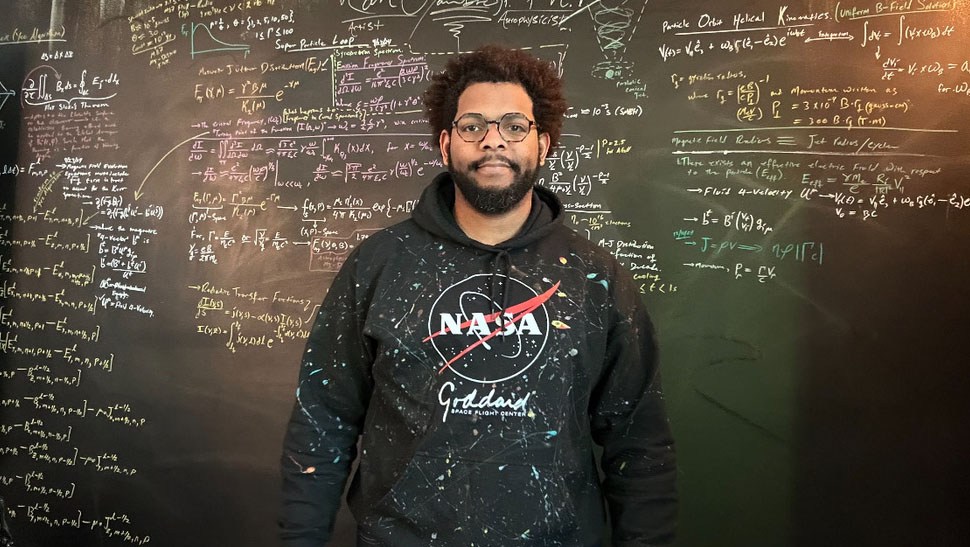
Theoretical physicist Ronald Gamble uses math to study how black holes warp the shape of spacetime. Sometimes, he pictures himself as Marvel’s Iron Man. “I feel like Tony Stark every other day.”
R. Gamble Jr.
Share this:
- Share via email (Opens in new window) Email
- Share on Facebook (Opens in new window) Facebook
- Share on X (Opens in new window) X
- Share on Pinterest (Opens in new window) Pinterest
- Share on Reddit (Opens in new window) Reddit
- Share to Google Classroom (Opens in new window) Google Classroom
- Print (Opens in new window) Print
This is a human-written story voiced by AI. Got feedback? Take our survey . (See our AI policy here .)
When Ronald Gamble first learned about black holes as a teen, he read as much as he could about them. But he noticed that researchers still had much to learn about how they worked. “The mystery of black holes really drove me to study them,” he says.
Around the same age, Gamble started painting. This love for art soon found its way into his homework. Applying geometry from art to describe physics was “a game changer,” he says. Sketching in his physics notebooks helped him “see” the math and better understand how mathematical languages worked.
As a theoretical astrophysicist, Gamble still combines the two. He studies how black holes warp the shape of spacetime around them. Space and time weave together to form the fabric of the universe. A black hole’s immense mass and strong magnetic field stretches and bends light into curved paths.
Using complex math, theorists like Gamble can draw these forces in four dimensions. These scientists are the ones “on chalkboards or whiteboards, coming up with new models to translate what we see in reality into math,” he says. The same math that explains how a shadow casts around a vase can be applied to light bending around a black hole. Sometimes, Gamble pictures himself as Marvel’s Iron Man. “I feel like Tony Stark every other day.”
Gamble splits his time between NASA Goddard Space Flight Center in Greenbelt, Md., and the University of Maryland College Park. In this interview, he shares his advice and experience with Science News Explores. (This interview has been edited for content and readability.)
What inspired you to pursue your career?
I read a lot of comics growing up. My mom was a sci-fi [science fiction] nerd, so I grew up watching Star Wars and Star Trek. I would imagine these things in movies, not realizing that you could study them in real life and make a career out of it — that you could be paid to study black holes and come up with a bunch of equations to describe them. It’s crazy to think about, but you can do it if you know the math.
My Ph.D. was the first one in astrophysics across my entire school. I had to carve this path out for myself but also leave breadcrumbs for everybody else who wants to do this behind me. Getting there took a lot of perseverance and navigating by trial and error.
I didn’t attend an Ivy League school, or large college campus. I went to North Carolina Agricultural and Technical State University. That’s an HBCU — historically Black college or university — in Greensboro, North Carolina. Our physics department was very small, but we got a lot of support. My advisors drove me into my career field. They really made me the physicist I am today — where I can now stand on my own two feet, do science independently and lead it.
Who inspired you to combine art and science?
I’ve been painting since I was 16. My mom was also a biologist and a painter. Her paintings were on our walls at home. If the art was there, the science was right next to it. In college, I double majored in physics and fine arts and minored in art history. I’m inspired by so many artists throughout history. For example, Salvador Dali’s “Persistence of Memory” was partly influenced by quantum mechanics and the theory of general relativity. That’s what he visualized in his head and put into a painting.
How do you get your best ideas?
I study how things move, so I like to be outside observing motion. Then I write down the equation. Being a theorist, I could work virtually anywhere, so I’m not tied down to a laptop or a lab. As far as sketching out the equations, you can do that anywhere. So I’ve worked from beaches, planes, trains — places like that. In physics, you’re trying to figure out what nature is telling you and translate it into a mathematical language.
What’s one of your biggest failures, and how did you get past it?
I failed calculus the first time and had to take it two more times after that. I relied too much on my ability to know mathematics very well, and it hurt my ability to mature my study habits. I needed to know this math to do the physics that I wanted to do. The threat of not being able to pursue the career that I wanted really drove me to study mathematics more intimately. So I started studying with three notebooks: one for my notes, one for drawings of my notes, and then one that I actually did my work in. I had to learn not to take for granted the things that I was good at.
What piece of advice do you wish you had been given when you were younger?
Make sure that the loudest voice in your head is your own. Also make sure that voice is not your biggest competitor. Your inner critic cannot be louder than your inner motivator. You have to outshine and outperform yourself to grow, but you also have to give yourself the grace to fail. You learn the most in your failures.
What should students know about pursuing careers in art and physics?
First, do not be afraid of the math. The math will take you farther than you realize, and it will help you get everything you need to advance in your career. If you’re not good at it, that’s okay. You don’t have to be an expert, but don’t shy away from it. Second, do not allow your imagination to fade away as you advance in science. Keep your imagination and interest in science close together.