Questions for ‘Animals can feel joy. Here’s how scientists might study it’ 
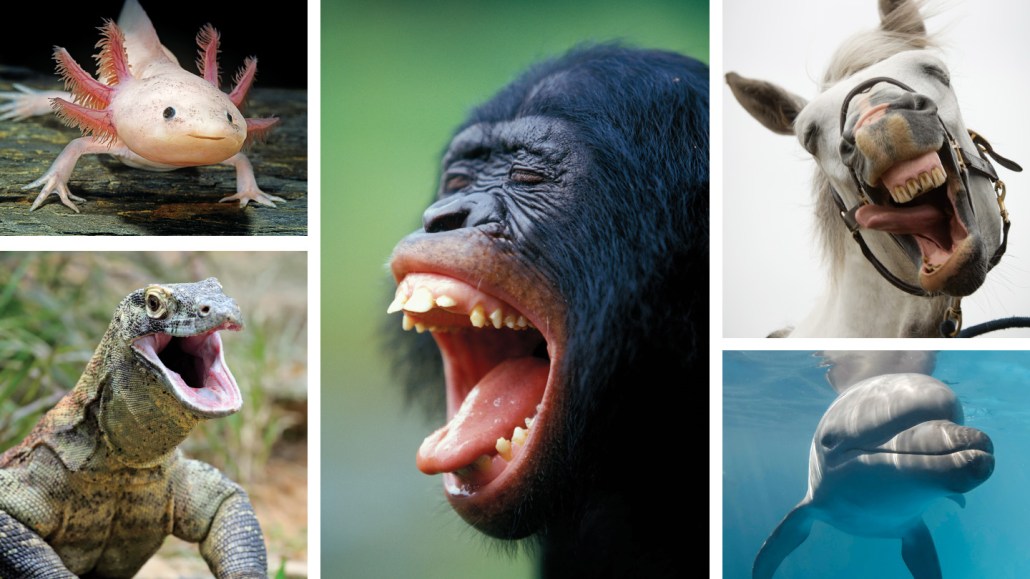
different animals appearing to experience joy – laughing or smiling. Axolotl, turtle, monkey, horse and dolphin.

Many animals appear to experience happiness, joy and other positive feelings. But animal emotions are most likely different from human emotions. This is one reason they're hard to study.

Clockwise from top left: Jurgen & Christine Sohns/imagebroker/getty images; Jon Starling/500px prime/getty images; Andrey Nekrasov/imageBROKER/getty images; ventz/istock/getty images plus; Paul Starosta/stone/getty images; Cyril Ruoso/alamy

To accompany Animals can feel joy. Here’s how scientists might study it’

SCIENCE

Before Reading:

  1. Which do you prefer — dogs or cats? To what extent do you think your chosen species feels emotions? Describe a specific animal behavior that some might interpret as an expression of emotion. (Hint: Think of characteristic, specific behaviors of cats or dogs.) If you believe the animal is expressing emotion, which human emotion would you most closely relate it to? If you believe the animal is not expressing an emotion, what emotion might another person mistake the behavior for? Explain your answer.
  2. Do you think it’s very important, moderately important or unimportant to develop a better understanding of animals’ capacity for emotion? Imagine you are debating with someone who has a different opinion on this question than you do. Briefly explain how this person’s opinion might differ from your own. (Hint: Don’t overthink this question. Just summarize an alternative viewpoint.) What might you say to this person to help them understand your reasoning? Write a brief summary of how you might explain yourself.

During Reading:

  1. What is anthropomorphism?
  2. What do scientists mean when they refer to “positive affect” in animals?
  3. List three types of animals that Erica Cartmill and her colleagues have studied to develop the “joy-o-meter.”
  4. For this project, how do the scientists define “joy”?
  5. What species is Youssa?
  6. Describe one way that chimpanzees communicate “positive intent” to one another.
  7. What did Sasha Winkler and her team use as a “happiness trigger” in the gray box experiment?
  8. What kind of animal is a kea? Ximena Nelson believes that sunny weather contributes to positive affect in keas. What evidence supports her theory?
  9. Nelson and her team sometimes play audio recordings of “warble calls” to keas in their study. Give an example of a typical kea’s response to such recordings.
  10. What species are Bo and Buster? Give an example of a reaction by this species that scientists interpret as an expression of positive affect.

After Reading:

  1. Review your answer to Question 1 in Before Reading. Use what you’ve learned in this story to design an experiment. Your experiment should investigate the extent to which this behavior is or is not a display of animal affect (positive or negative). Give an example of experimental results that would support the theory that this animal is experiencing some kind of “affect.” (Keep in mind that these results need not prove “affect” in animals. The hypothetical results need only support the theory.)
  2. Review your answer to Question 2 in Before Reading. After reading this story, would you answer this question the same or differently? If you would answer the same, explain how this story reinforces your original opinion. If you would answer differently, explain what you would change about your original answer. Whether you would answer the same or differently, point to information in this story that supports your reasoning.