Earth's Place in the Universe
- Physics
Scientists Say: Fission
Nuclear fission is the process of splitting atoms apart to release huge amounts of energy.
- Physics
Explainer: Radioactive dating helps solve mysteries
Knowing the decay rate of radioactive elements can help date ancient fossils and other artifacts.
- Earth
Fossil-fuel use is confusing some carbon-dating measurements
Carbon-14 dating of recent artifacts will soon give scientists confusing results. That’s another price society pays for its reliance on fossil fuels.
- Space
NASA is readying to send humans back to the moon
The launch of NASA's Artemis I is a huge step toward sending humans back to the moon and beyond.
- Planets
Mars might still be volcanically active, quakes there suggest
Seismic rumblings picked up by NASA’s InSight lander hint at molten rock moving deep below the planet’s fractured surface.
- Space
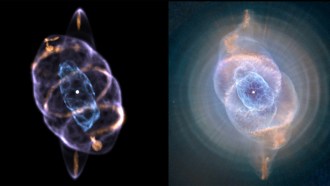
Jets may have sculpted rings of Cat’s Eye nebula
The Cat’s Eye nebula is one of the most complex of its kind. A 3-D model now reveals the source of that complexity.
-
- Physics
Scientists Say: Neutron
Neutrons are one of the main building blocks of atoms and have no electric charge.
- Earth
Scientists Say: Pole
A pole is either of two opposite ends of a molecule, magnet, battery, planet or other object.
- Planets
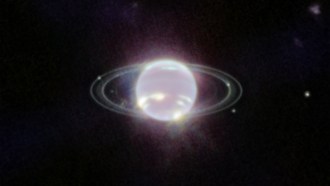
Check out the first direct look at Neptune’s rings since the ’80s
The Voyager 2 spacecraft took the first pics of Neptune’s rings 33 years ago. Now, NASA’s James Webb telescope is providing a more detailed view of them.
- Science & Society
This physicist hopes to shake up our understanding of space
Adeene Denton uses a combination of geology, astrophysics and coding to better understand the structure of planets.
- Physics
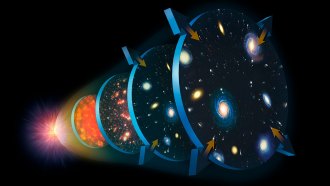
Mysteries about the universe abound, from its beginning to its end
Scientists have a good understanding of the laws that make our universe tick. But they still don’t quite know how it began — or will end.