Space
Newfound clouds of missing ‘ordinary’ matter sit outside galaxies
Dark matter isn’t the universe’s only “missing” matter. Distant bursts of radio waves have now turned up vast, faint gas clouds surrounding galaxies.
The puffiest planets known in our galaxy orbit a sunlike star more than 1,000 light-years from Earth.
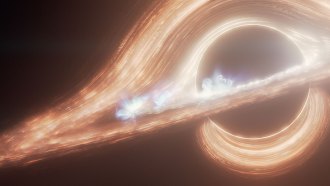
Past this boundary, nothing that enters a black hole can ever leave — not even light.
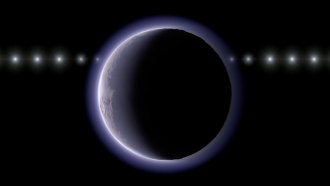
A brief stellar eclipse hints that this 2002 XV93 has a thin atmosphere. It would be a first for any solar-system body farther from the sun than Pluto.
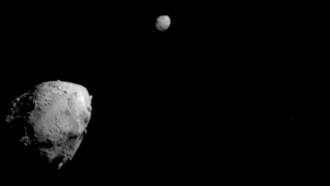
In 2022, NASA smashed a spacecraft into an asteroid. New data show how that impact changed the orbit around the sun of this space rock — and its partner.
After more than a century, scientists are just beginning to understand black holes — the most bizarre and powerful things in the universe.
Tiny black holes in the early universe could explain why matter is common and antimatter is not.
No light will ever reach Earth from beyond this distant horizon of space.
Some branches of physics hint that our universe is just one of many in a vast “multiverse.”
A collapsed structure, which turned up in 30-year-old radar data from Venus, may be one of many underground caves.