Earth's Place in the Universe
- Earth
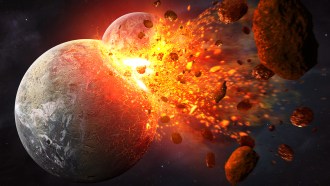
One collision could have formed the moon and started plate tectonics
A hypothetical planet slamming into Earth 4.5 billion years ago might have set subduction into motion.
- Planets
Research on exoplanets took top award at 2023 Regeneron ISEF
Six young researchers took home the top awards, each valued at a minimum of $50,000. Hundreds more shared nearly $9 million in prizes at international event.
- Tech
A new solar-powered gel purifies water in a flash
The unusual, fruit-inspired structure of this material provides quick filtration that could satisfy people's daily water needs.
- Planets
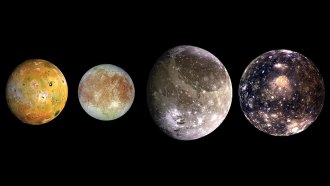
Let’s learn about Jupiter’s moons
Jupiter has nearly 100 known moons — some of which look like prime spots to search for alien life.
- Space
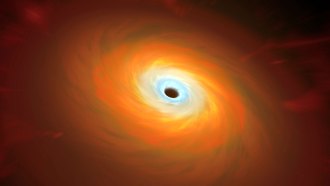
Scientists Say: Accretion Disk
Cosmic swirls of gas, dust and plasma, accretion disks reveal the shadowy silhouettes of black holes and more.
- Planets
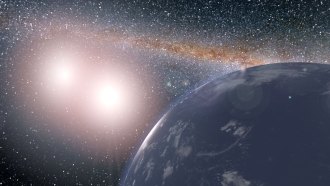
Planets like Star Wars’ Tatooine could be fit for life
Like Luke Skywalker’s home, planets orbiting two stars may be plentiful. A new computer model suggests that many of those worlds could sustain life.
- Earth
Scientists Say: Equinox and Solstice
Equinoxes and solstices mark the maximums, minimums and mediums of hours spent in daylight.
- Space
Spacecraft traveling through a wormhole could send messages home
A probe going through a wormhole should be able to send messages home before such a tunnel forever closes, a new computer model finds.
- Math
Scientists Say: Calculus
Calculus is math that deals with curves, from their changing slopes to the areas they enclose.
- Planets
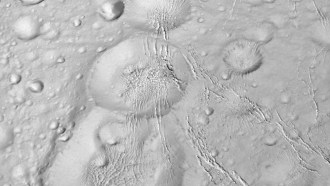
Saturn’s moon Enceladus wears a thick blanket of snow
Pits on the frosty moon reveal the snow’s surprising depth, up to 700 meters (2,300 feet) in some places.
- Planets
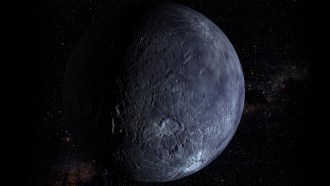
The dwarf planet Quaoar hosts an impossible ring
Quaoar’s ring lies outside the Roche limit. That’s an imaginary line beyond which rings aren’t thought to be stable.
- Physics
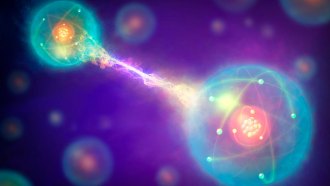
Let’s learn about the quantum realm
On the smallest scales, the universe behaves in some pretty strange ways.