Earth's Place in the Universe
- Space
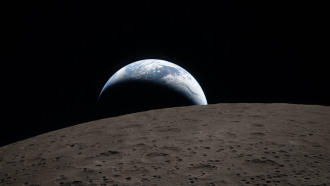
Artemis II just made a historic loop around the moon
The astronauts had a front-row view of the lunar farside and the first eclipse ever seen from the moon.
- Space
Astronauts are flying to the moon aboard Artemis II
This first human trip to the moon in more than 50 years will take four astronauts farther than anyone has gone before.
- Space
Supermassive black holes might trace back to huge, ancient stars
Hefty stars might have collapsed into “intermediate mass” black holes — the building blocks of supermassive ones, a teen’s research suggests.
- Planets
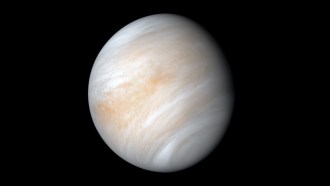
Let’s learn about Venus
Venus’ surface is hot enough to melt lead, studded with volcanoes and shrouded in clouds of corrosive acid.
- Space
They came from other stars! [COMIC]
Only three interstellar objects have ever been spotted. Here’s what we know about them and why they’re so cool.
- Earth
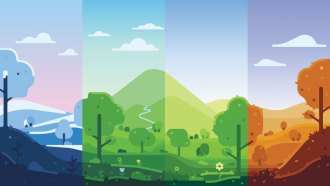
Experiment: How does the tilt of Earth’s axis affect the seasons?
Seasons have nothing to do with Earth’s distance from the sun. The real reason for the seasons is the tilt of Earth’s axis.
- Space
This cosmologist studies the invisible parts of the universe
Katie Mack started out building solar-powered LEGO cars as a kid. Now she studies dark matter to better understand how galaxies form and evolve.
- Space
This is the largest, most detailed radio image yet of our Milky Way
Supernova remnants, stellar nurseries and more populate this new view of our galaxy, as seen from Earth’s southern hemisphere.
- Earth
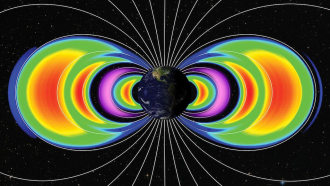
Scientists Say: Van Allen belts
Astronomers have detected these radiation belts around Earth and beyond. Jupiter’s belt is thousands of times as intense as Earth’s.
- Space
Fast, mysterious clouds swarm around our galaxy
Astronomers want to know the source — and importance — of these faint, fast-moving clouds that zoom beyond and toward our Milky Way’s disk.
- Earth
Scientists Say: Supermoon
This supersized lunar event occurs when a full moon or new moon coincides with the moon’s perigee — the point where it is the closest to Earth.
- Space
Scientists caught a black hole ringing like a bell
Two black holes merged, creating a new, bigger one. This event triggered the clearest ripples in spacetime ever observed.